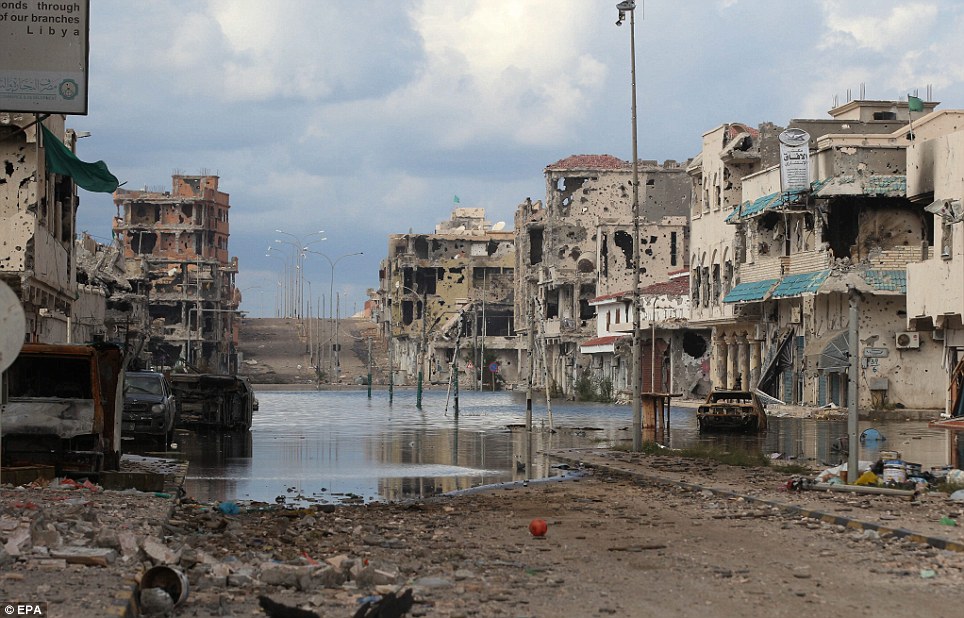
We already know the pro-western voices are rejoicing at the NATO-led victory over the "tyrant" Gaddafi’s regime, calling it a triumph for democracy, freedom and justice. But the following article, in outlining the ten myths that served to justify the NATO-led war on Libya, provides an alternative view. Although the article was written well before Gaddafi’s brutal murder, it is relevant in the context of the bias western powers/media “humanitarian intervention” propaganda, and, although lengthy, is well worth the read.

by Maximilian C. Forte
Since Colonel Gaddafi has lost his military hold in the war against NATO and the insurgents/rebels/new regime, numerous talking heads have taken to celebrating this war as a “success”. They believe this is a “victory of the Libyan people” and that we should all be celebrating. Others proclaim victory for the “responsibility to protect,” for “humanitarian interventionism,” and condemn the “anti-imperialist left”. Some of those who claim to be “revolutionaries,” or believe they support the “Arab revolution,” somehow find it possible to sideline NATO’s role in the war, instead extolling the democratic virtues of the insurgents, glorifying their martyrdom, and magnifying their role until everything else is pushed from view. I wish to dissent from this circle of acclamation, and remind readers of the role of ideologically-motivated fabrications of “truth” that were used to justify, enable, enhance, and motivate the war against Libya - and to emphasize how damaging the practical effects of those myths have been to Libyans, and to all those who favoured peaceful, non-militarist solutions.
 |
| NATO's Bombing of Libya |
These top ten myths are some of the most repeated claims, by the insurgents, and/or by NATO, European leaders, the Obama administration, the mainstream media, and even the so-called “International Criminal Court” - the main actors speaking in the war against Libya. In turn, we look at some of the reasons why these claims are better seen as imperial folklore, as the myths that supported the broadest of all myths - that this war is a “humanitarian intervention,” one designed to “protect civilians”. Again, the importance of these myths lies in their wide reproduction, with little question, and to deadly effect. In addition, they threaten to severely distort the ideals of human rights and their future invocation, as well aiding in the continued militarization of Western culture and society.
1. Genocide
Just a few days after the street protests began, on February 21 the very quick to defect Libyan deputy Permanent Representative to the UN, Ibrahim Dabbashi, stated: “We are expecting a real genocide in Tripoli. The airplanes are still bringing mercenaries to the airports”. This is excellent: a myth that is composed of myths. With that statement he linked three key myths together - the role of airports (hence the need for that gateway drug of military intervention: the no-fly zone), the role of “mercenaries” (meaning, simply, black people), and the threat of “genocide” (geared toward the language of the UN’s doctrine of the Responsibility to Protect). As ham-fisted and wholly unsubstantiated as the assertion was, he was clever in cobbling together three ugly myths, one of them grounded in racist discourse and practice that endures to the present, with newer atrocities reported against black Libyan and African migrants on a daily basis. He was not alone in making these assertions. Among others like him, Soliman Bouchuiguir, president of the Libyan League for Human Rights, told Reuters on March 14 that if Gaddafi’s forces reached Benghazi, “there will be a real bloodbath, a massacre like we saw in Rwanda”. That’s not the only time we would be deliberately reminded of Rwanda. Here was Lt. Gen Roméo Dallaire, the much worshipped Canadian force commander of the U.N. peacekeeping mission for Rwanda in 1994, currently an appointed senator in the Canadian Parliament and co-director of the Will to Intervene project at Concordia University. Dallaire, in a precipitous sprint to judgment, not only made repeated references to Rwanda when trying to explain Libya, he spoke of Gaddafi as “employing genocidal threats to ‘cleanse Libya house by house’”. This is one instance where selective attention to Gaddafi’s rhetorical excess was taken all too seriously, when on other occasions the powers that be are instead quick to dismiss it: U.S. State Department spokesman, Mark Toner waved away Gaddafi’s alleged threats against Europe by saying that Gaddafi is “someone who’s given to overblown rhetoric”. How very calm, by contrast, and how very convenient - because on February 23, President Obama declared that he had instructed his administration to come up with a “full range of options” to take against Gaddafi.
But “genocide” has a well established international legal definition, as seen repeatedly in the UN’s 1948 Convention on the Prevention and Punishment of the Crime of Genocide, where genocide involves the persecution of a “a national, ethnical, racial or religious group”. Not all violence is “genocidal”. Internecine violence is not genocide. Genocide is neither just “lots of violence” nor violence against undifferentiated civilians. What both Dabbashi, Dallaire, and others failed to do was to identify the persecuted national, ethnic, racial or religious group, and how it differed in those terms from those allegedly committing the genocide. They really ought to know better (and they do), one as a UN ambassador and the other as a much exalted expert and lecturer on genocide. This suggests that myth-making was either deliberate, or founded on prejudice.
What foreign military intervention did do, however, was to enable the actual genocidal violence that has been routinely sidelined until only very recently: the horrific violence against African migrants and black Libyans, singled out solely on the basis of their skin colour. That has proceeded without impediment, without apology, and until recently, without much notice. Indeed, the media even collaborates, rapid to assert without evidence that any captured or dead black man must be a “mercenary”. This is the genocide that the white, Western world, and those who dominate the “conversation” about Libya, have missed (and not by accident).
2. Gaddafi is “bombing his own people”
We must remember that one of the initial reasons in rushing to impose a no-fly zone was to prevent Gaddafi from using his air force to bomb “his own people” - a distinct phrasing that echoes what was tried and tested in the demonization of Saddam Hussein in Iraq. On February 21, when the first alarmist “warnings” about “genocide” were being made by the Libyan opposition, both Al Jazeera and the BBC claimed that Gaddafi had deployed his air force against protesters - as the BBC “reported”: “Witnesses say warplanes have fired on protesters in the city”. Yet, on March 1, in a Pentagon press conference, when asked: “Do you see any evidence that he [Gaddafi] actually has fired on his own people from the air? There were reports of it, but do you have independent confirmation? If so, to what extent?” U.S. Secretary of Defense Robert Gates replied, “We’ve seen the press reports, but we have no confirmation of that”. Backing him up was Admiral Mullen: “That’s correct. We’ve seen no confirmation whatsoever”.
In fact, claims that Gaddafi also used helicopters against unarmed protesters are totally unfounded, a pure fabrication based on fake claims. This is important since it was Gaddafi’s domination of Libyan air space that foreign interventionists wanted to nullify, and therefore myths of atrocities perpetrated from the air took on added value as providing an entry point for foreign military intervention that went far beyond any mandate to “protect civilians”.
David Kirpatrick of The New York Times, as early as March 21 confirmed that, “the rebels feel no loyalty to the truth in shaping their propaganda, claiming nonexistent battlefield victories, asserting they were still fighting in a key city days after it fell to Qaddafi forces, and making vastly inflated claims of his barbaric behavior”. The “vastly inflated claims” are what became part of the imperial folklore surrounding events in Libya, that suited Western intervention. Rarely did the Benghazi-based journalistic crowd question or contradict their hosts.
3. Save Benghazi
This article is being written as the Libyan opposition forces march on Sirte and Sabha, the two last remaining strongholds of the Gaddafi government, with ominous warnings to the population that they must surrender, or else. Apparently, Benghazi became somewhat of a “holy city” in the international discourse dominated by leaders of the European Union and NATO. Benghazi was the one city on earth that could not be touched. It was like sacred ground. Tripoli? Sirte? Sabha? Those can be sacrificed, as we all look on, without a hint of protest from any of the powers that be - this, even as we get the first reports of how the opposition has slaughtered people in Tripoli. Let’s turn to the Benghazi myth.
“If we waited one more day,” Barack Obama said in his March 28 address, “Benghazi, a city nearly the size of Charlotte, could suffer a massacre that would have reverberated across the region and stained the conscience of the world”. In a joint letter, Obama with UK Prime Minister David Cameron and French President Nicolas Sarkozy asserted: “By responding immediately, our countries halted the advance of Gaddafi’s forces. The bloodbath that he had promised to inflict on the citizens of the besieged city of Benghazi has been prevented. Tens of thousands of lives have been protected”. Not only did French jets bomb a retreating column, what we saw was a very short column that included trucks and ambulances, and that clearly could have neither destroyed nor occupied Benghazi.
Other than Gaddafi’s “overblown rhetoric,” which the U.S. was quick to dismiss when it suited its purposes, there is to date still no evidence furnished that shows Benghazi would have witnessed the loss of “tens of thousands” of lives as proclaimed by Obama, Cameron, and Sarkozy. This was best explained by Professor Alan J. Kuperman in “False pretense for war in Libya?”:
Just a few days after the street protests began, on February 21 the very quick to defect Libyan deputy Permanent Representative to the UN, Ibrahim Dabbashi, stated: “We are expecting a real genocide in Tripoli. The airplanes are still bringing mercenaries to the airports”. This is excellent: a myth that is composed of myths. With that statement he linked three key myths together - the role of airports (hence the need for that gateway drug of military intervention: the no-fly zone), the role of “mercenaries” (meaning, simply, black people), and the threat of “genocide” (geared toward the language of the UN’s doctrine of the Responsibility to Protect). As ham-fisted and wholly unsubstantiated as the assertion was, he was clever in cobbling together three ugly myths, one of them grounded in racist discourse and practice that endures to the present, with newer atrocities reported against black Libyan and African migrants on a daily basis. He was not alone in making these assertions. Among others like him, Soliman Bouchuiguir, president of the Libyan League for Human Rights, told Reuters on March 14 that if Gaddafi’s forces reached Benghazi, “there will be a real bloodbath, a massacre like we saw in Rwanda”. That’s not the only time we would be deliberately reminded of Rwanda. Here was Lt. Gen Roméo Dallaire, the much worshipped Canadian force commander of the U.N. peacekeeping mission for Rwanda in 1994, currently an appointed senator in the Canadian Parliament and co-director of the Will to Intervene project at Concordia University. Dallaire, in a precipitous sprint to judgment, not only made repeated references to Rwanda when trying to explain Libya, he spoke of Gaddafi as “employing genocidal threats to ‘cleanse Libya house by house’”. This is one instance where selective attention to Gaddafi’s rhetorical excess was taken all too seriously, when on other occasions the powers that be are instead quick to dismiss it: U.S. State Department spokesman, Mark Toner waved away Gaddafi’s alleged threats against Europe by saying that Gaddafi is “someone who’s given to overblown rhetoric”. How very calm, by contrast, and how very convenient - because on February 23, President Obama declared that he had instructed his administration to come up with a “full range of options” to take against Gaddafi.
But “genocide” has a well established international legal definition, as seen repeatedly in the UN’s 1948 Convention on the Prevention and Punishment of the Crime of Genocide, where genocide involves the persecution of a “a national, ethnical, racial or religious group”. Not all violence is “genocidal”. Internecine violence is not genocide. Genocide is neither just “lots of violence” nor violence against undifferentiated civilians. What both Dabbashi, Dallaire, and others failed to do was to identify the persecuted national, ethnic, racial or religious group, and how it differed in those terms from those allegedly committing the genocide. They really ought to know better (and they do), one as a UN ambassador and the other as a much exalted expert and lecturer on genocide. This suggests that myth-making was either deliberate, or founded on prejudice.
What foreign military intervention did do, however, was to enable the actual genocidal violence that has been routinely sidelined until only very recently: the horrific violence against African migrants and black Libyans, singled out solely on the basis of their skin colour. That has proceeded without impediment, without apology, and until recently, without much notice. Indeed, the media even collaborates, rapid to assert without evidence that any captured or dead black man must be a “mercenary”. This is the genocide that the white, Western world, and those who dominate the “conversation” about Libya, have missed (and not by accident).
2. Gaddafi is “bombing his own people”
We must remember that one of the initial reasons in rushing to impose a no-fly zone was to prevent Gaddafi from using his air force to bomb “his own people” - a distinct phrasing that echoes what was tried and tested in the demonization of Saddam Hussein in Iraq. On February 21, when the first alarmist “warnings” about “genocide” were being made by the Libyan opposition, both Al Jazeera and the BBC claimed that Gaddafi had deployed his air force against protesters - as the BBC “reported”: “Witnesses say warplanes have fired on protesters in the city”. Yet, on March 1, in a Pentagon press conference, when asked: “Do you see any evidence that he [Gaddafi] actually has fired on his own people from the air? There were reports of it, but do you have independent confirmation? If so, to what extent?” U.S. Secretary of Defense Robert Gates replied, “We’ve seen the press reports, but we have no confirmation of that”. Backing him up was Admiral Mullen: “That’s correct. We’ve seen no confirmation whatsoever”.
In fact, claims that Gaddafi also used helicopters against unarmed protesters are totally unfounded, a pure fabrication based on fake claims. This is important since it was Gaddafi’s domination of Libyan air space that foreign interventionists wanted to nullify, and therefore myths of atrocities perpetrated from the air took on added value as providing an entry point for foreign military intervention that went far beyond any mandate to “protect civilians”.
David Kirpatrick of The New York Times, as early as March 21 confirmed that, “the rebels feel no loyalty to the truth in shaping their propaganda, claiming nonexistent battlefield victories, asserting they were still fighting in a key city days after it fell to Qaddafi forces, and making vastly inflated claims of his barbaric behavior”. The “vastly inflated claims” are what became part of the imperial folklore surrounding events in Libya, that suited Western intervention. Rarely did the Benghazi-based journalistic crowd question or contradict their hosts.
3. Save Benghazi
This article is being written as the Libyan opposition forces march on Sirte and Sabha, the two last remaining strongholds of the Gaddafi government, with ominous warnings to the population that they must surrender, or else. Apparently, Benghazi became somewhat of a “holy city” in the international discourse dominated by leaders of the European Union and NATO. Benghazi was the one city on earth that could not be touched. It was like sacred ground. Tripoli? Sirte? Sabha? Those can be sacrificed, as we all look on, without a hint of protest from any of the powers that be - this, even as we get the first reports of how the opposition has slaughtered people in Tripoli. Let’s turn to the Benghazi myth.
“If we waited one more day,” Barack Obama said in his March 28 address, “Benghazi, a city nearly the size of Charlotte, could suffer a massacre that would have reverberated across the region and stained the conscience of the world”. In a joint letter, Obama with UK Prime Minister David Cameron and French President Nicolas Sarkozy asserted: “By responding immediately, our countries halted the advance of Gaddafi’s forces. The bloodbath that he had promised to inflict on the citizens of the besieged city of Benghazi has been prevented. Tens of thousands of lives have been protected”. Not only did French jets bomb a retreating column, what we saw was a very short column that included trucks and ambulances, and that clearly could have neither destroyed nor occupied Benghazi.
Other than Gaddafi’s “overblown rhetoric,” which the U.S. was quick to dismiss when it suited its purposes, there is to date still no evidence furnished that shows Benghazi would have witnessed the loss of “tens of thousands” of lives as proclaimed by Obama, Cameron, and Sarkozy. This was best explained by Professor Alan J. Kuperman in “False pretense for war in Libya?”:
“The best evidence that Khadafy did not plan genocide in Benghazi is that he did not perpetrate it in the other cities he had recaptured either fully or partially - including Zawiya, Misurata, and Ajdabiya, which together have a population greater than Benghazi….Khadafy’s acts were a far cry from Rwanda, Darfur, Congo, Bosnia, and other killing fields….Despite ubiquitous cellphones equipped with cameras and video, there is no graphic evidence of deliberate massacre….Nor did Khadafy ever threaten civilian massacre in Benghazi, as Obama alleged. The ‘no mercy’ warning, of March 17, targeted rebels only, as reported by The New York Times, which noted that Libya’s leader promised amnesty for those ‘who throw their weapons away’. Khadafy even offered the rebels an escape route and open border to Egypt, to avoid a fight ‘to the bitter end’”.
In a bitter irony, what evidence there is of massacres, committed by both sides, is now to be found in Tripoli in recent days, months after NATO imposed its “life-saving” military measures. Revenge killings are daily being reported with greater frequency, including the wholesale slaughter of black Libyans and African migrants by rebel forces. Another sad irony: in Benghazi, which the insurgents have held for months now, well after Gaddafi forces were repulsed, not even that has prevented violence: revenge killings have been reported there too - more under [myth no.] #6 below.
4. African Mercenaries
Patrick Cockburn summarized the functional utility of the myth of the “African mercenary” and the context in which it arose: “Since February, the insurgents, often supported by foreign powers, claimed that the battle was between Gaddafi and his family on the one side and the Libyan people on the other. Their explanation for the large pro-Gaddafi forces was that they were all mercenaries, mostly from black Africa, whose only motive was money”. As he notes, black prisoners were put on display for the media (which is a violation of the Geneva Convention), but Amnesty International later found that all the prisoners had supposedly been released since none of them were fighters, but rather were undocumented workers from Mali, Chad, and west Africa. The myth was useful for the opposition to insist that this was a war between “Gaddafi and the Libyan people,” as if he had no domestic support at all - an absolute and colossal fabrication such that one would think only little children could believe a story so fantastic. The myth is also useful for cementing the intended rupture between “the new Libya” and Pan-Africanism, realigning Libya with Europe and the “modern world” which some of the opposition so explicitly crave.
The “African mercenary” myth, as put into deadly, racist practice, is a fact that paradoxically has been both documented and ignored. Months ago I provided an extensive review of the role of the mainstream media, led by Al Jazeera, as well as the seeding of social media, in creating the African mercenary myth. Among the departures from the norm of vilifying Sub-Saharan Africans and black Libyans that instead documented the abuse of these civilians, were the Los Angeles Times, Human Rights Watch which found no evidence of any mercenaries at all in eastern Libya (totally contradicting the claims presented as truth by Al Arabiya and The Telegraph, among others such as TIME and The Guardian). In an extremely rare departure from the propaganda about the black mercenary threat which Al Jazeera and its journalists helped to actively disseminate, Al Jazeera produced a single report focusing on the robbing, killing, and abduction of black residents in eastern Libya (now that CBS, Channel 4, and others are noting the racism, Al Jazeera is trying to ambiguously show some interest). Finally, there is some increased recognition of these facts of media collaboration in the racist vilification of the insurgents’ civilian victims - see FAIR: “NYT Points Out ‘Racist Overtones’ in Libyan Disinformation It Helped Spread”.
The racist targeting and killing of black Libyans and Sub-Saharan Africans continues to the present. Patrick Cockburn and Kim Sengupta speak of the recently discovered mass of “rotting bodies of 30 men, almost all black and many handcuffed, slaughtered as they lay on stretchers and even in an ambulance in central Tripoli”. Even while showing us video of hundreds of bodies in the Abu Salim hospital, the BBC dares not remark on the fact that most of those are clearly black people, and even wonders about who might have killed them. This is not a question for the anti-Gaddafi forces interviewed by Sengupta: “‘Come and see. These are blacks, Africans, hired by Gaddafi, mercenaries,’ shouted Ahmed Bin Sabri, lifting the tent flap to show the body of one dead patient, his grey T-shirt stained dark red with blood, the saline pipe running into his arm black with flies. Why had an injured man receiving treatment been executed?” Recent reports reveal the insurgents engaging in ethnic cleansing against black Libyans in Tawergha, the insurgents calling themselves “the brigade for purging slaves, black skin,” vowing that in the “new Libya” black people from Tawergha would be barred from health care and schooling in nearby Misrata, from which black Libyans had already been expelled by the insurgents. Currently, Human Rights Watch has reported: “Dark-skinned Libyans and sub-Saharan Africans face particular risks because rebel forces and other armed groups have often considered them pro-Gadhafi mercenaries from other African countries. We’ve seen violent attacks and killings of these people in areas where the National Transitional Council took control”. Amnesty International has also just reported on the disproportionate detention of black Africans in rebel-controlled Az-Zawiya, as well as the targeting of unarmed, migrant farm workers. Reports continue to mount as this is being written, with other human rights groups finding evidence of the insurgents targeting Sub-Saharan African migrant workers. As the chair of the African Union, Jean Ping, recently stated: “NTC seems to confuse black people with mercenaries. All blacks are mercenaries. If you do that, it means (that the) one-third of the population of Libya, which is black, is also mercenaries. They are killing people, normal workers, mistreating them”. (To read more, please consult the list of recent reports that I have compiled.)
The “African mercenary” myth continues to be one of the most vicious of all the myths, and the most racist. Even in recent days, newspapers such as the Boston Globe uncritically and unquestioningly show photographs of black victims or black detainees with the immediate assertion that they must be mercenaries, despite the absence of any evidence. Instead we are usually provided with casual assertions that Gaddafi is “known to have” recruited Africans from other nations in the past, without even bothering to find out if those shown in the photos are black Libyans. The lynching of both black Libyans and Sub-Saharan African migrant workers has been continuous, and has neither received any expression of even nominal concern by the U.S. and NATO members, nor has it aroused the interest of the so-called “International Criminal Court”. There is as little chance of there being any justice for the victims as there is of anyone putting a stop to these heinous crimes that clearly constitute a case of ethnic cleansing. The media, only now, is becoming more conscious of the need to cover these crimes, having glossed them over for months.
5. Viagra-fueled Mass Rape
The reported crimes and human rights violations of the Gaddafi regime are awful enough as they are that one has to wonder why anyone would need to invent stories, such as that of Gaddafi’s troops, with erections powered by Viagra, going on a rape spree. Perhaps it was peddled because it’s the kind of story that “captures the imagination of traumatized publics”. This story was taken so seriously that some people started writing to Pfizer to get it to stop selling Viagra to Libya, since its product was allegedly being used as a weapon of war. People who otherwise should know better, set out to deliberately misinform the international public.
The Viagra story was first disseminated by Al Jazeera, in collaboration with its rebel partners, favoured by the Qatari regime that funds Al Jazeera. It was then redistributed by almost all other major Western news media.
Luis Moreno-Ocampo, Chief Prosecutor of the International Criminal Court, appeared before the world media to say that there was “evidence” that Gaddafi distributed Viagra to his troops in order “to enhance the possibility to rape” and that Gaddafi ordered the rape of hundreds of women. Moreno-Ocampo insisted: “We are getting information that Qaddafi himself decided to rape” and that “we have information that there was a policy to rape in Libya those who were against the government”. He also exclaimed that Viagra is “like a machete,” and that “Viagra is a tool of massive rape”.
In a startling declaration to the UN Security Council, U.S. Ambassador Susan Rice also asserted that Gaddafi was supplying his troops with Viagra to encourage mass rape. She offered no evidence whatsoever to back up her claim. Indeed, U.S. military and intelligence sources flatly contradicted Rice, telling NBC News that “there is no evidence that Libyan military forces are being given Viagra and engaging in systematic rape against women in rebel areas”. Rice is a liberal interventionist who was one of those to persuade Obama to intervene in Libya. She utilized this myth because it helped her make the case at the UN that there was no “moral equivalence” between Gaddafi’s human rights abuses and those of the insurgents.
U.S. Secretary of State Hillary Clinton also declared that “Gadhafi’s security forces and other groups in the region are trying to divide the people by using violence against women and rape as tools of war, and the United States condemns this in the strongest possible terms”. She added that she was “deeply concerned” by these reports of “wide-scale rape”. (She has, thus far, said nothing at all about the rebels’ racist lynchings.)
By June 10, Cherif Bassiouni, who is leading a UN rights inquiry into the situation in Libya, suggested that the Viagra and mass rape claim was part of a “massive hysteria”. Indeed, both sides in the war have made the same allegations against each other. Bassiouni also told the press of a case of “a woman who claimed to have sent out 70,000 questionnaires and received 60,000 responses, of which 259 reported sexual abuse”. However, his teams asked for those questionnaires, they never received them - “But she’s going around the world telling everybody about it…so now she got that information to Ocampo and Ocampo is convinced that here we have a potential 259 women who have responded to the fact that they have been sexually abused,” Bassiouni said. He also pointed out that it “did not appear to be credible that the woman was able to send out 70,000 questionnaires in March when the postal service was not functioning”. In fact, Bassiouni’s team “uncovered only four alleged cases” of rape and sexual abuse: “Can we draw a conclusion that there is a systematic policy of rape? In my opinion we can’t”. In addition to the UN, Amnesty International’s Donatella Rovera said in an interview with the French daily Libération, that Amnesty had “not found cases of rape….Not only have we not met any victims, but we have not even met any persons who have met victims. As for the boxes of Viagra that Gaddafi is supposed to have had distributed, they were found intact near tanks that were completely burnt out”.
However, this did not stop some news manufacturers from trying to maintain the rape claims, in modified form. The BBC went on to add another layer just a few days after Bassiouni humiliated the ICC and the media: the BBC now claimed that rape victims in Libya faced “honour killings”. This is news to the few Libyans I know, who never heard of honour killings in their country. The scholarly literature on Libya turns up little or nothing on this phenomenon in Libya. The honour killings myth serves a useful purpose for keeping the mass rape claim on life support: it suggests that women would not come forward and give evidence, out of shame. Also just a few days after Bassiouni spoke, Libyan insurgents, in collaboration with CNN, made a last-ditch effort to save the rape allegations: they presented a cell phone with a rape video on it, claiming it belonged to a government soldier. The men shown in the video are in civilian clothes. There is no evidence of Viagra. There is no date on the video and we have no idea who recorded it or where. Those presenting the cell phone claimed that many other videos existed, but they were conveniently being destroyed to preserve the “honour” of the victims.
6. Responsibility to Protect (R2P)
4. African Mercenaries
Patrick Cockburn summarized the functional utility of the myth of the “African mercenary” and the context in which it arose: “Since February, the insurgents, often supported by foreign powers, claimed that the battle was between Gaddafi and his family on the one side and the Libyan people on the other. Their explanation for the large pro-Gaddafi forces was that they were all mercenaries, mostly from black Africa, whose only motive was money”. As he notes, black prisoners were put on display for the media (which is a violation of the Geneva Convention), but Amnesty International later found that all the prisoners had supposedly been released since none of them were fighters, but rather were undocumented workers from Mali, Chad, and west Africa. The myth was useful for the opposition to insist that this was a war between “Gaddafi and the Libyan people,” as if he had no domestic support at all - an absolute and colossal fabrication such that one would think only little children could believe a story so fantastic. The myth is also useful for cementing the intended rupture between “the new Libya” and Pan-Africanism, realigning Libya with Europe and the “modern world” which some of the opposition so explicitly crave.
The “African mercenary” myth, as put into deadly, racist practice, is a fact that paradoxically has been both documented and ignored. Months ago I provided an extensive review of the role of the mainstream media, led by Al Jazeera, as well as the seeding of social media, in creating the African mercenary myth. Among the departures from the norm of vilifying Sub-Saharan Africans and black Libyans that instead documented the abuse of these civilians, were the Los Angeles Times, Human Rights Watch which found no evidence of any mercenaries at all in eastern Libya (totally contradicting the claims presented as truth by Al Arabiya and The Telegraph, among others such as TIME and The Guardian). In an extremely rare departure from the propaganda about the black mercenary threat which Al Jazeera and its journalists helped to actively disseminate, Al Jazeera produced a single report focusing on the robbing, killing, and abduction of black residents in eastern Libya (now that CBS, Channel 4, and others are noting the racism, Al Jazeera is trying to ambiguously show some interest). Finally, there is some increased recognition of these facts of media collaboration in the racist vilification of the insurgents’ civilian victims - see FAIR: “NYT Points Out ‘Racist Overtones’ in Libyan Disinformation It Helped Spread”.
The racist targeting and killing of black Libyans and Sub-Saharan Africans continues to the present. Patrick Cockburn and Kim Sengupta speak of the recently discovered mass of “rotting bodies of 30 men, almost all black and many handcuffed, slaughtered as they lay on stretchers and even in an ambulance in central Tripoli”. Even while showing us video of hundreds of bodies in the Abu Salim hospital, the BBC dares not remark on the fact that most of those are clearly black people, and even wonders about who might have killed them. This is not a question for the anti-Gaddafi forces interviewed by Sengupta: “‘Come and see. These are blacks, Africans, hired by Gaddafi, mercenaries,’ shouted Ahmed Bin Sabri, lifting the tent flap to show the body of one dead patient, his grey T-shirt stained dark red with blood, the saline pipe running into his arm black with flies. Why had an injured man receiving treatment been executed?” Recent reports reveal the insurgents engaging in ethnic cleansing against black Libyans in Tawergha, the insurgents calling themselves “the brigade for purging slaves, black skin,” vowing that in the “new Libya” black people from Tawergha would be barred from health care and schooling in nearby Misrata, from which black Libyans had already been expelled by the insurgents. Currently, Human Rights Watch has reported: “Dark-skinned Libyans and sub-Saharan Africans face particular risks because rebel forces and other armed groups have often considered them pro-Gadhafi mercenaries from other African countries. We’ve seen violent attacks and killings of these people in areas where the National Transitional Council took control”. Amnesty International has also just reported on the disproportionate detention of black Africans in rebel-controlled Az-Zawiya, as well as the targeting of unarmed, migrant farm workers. Reports continue to mount as this is being written, with other human rights groups finding evidence of the insurgents targeting Sub-Saharan African migrant workers. As the chair of the African Union, Jean Ping, recently stated: “NTC seems to confuse black people with mercenaries. All blacks are mercenaries. If you do that, it means (that the) one-third of the population of Libya, which is black, is also mercenaries. They are killing people, normal workers, mistreating them”. (To read more, please consult the list of recent reports that I have compiled.)
The “African mercenary” myth continues to be one of the most vicious of all the myths, and the most racist. Even in recent days, newspapers such as the Boston Globe uncritically and unquestioningly show photographs of black victims or black detainees with the immediate assertion that they must be mercenaries, despite the absence of any evidence. Instead we are usually provided with casual assertions that Gaddafi is “known to have” recruited Africans from other nations in the past, without even bothering to find out if those shown in the photos are black Libyans. The lynching of both black Libyans and Sub-Saharan African migrant workers has been continuous, and has neither received any expression of even nominal concern by the U.S. and NATO members, nor has it aroused the interest of the so-called “International Criminal Court”. There is as little chance of there being any justice for the victims as there is of anyone putting a stop to these heinous crimes that clearly constitute a case of ethnic cleansing. The media, only now, is becoming more conscious of the need to cover these crimes, having glossed them over for months.
5. Viagra-fueled Mass Rape
The reported crimes and human rights violations of the Gaddafi regime are awful enough as they are that one has to wonder why anyone would need to invent stories, such as that of Gaddafi’s troops, with erections powered by Viagra, going on a rape spree. Perhaps it was peddled because it’s the kind of story that “captures the imagination of traumatized publics”. This story was taken so seriously that some people started writing to Pfizer to get it to stop selling Viagra to Libya, since its product was allegedly being used as a weapon of war. People who otherwise should know better, set out to deliberately misinform the international public.
The Viagra story was first disseminated by Al Jazeera, in collaboration with its rebel partners, favoured by the Qatari regime that funds Al Jazeera. It was then redistributed by almost all other major Western news media.
Luis Moreno-Ocampo, Chief Prosecutor of the International Criminal Court, appeared before the world media to say that there was “evidence” that Gaddafi distributed Viagra to his troops in order “to enhance the possibility to rape” and that Gaddafi ordered the rape of hundreds of women. Moreno-Ocampo insisted: “We are getting information that Qaddafi himself decided to rape” and that “we have information that there was a policy to rape in Libya those who were against the government”. He also exclaimed that Viagra is “like a machete,” and that “Viagra is a tool of massive rape”.
In a startling declaration to the UN Security Council, U.S. Ambassador Susan Rice also asserted that Gaddafi was supplying his troops with Viagra to encourage mass rape. She offered no evidence whatsoever to back up her claim. Indeed, U.S. military and intelligence sources flatly contradicted Rice, telling NBC News that “there is no evidence that Libyan military forces are being given Viagra and engaging in systematic rape against women in rebel areas”. Rice is a liberal interventionist who was one of those to persuade Obama to intervene in Libya. She utilized this myth because it helped her make the case at the UN that there was no “moral equivalence” between Gaddafi’s human rights abuses and those of the insurgents.
U.S. Secretary of State Hillary Clinton also declared that “Gadhafi’s security forces and other groups in the region are trying to divide the people by using violence against women and rape as tools of war, and the United States condemns this in the strongest possible terms”. She added that she was “deeply concerned” by these reports of “wide-scale rape”. (She has, thus far, said nothing at all about the rebels’ racist lynchings.)
By June 10, Cherif Bassiouni, who is leading a UN rights inquiry into the situation in Libya, suggested that the Viagra and mass rape claim was part of a “massive hysteria”. Indeed, both sides in the war have made the same allegations against each other. Bassiouni also told the press of a case of “a woman who claimed to have sent out 70,000 questionnaires and received 60,000 responses, of which 259 reported sexual abuse”. However, his teams asked for those questionnaires, they never received them - “But she’s going around the world telling everybody about it…so now she got that information to Ocampo and Ocampo is convinced that here we have a potential 259 women who have responded to the fact that they have been sexually abused,” Bassiouni said. He also pointed out that it “did not appear to be credible that the woman was able to send out 70,000 questionnaires in March when the postal service was not functioning”. In fact, Bassiouni’s team “uncovered only four alleged cases” of rape and sexual abuse: “Can we draw a conclusion that there is a systematic policy of rape? In my opinion we can’t”. In addition to the UN, Amnesty International’s Donatella Rovera said in an interview with the French daily Libération, that Amnesty had “not found cases of rape….Not only have we not met any victims, but we have not even met any persons who have met victims. As for the boxes of Viagra that Gaddafi is supposed to have had distributed, they were found intact near tanks that were completely burnt out”.
However, this did not stop some news manufacturers from trying to maintain the rape claims, in modified form. The BBC went on to add another layer just a few days after Bassiouni humiliated the ICC and the media: the BBC now claimed that rape victims in Libya faced “honour killings”. This is news to the few Libyans I know, who never heard of honour killings in their country. The scholarly literature on Libya turns up little or nothing on this phenomenon in Libya. The honour killings myth serves a useful purpose for keeping the mass rape claim on life support: it suggests that women would not come forward and give evidence, out of shame. Also just a few days after Bassiouni spoke, Libyan insurgents, in collaboration with CNN, made a last-ditch effort to save the rape allegations: they presented a cell phone with a rape video on it, claiming it belonged to a government soldier. The men shown in the video are in civilian clothes. There is no evidence of Viagra. There is no date on the video and we have no idea who recorded it or where. Those presenting the cell phone claimed that many other videos existed, but they were conveniently being destroyed to preserve the “honour” of the victims.
6. Responsibility to Protect (R2P)

Having asserted, wrongly as we saw, that Libya faced impending “genocide” at the hands of Gaddafi’s forces, it became easier for Western powers to invoke the UN’s 2005 doctrine of the Responsibility to Protect. Meanwhile, it is not at all clear that by the time the UN Security Council passed Resolution 1973 that the violence in Libya had even reached the levels seen in Egypt, Syria, and Yemen. The most common refrain used against critics of the selectivity of this supposed “humanitarian interventionism” is that just because the West cannot intervene everywhere does not mean it should not intervene in Libya. Maybe…but that still does not explain why Libya was the chosen target. This is a critical point because some of the earliest critiques of R2P voiced at the UN raised the issue of selectivity, of who gets to decide, and why some crises where civilians are targeted (say, Gaza) are essentially ignored, while others receive maximum concern, and whether R2P served as the new fig leaf for hegemonic geopolitics.
The myth at work here is that foreign military intervention was guided by humanitarian concerns. To make the myth work, one has to willfully ignore at least three key realities. One thus has to ignore the new scramble for Africa, where Chinese interests are seen as competing with the West for access to resources and political influence, something that AFRICOM is meant to challenge. Gaddafi challenged AFRICOM’s intent to establish military bases in Africa. AFRICOM has since become directly involved in the Libya intervention and specifically “Operation Odyssey Dawn”. Horace Campbell argued that “U.S. involvement in the Libyan bombing is being turned into a public relations ploy for AFRICOM” and an “opportunity to give AFRICOM credibility under the facade of the Libyan intervention”. In addition, Gaddafi’s power and influence on the continent had also been increasing, through aid, investment, and a range of projects designed to lessen African dependency on the West and to challenge Western multilateral institutions by building African unity - rendering him a rival to U.S. interests. Secondly, one has to ignore not just the anxiety of Western oil interests over Gaddafi’s “resource nationalism” (threatening to take back what oil companies had gained), an anxiety now clearly manifest in the European corporate rush into Libya to scoop up the spoils of victory - but one has to also ignore the apprehension over what Gaddafi was doing with those oil revenues in supporting greater African economic independence, and for historically backing national liberation movements that challenged Western hegemony. Thirdly, one has to also ignore the fear in Washington that the U.S. was losing a grip on the course of the so-called “Arab revolution”. How one can stack up these realities, and match them against ambiguous and partial “humanitarian” concerns, and then conclude that, yes, human rights is what mattered most, seems entirely implausible and unconvincing - especially with the atrocious track record of NATO and U.S. human rights violations in Afghanistan, Iraq, and before that Kosovo and Serbia. The humanitarian angle is simply neither credible nor even minimally logical.
If R2P is seen as founded on moral hypocrisy and contradiction - now definitively revealed - it will become much harder in the future to cry wolf again and expect to get a respectful hearing. This is especially the case since little in the way of diplomacy and peaceful negotiation preceded the military intervention - while Obama is accused by some of having been slow to react, this was if anything a rush to war, on a pace that by very far surpassed Bush’s invasion of Iraq. Not only do we know from the African Union about how its efforts to establish a peaceful transition were impeded, but Dennis Kucinich also reveals that he received reports that a peaceful settlement was at hand, only to be “scuttled by State Department officials”. These are absolutely critical violations of the R2P doctrine, showing how those ideals could instead be used for a practice that involved a hasty march to war, and war aimed at regime change (which is itself a violation of international law).
That R2P served as a justifying myth that often achieved the opposite of its stated aims, is no longer a surprise. I am not even speaking here of the role of Qatar and the United Arab Emirates in bombing Libya and aiding the insurgents - even as they backed Saudi military intervention to crush the pro-democracy protests in Bahrain, nor of the ugly pall cast on an intervention led by the likes of unchallenged abusers of human rights who have committed war crimes with impunity in Kosovo, Iraq, and Afghanistan. I am taking a narrower approach - such as the documented cases where NATO not only willfully failed to protect civilians in Libya, but it even deliberately and knowingly targeted them in a manner that constitutes terrorism by most official definitions used by Western governments.
NATO admitted to deliberately targeting Libya’s state television, killing three civilian reporters, in a move condemned by international journalist federations as a direct violation of a 2006 Security Council resolution banning attacks on journalists. A U.S. Apache helicopter - in a repeat of the infamous killings shown in the Collateral Murder video - gunned down civilians in the central square of Zawiya, killing the brother of the information minister among others. Taking a fairly liberal notion of what constitutes “command and control facilities,” NATO targeted a civilian residential space resulting in the deaths of some of Gaddafi’s family members, including three grandchildren. As if to protect the myth of “protecting civilians” and the unconscionable contradiction of a “war for human rights,” the major news media often kept silent about civilian deaths caused by NATO bombardments. R2P has been invisible when it comes to civilians targeted by NATO.
The myth at work here is that foreign military intervention was guided by humanitarian concerns. To make the myth work, one has to willfully ignore at least three key realities. One thus has to ignore the new scramble for Africa, where Chinese interests are seen as competing with the West for access to resources and political influence, something that AFRICOM is meant to challenge. Gaddafi challenged AFRICOM’s intent to establish military bases in Africa. AFRICOM has since become directly involved in the Libya intervention and specifically “Operation Odyssey Dawn”. Horace Campbell argued that “U.S. involvement in the Libyan bombing is being turned into a public relations ploy for AFRICOM” and an “opportunity to give AFRICOM credibility under the facade of the Libyan intervention”. In addition, Gaddafi’s power and influence on the continent had also been increasing, through aid, investment, and a range of projects designed to lessen African dependency on the West and to challenge Western multilateral institutions by building African unity - rendering him a rival to U.S. interests. Secondly, one has to ignore not just the anxiety of Western oil interests over Gaddafi’s “resource nationalism” (threatening to take back what oil companies had gained), an anxiety now clearly manifest in the European corporate rush into Libya to scoop up the spoils of victory - but one has to also ignore the apprehension over what Gaddafi was doing with those oil revenues in supporting greater African economic independence, and for historically backing national liberation movements that challenged Western hegemony. Thirdly, one has to also ignore the fear in Washington that the U.S. was losing a grip on the course of the so-called “Arab revolution”. How one can stack up these realities, and match them against ambiguous and partial “humanitarian” concerns, and then conclude that, yes, human rights is what mattered most, seems entirely implausible and unconvincing - especially with the atrocious track record of NATO and U.S. human rights violations in Afghanistan, Iraq, and before that Kosovo and Serbia. The humanitarian angle is simply neither credible nor even minimally logical.
If R2P is seen as founded on moral hypocrisy and contradiction - now definitively revealed - it will become much harder in the future to cry wolf again and expect to get a respectful hearing. This is especially the case since little in the way of diplomacy and peaceful negotiation preceded the military intervention - while Obama is accused by some of having been slow to react, this was if anything a rush to war, on a pace that by very far surpassed Bush’s invasion of Iraq. Not only do we know from the African Union about how its efforts to establish a peaceful transition were impeded, but Dennis Kucinich also reveals that he received reports that a peaceful settlement was at hand, only to be “scuttled by State Department officials”. These are absolutely critical violations of the R2P doctrine, showing how those ideals could instead be used for a practice that involved a hasty march to war, and war aimed at regime change (which is itself a violation of international law).
That R2P served as a justifying myth that often achieved the opposite of its stated aims, is no longer a surprise. I am not even speaking here of the role of Qatar and the United Arab Emirates in bombing Libya and aiding the insurgents - even as they backed Saudi military intervention to crush the pro-democracy protests in Bahrain, nor of the ugly pall cast on an intervention led by the likes of unchallenged abusers of human rights who have committed war crimes with impunity in Kosovo, Iraq, and Afghanistan. I am taking a narrower approach - such as the documented cases where NATO not only willfully failed to protect civilians in Libya, but it even deliberately and knowingly targeted them in a manner that constitutes terrorism by most official definitions used by Western governments.
NATO admitted to deliberately targeting Libya’s state television, killing three civilian reporters, in a move condemned by international journalist federations as a direct violation of a 2006 Security Council resolution banning attacks on journalists. A U.S. Apache helicopter - in a repeat of the infamous killings shown in the Collateral Murder video - gunned down civilians in the central square of Zawiya, killing the brother of the information minister among others. Taking a fairly liberal notion of what constitutes “command and control facilities,” NATO targeted a civilian residential space resulting in the deaths of some of Gaddafi’s family members, including three grandchildren. As if to protect the myth of “protecting civilians” and the unconscionable contradiction of a “war for human rights,” the major news media often kept silent about civilian deaths caused by NATO bombardments. R2P has been invisible when it comes to civilians targeted by NATO.
 |
| NATO's Bombings on Libyan Civilians |
In terms of the failure to protect civilians, in a manner that is actually an international criminal offense, we have the numerous reports of NATO ships ignoring the distress calls of refugee boats in the Mediterranean that were fleeing Libya. In May, 61 African refugees died on a single vessel, despite making contact with vessels belonging to NATO member states. In a repeat of the situation, dozens died in early August on another vessel. In fact, on NATO’s watch, at least 1,500 refugees fleeing Libya have died at sea since the war began. They were mostly Sub-Saharan Africans, and they died in multiples of the death toll suffered by Benghazi during the protests. R2P was utterly absent for these people.
NATO has developed a peculiar terminological twist for Libya, designed to absolve the rebels of any role in perpetrating crimes against civilians, and abdicating its so-called responsibility to protect. Throughout the war, spokespersons for NATO and for the U.S. and European governments consistently portrayed all of the actions of Gaddafi’s forces as “threatening civilians,” even when engaged in either defensive actions, or combat against armed opponents. For example, this week the NATO spokesperson, Roland Lavoie, “appeared to struggle to explain how NATO strikes were protecting civilians at this stage in the conflict. Asked about NATO’s assertion that it hit 22 armed vehicles near Sirte on Monday, he was unable to say how the vehicles were threatening civilians, or whether they were in motion or parked”.
By protecting the rebels, in the same breath as they spoke of protecting civilians, it is clear that NATO intended for us to see Gaddafi’s armed opponents as mere civilians. Interestingly, in Afghanistan, where NATO and the U.S. fund, train, and arm the Karzai regime in attacking “his own people” (like they do in Pakistan), the armed opponents are consistently labeled “terrorists” or “insurgents” - even if the majority of them are civilians who have never served in any official standing army. They are insurgents in Afghanistan, and their deaths at the hands of NATO are listed separately from the tallies for civilian casualties. By some magic, in Libya, they are all “civilians”. In response to the announcement of the UN Security Council voting for military intervention, a volunteer translator for Western reporters in Tripoli made this key observation: “Civilians holding guns, and you want to protect them? It’s a joke. We are the civilians. What about us?”
NATO has provided a shield for the insurgents in Libya to victimize unarmed civilians in areas they came to occupy. There was no hint of any “responsibility to protect” in these cases. NATO assisted the rebels in starving Tripoli of supplies, subjecting its civilian population to a siege that deprived them of water, food, medicine, and fuel. When Gaddafi was accused of doing this to Misrata, the international media were quick to cite this as a war crime. Save Misrata, kill Tripoli - whatever you want to label such “logic,” humanitarian is not an acceptable option. Leaving aside the documented crimes by the insurgents against black Libyans and African migrant workers, the insurgents were also found by Human Rights Watch to have engaged in “looting, arson, and abuse of civilians in [four] recently captured towns in western Libya”. In Benghazi, which the insurgents have held for months now, revenge killings have been reported by The New York Times as late as this May, and by Amnesty International in late June and faulted the insurgents’ National Transitional Council. The responsibility to protect? It now sounds like something deserving wild mockery.
7. Gaddafi - the Demon
NATO has developed a peculiar terminological twist for Libya, designed to absolve the rebels of any role in perpetrating crimes against civilians, and abdicating its so-called responsibility to protect. Throughout the war, spokespersons for NATO and for the U.S. and European governments consistently portrayed all of the actions of Gaddafi’s forces as “threatening civilians,” even when engaged in either defensive actions, or combat against armed opponents. For example, this week the NATO spokesperson, Roland Lavoie, “appeared to struggle to explain how NATO strikes were protecting civilians at this stage in the conflict. Asked about NATO’s assertion that it hit 22 armed vehicles near Sirte on Monday, he was unable to say how the vehicles were threatening civilians, or whether they were in motion or parked”.
By protecting the rebels, in the same breath as they spoke of protecting civilians, it is clear that NATO intended for us to see Gaddafi’s armed opponents as mere civilians. Interestingly, in Afghanistan, where NATO and the U.S. fund, train, and arm the Karzai regime in attacking “his own people” (like they do in Pakistan), the armed opponents are consistently labeled “terrorists” or “insurgents” - even if the majority of them are civilians who have never served in any official standing army. They are insurgents in Afghanistan, and their deaths at the hands of NATO are listed separately from the tallies for civilian casualties. By some magic, in Libya, they are all “civilians”. In response to the announcement of the UN Security Council voting for military intervention, a volunteer translator for Western reporters in Tripoli made this key observation: “Civilians holding guns, and you want to protect them? It’s a joke. We are the civilians. What about us?”
NATO has provided a shield for the insurgents in Libya to victimize unarmed civilians in areas they came to occupy. There was no hint of any “responsibility to protect” in these cases. NATO assisted the rebels in starving Tripoli of supplies, subjecting its civilian population to a siege that deprived them of water, food, medicine, and fuel. When Gaddafi was accused of doing this to Misrata, the international media were quick to cite this as a war crime. Save Misrata, kill Tripoli - whatever you want to label such “logic,” humanitarian is not an acceptable option. Leaving aside the documented crimes by the insurgents against black Libyans and African migrant workers, the insurgents were also found by Human Rights Watch to have engaged in “looting, arson, and abuse of civilians in [four] recently captured towns in western Libya”. In Benghazi, which the insurgents have held for months now, revenge killings have been reported by The New York Times as late as this May, and by Amnesty International in late June and faulted the insurgents’ National Transitional Council. The responsibility to protect? It now sounds like something deserving wild mockery.
7. Gaddafi - the Demon
 Depending on your perspective, either Gaddafi is a heroic revolutionary, and thus the demonization by the West is extreme, or Gaddafi is a really bad man, in which case the demonization is unnecessary and absurd. The myth here is that the history of Gaddafi’s power was marked only by atrocity - he is thoroughly evil, without any redeeming qualities, and anyone accused of being a “Gaddafi supporter” should somehow feel more ashamed than those who openly support NATO. This is binary absolutism at its worst - virtually no one made allowance for the possibility that some might neither support Gaddafi, the insurgents, nor NATO. Everyone was to be forced into one of those camps, no exceptions allowed. What resulted was a phony debate, dominated by fanatics of one side or another. Missed in the discussion, recognition of the obvious: however much Gaddafi had been “in bed” with the West over the past decade, his forces were now fighting against a NATO-driven take over of his country.
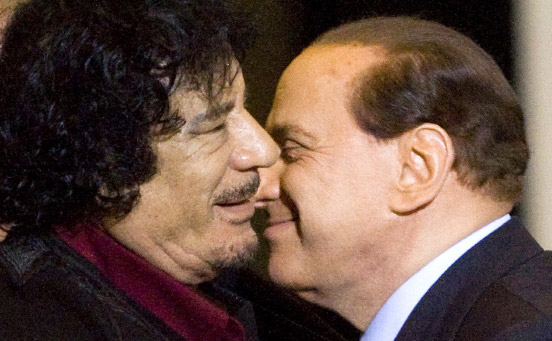
The other result was the impoverishment of historical consciousness, and the degradation of more complex appreciations of the full breadth of the Gaddafi record. This would help explain why some would not rush to condemn and disown the man (without having to resort to crude and infantile caricaturing of their motivations). While even Glenn Greenwald feels the need to dutifully insert, “No decent human being would possibly harbor any sympathy for Gadaffi,” I have known decent human beings in Nicaragua, Trinidad, Dominica, and among the Mohawks in Montreal who very much appreciate Gaddafi’s support - not to mention his support for various national liberation movements, including the struggle against apartheid in South Africa. Gaddafi’s regime has many faces: some are seen by his domestic opponents, others are seen by recipients of his aid, and others were smiled at by the likes of Silvio Berlusconi, Nicolas Sarkozy, Condoleeza Rice, Hillary Clinton and Barack Obama. There are many faces, and they are all simultaneously real. Some refuse to “disown” Gaddafi, to “apologize” for his friendship towards them, no matter how distasteful, indecent, and embarrassing other “progressives” may find him. That needs to be respected, instead of this now fashionable bullying and gang banging that reduces a range of positions to one juvenile accusation: “you support a dictator”. Ironically, we support many dictators, with our very own tax dollars, and we routinely offer no apologies for this fact.
Speaking of the breadth of Gaddafi’s record, that ought to resist simplistic, revisionist reduction, some might care to note that even now, the U.S. State Department’s webpage on Libya still points to a Library of Congress Country Study on Libya that features some of the Gaddafi government’s many social welfare achievements over the years in the areas of medical care, public housing, and education. In addition, Libyans have the highest literacy rate in Africa (see UNDP, p. 171) and Libya is the only continental African nation to rank “high” in the UNDP’s Human Development Index. Even the BBC recognized these achievements:
“Women in Libya are free to work and to dress as they like, subject to family constraints. Life expectancy is in the seventies. And per capita income - while not as high as could be expected given Libya’s oil wealth and relatively small population of 6.5m - is estimated at $12,000 (£9,000), according to the World Bank. Illiteracy has been almost wiped out, as has homelessness - a chronic problem in the pre-Gaddafi era, where corrugated iron shacks dotted many urban centres around the country”.
So if one supports health care, does that mean one supports dictatorship? And if “the dictator” funds public housing and subsidizes incomes, do we simply erase those facts from our memory?
8. Freedom Fighters - the Angels
The complement to the demonization of Gaddafi was the angelization of the “rebels”. My aim here is not to counter the myth by way of inversion, and demonizing all of Gaddafi’s opponents, who have many serious and legitimate grievances, and in large numbers have clearly had more than they can bear. I am instead interested in how “we,” in the North Atlantic part of the equation, construct them in ways that suit our intervention. One standard way, repeated in different ways across a range of media and by U.S. government spokespersons, can be seen in this New York Times’ depiction of the rebels as “secular-minded professionals - lawyers, academics, businesspeople - who talk about democracy, transparency, human rights and the rule of law”. The listing of professions familiar to the American middle class which respects them, is meant to inspire a shared sense of identification between readers and the Libyan opposition, especially when we recall that it is on the Gaddafi side where the forces of darkness dwell: the main “professions” we find are torturer, terrorist, and African mercenary.
For many weeks it was almost impossible to get reporters embedded with the rebel National Transitional Council in Benghazi to even begin to provide a description of who constituted the anti-Gaddafi movement, if it was one organization or many groups, what their agendas were, and so forth. The subtle leitmotif in the reports was one that cast the rebellion as entirely spontaneous and indigenous - which may be true, in part, and it may also be an oversimplification. Among the reports that significantly complicated the picture were those that discussed the CIA ties to the insurgents (for more, see this, this, this, and that); others highlighted the role of the National Endowment for Democracy, the International Republican Institute, the National Democratic Institute, and USAID, which have been active in Libya since 2005; those that detailed the role of various expatriate groups; and, reports of the active role of “radical Islamist” militias embedded within the overall insurgency, with some pointing to Al Qaeda connections.
Some feel a definite need for being on the side of “the good guys,” especially as neither Iraq nor Afghanistan offer any such sense of righteous vindication. Americans want the world to see them as doing good, as being not only indispensable, but also irreproachable. They could wish for nothing better than being seen as atoning for their sins in Iraq and Afghanistan. This is a special moment, where the bad guy can safely be the other once again. A world that is safe for America is a world that is unsafe for evil. Marching band, baton twirlers, Anderson Cooper, confetti - we get it.
9. Victory for the Libyan People
To say that the current turn in Libya represents a victory by the Libyan people in charting their own destiny is, at best, an oversimplification that masks the range of interests involved since the beginning in shaping and determining the course of events on the ground, and that ignores the fact that for much of the war Gaddafi was able to rely on a solid base of popular support. As early as February 25, a mere week after the start of the first street protests, Nicolas Sarkozy had already determined that Gaddafi “must go”. By February 28, David Cameron began working on a proposal for a no-fly zone - these statements and decisions were made without any attempt at dialogue and diplomacy. By March 30, The New York Times reported that for “several weeks” CIA operatives had been working inside Libya, which would mean they were there from mid-February, that is, when the protests began - they were then joined inside Libya by “dozens of British special forces and MI6 intelligence officers”. The NYT also reported in the same article that “several weeks” before (again, around mid-February), President Obama Several “signed a secret finding authorizing the CIA to provide arms and other support to Libyan rebels,” with that “other support” entailing a range of possible “covert actions”. USAID had already deployed a team to Libya by early March. At the end of March, Obama publicly stated that the objective was to depose Gaddafi. In terribly suspicious wording, “a senior U.S. official said the administration had hoped that the Libyan uprising would evolve ‘organically,’ like those in Tunisia and Egypt, without need for foreign intervention” - which sounds like exactly the kind of statement one makes when something begins in a fashion that is not “organic” and when comparing events in Libya as marked by a potential legitimacy deficit when compared to those of Tunisia and Egypt. Yet on March 14 the NTC’s Abdel Hafeez Goga asserted, “We are capable of controlling all of Libya, but only after the no-fly zone is imposed” - which is still not the case even six months later.
In recent days it has also been revealed that what the rebel leadership swore it would oppose - foreign boots on the ground” - is in fact a reality confirmed by NATO: “Special forces troops from Britain, France, Jordan and Qatar on the ground in Libya have stepped up operations in Tripoli and other cities in recent days to help rebel forces as they conducted their final advance on the Gadhafi regime”. This, and other summaries, are only scratching the surface of the range of external support provided to the rebels. The myth here is that of the nationalist, self-sufficient rebel, fueled entirely by popular support.
At the moment, war supporters are proclaiming the intervention a “success”. It should be noted that there was another case where an air campaign, deployed to support local armed militia on the ground, aided by U.S. covert military operatives, also succeeded in deposing another regime, and even much more quickly. That case was Afghanistan. Success.
10. Defeat for “the Left”
As if reenacting the pattern of articles condemning “the left” that came out in the wake of the Iran election protests in 2009 (see as examples Hamid Dabashi and Slavoj Žižek), the war in Libya once again seemed to have presented an opportunity to target the left, as if this was topmost on the agenda - as if “the left” was the problem to be addressed. Here we see articles, in various states of intellectual and political disrepair, by Juan Cole (see some of the rebuttals: “The case of Professor Juan Cole,” “An open letter to Professor Juan Cole: A reply to a slander,” “Professor Cole ‘answers’ WSWS on Libya: An admission of intellectual and political bankruptcy”), Gilbert Achcar (and this especially), Immanuel Wallerstein, and Helena Sheehan who seemingly arrived at some of her most critical conclusions at the airport at the end of her very first visit to Tripoli.
There seems to be some confusion over roles and identities. There is no homogeneous left, nor ideological agreement among anti-imperialists (which includes conservatives and libertarians, among anarchists and Marxists). Nor was the “anti-imperialist left” in any position to either do real harm on the ground, as is the case of the actual protagonists. There was little chance of the anti-interventionists in influencing foreign policy, which took shape in Washington before any of the serious critiques against intervention were published. These points suggest that at least some of the critiques are moved by concerns that go beyond Libya, and that even have very little to do with Libya ultimately. The most common accusation is that the anti-imperialist left is somehow coddling a dictator. The argument is that this is based on a flawed analysis - in criticizing the position of Hugo Chávez, Wallerstein says Chávez’s analysis is deeply flawed, and offers this among the criticisms: “The second point missed by Hugo Chavez’s analysis is that there is not going to be any significant military involvement of the western world in Libya” (yes, read it again). Indeed, many of the counterarguments deployed against the anti-interventionist left echo or wholly reproduce the top myths that were dismantled above, that get their geopolitical analysis almost entirely wrong, and that pursue politics focused in part on personality and events of the day. This also shows us the deep poverty of politics premised primarily on simplistic and one-sided ideas of “human rights” and “protection” (see Richard Falk’s critique), and the success of the new military humanism in siphoning off the energies of the left. And a question persists: if those opposed to intervention were faulted for providing a moral shield for “dictatorship” (as if imperialism was not itself a global dictatorship), what about those humanitarians who have backed the rise of xenophobic and racist militants who by so many accounts engage in ethnic cleansing? Does it mean that the pro-interventionist crowd is racist? Do they even object to the racism? So far, I have heard only silence from those quarters.
The agenda in brow-beating the anti-imperialist straw man masks an effort to curb dissent against an unnecessary war that has prolonged and widened human suffering; advanced the cause of war corporatists, transnational firms, and neoliberals; destroyed the legitimacy of multilateral institutions that were once openly committed to peace in international relations; violated international law and human rights; witnessed the rise of racist violence; empowered the imperial state to justify its continued expansion; violated domestic laws; and reduced the discourse of humanitarianism to a clutch of simplistic slogans, reactionary impulses, and formulaic policies that privilege war as a first option. Really, the left is the problem here?
8. Freedom Fighters - the Angels
The complement to the demonization of Gaddafi was the angelization of the “rebels”. My aim here is not to counter the myth by way of inversion, and demonizing all of Gaddafi’s opponents, who have many serious and legitimate grievances, and in large numbers have clearly had more than they can bear. I am instead interested in how “we,” in the North Atlantic part of the equation, construct them in ways that suit our intervention. One standard way, repeated in different ways across a range of media and by U.S. government spokespersons, can be seen in this New York Times’ depiction of the rebels as “secular-minded professionals - lawyers, academics, businesspeople - who talk about democracy, transparency, human rights and the rule of law”. The listing of professions familiar to the American middle class which respects them, is meant to inspire a shared sense of identification between readers and the Libyan opposition, especially when we recall that it is on the Gaddafi side where the forces of darkness dwell: the main “professions” we find are torturer, terrorist, and African mercenary.
For many weeks it was almost impossible to get reporters embedded with the rebel National Transitional Council in Benghazi to even begin to provide a description of who constituted the anti-Gaddafi movement, if it was one organization or many groups, what their agendas were, and so forth. The subtle leitmotif in the reports was one that cast the rebellion as entirely spontaneous and indigenous - which may be true, in part, and it may also be an oversimplification. Among the reports that significantly complicated the picture were those that discussed the CIA ties to the insurgents (for more, see this, this, this, and that); others highlighted the role of the National Endowment for Democracy, the International Republican Institute, the National Democratic Institute, and USAID, which have been active in Libya since 2005; those that detailed the role of various expatriate groups; and, reports of the active role of “radical Islamist” militias embedded within the overall insurgency, with some pointing to Al Qaeda connections.
Some feel a definite need for being on the side of “the good guys,” especially as neither Iraq nor Afghanistan offer any such sense of righteous vindication. Americans want the world to see them as doing good, as being not only indispensable, but also irreproachable. They could wish for nothing better than being seen as atoning for their sins in Iraq and Afghanistan. This is a special moment, where the bad guy can safely be the other once again. A world that is safe for America is a world that is unsafe for evil. Marching band, baton twirlers, Anderson Cooper, confetti - we get it.
9. Victory for the Libyan People
To say that the current turn in Libya represents a victory by the Libyan people in charting their own destiny is, at best, an oversimplification that masks the range of interests involved since the beginning in shaping and determining the course of events on the ground, and that ignores the fact that for much of the war Gaddafi was able to rely on a solid base of popular support. As early as February 25, a mere week after the start of the first street protests, Nicolas Sarkozy had already determined that Gaddafi “must go”. By February 28, David Cameron began working on a proposal for a no-fly zone - these statements and decisions were made without any attempt at dialogue and diplomacy. By March 30, The New York Times reported that for “several weeks” CIA operatives had been working inside Libya, which would mean they were there from mid-February, that is, when the protests began - they were then joined inside Libya by “dozens of British special forces and MI6 intelligence officers”. The NYT also reported in the same article that “several weeks” before (again, around mid-February), President Obama Several “signed a secret finding authorizing the CIA to provide arms and other support to Libyan rebels,” with that “other support” entailing a range of possible “covert actions”. USAID had already deployed a team to Libya by early March. At the end of March, Obama publicly stated that the objective was to depose Gaddafi. In terribly suspicious wording, “a senior U.S. official said the administration had hoped that the Libyan uprising would evolve ‘organically,’ like those in Tunisia and Egypt, without need for foreign intervention” - which sounds like exactly the kind of statement one makes when something begins in a fashion that is not “organic” and when comparing events in Libya as marked by a potential legitimacy deficit when compared to those of Tunisia and Egypt. Yet on March 14 the NTC’s Abdel Hafeez Goga asserted, “We are capable of controlling all of Libya, but only after the no-fly zone is imposed” - which is still not the case even six months later.
In recent days it has also been revealed that what the rebel leadership swore it would oppose - foreign boots on the ground” - is in fact a reality confirmed by NATO: “Special forces troops from Britain, France, Jordan and Qatar on the ground in Libya have stepped up operations in Tripoli and other cities in recent days to help rebel forces as they conducted their final advance on the Gadhafi regime”. This, and other summaries, are only scratching the surface of the range of external support provided to the rebels. The myth here is that of the nationalist, self-sufficient rebel, fueled entirely by popular support.
At the moment, war supporters are proclaiming the intervention a “success”. It should be noted that there was another case where an air campaign, deployed to support local armed militia on the ground, aided by U.S. covert military operatives, also succeeded in deposing another regime, and even much more quickly. That case was Afghanistan. Success.
10. Defeat for “the Left”
As if reenacting the pattern of articles condemning “the left” that came out in the wake of the Iran election protests in 2009 (see as examples Hamid Dabashi and Slavoj Žižek), the war in Libya once again seemed to have presented an opportunity to target the left, as if this was topmost on the agenda - as if “the left” was the problem to be addressed. Here we see articles, in various states of intellectual and political disrepair, by Juan Cole (see some of the rebuttals: “The case of Professor Juan Cole,” “An open letter to Professor Juan Cole: A reply to a slander,” “Professor Cole ‘answers’ WSWS on Libya: An admission of intellectual and political bankruptcy”), Gilbert Achcar (and this especially), Immanuel Wallerstein, and Helena Sheehan who seemingly arrived at some of her most critical conclusions at the airport at the end of her very first visit to Tripoli.
There seems to be some confusion over roles and identities. There is no homogeneous left, nor ideological agreement among anti-imperialists (which includes conservatives and libertarians, among anarchists and Marxists). Nor was the “anti-imperialist left” in any position to either do real harm on the ground, as is the case of the actual protagonists. There was little chance of the anti-interventionists in influencing foreign policy, which took shape in Washington before any of the serious critiques against intervention were published. These points suggest that at least some of the critiques are moved by concerns that go beyond Libya, and that even have very little to do with Libya ultimately. The most common accusation is that the anti-imperialist left is somehow coddling a dictator. The argument is that this is based on a flawed analysis - in criticizing the position of Hugo Chávez, Wallerstein says Chávez’s analysis is deeply flawed, and offers this among the criticisms: “The second point missed by Hugo Chavez’s analysis is that there is not going to be any significant military involvement of the western world in Libya” (yes, read it again). Indeed, many of the counterarguments deployed against the anti-interventionist left echo or wholly reproduce the top myths that were dismantled above, that get their geopolitical analysis almost entirely wrong, and that pursue politics focused in part on personality and events of the day. This also shows us the deep poverty of politics premised primarily on simplistic and one-sided ideas of “human rights” and “protection” (see Richard Falk’s critique), and the success of the new military humanism in siphoning off the energies of the left. And a question persists: if those opposed to intervention were faulted for providing a moral shield for “dictatorship” (as if imperialism was not itself a global dictatorship), what about those humanitarians who have backed the rise of xenophobic and racist militants who by so many accounts engage in ethnic cleansing? Does it mean that the pro-interventionist crowd is racist? Do they even object to the racism? So far, I have heard only silence from those quarters.
The agenda in brow-beating the anti-imperialist straw man masks an effort to curb dissent against an unnecessary war that has prolonged and widened human suffering; advanced the cause of war corporatists, transnational firms, and neoliberals; destroyed the legitimacy of multilateral institutions that were once openly committed to peace in international relations; violated international law and human rights; witnessed the rise of racist violence; empowered the imperial state to justify its continued expansion; violated domestic laws; and reduced the discourse of humanitarianism to a clutch of simplistic slogans, reactionary impulses, and formulaic policies that privilege war as a first option. Really, the left is the problem here?
Maximilian Forte is an associate professor in the Department of Sociology and Anthropology at Concordia University in Montreal, Canada. His website can be found at http://openanthropology.org/ as can his previous articles on Libya and other facets of imperialism.
[Source: counterpunch.org. Images added.]