Pages

Sunday, 2 September 2012

7 COUNTRIES BATTLING WATER ISSUES, AS SEEN FROM SPACE


New Picture
7 countries battling water issues
By
Mother Nature Network, 31 August 2012.

From melting glaciers to rising sea levels

If you were to understand our planet only from the images that NASA and other space agencies snap from above, you might think we were a bucolic, peaceful species at home with our environment. But the planet has plenty of eco-problems - especially with water. Across the globe, permafrost and glaciers are melting, while sea levels are rising.

New Picture 3

Here are seven images of countries from space and the water concern that each nation faces.(Text: Katherine Butler)

1. The Maldives: Endangered ocean jewels

New Picture 4

The Maldives, an island nation located in the northern Indian Ocean southwest of India, is a string of small coral islands with an average elevation of about one meter above sea level. For this reason, National Geographic and others call the nation “ground zero” for climate change.

In 2009, President Mohamed Nasheed and his ministers held an underwater cabinet meeting to highlight the concerns for this “sinking” nation. According to the Intergovernmental Panel on Climate Change, if water to were to rise a mere seven inches, the Maldives would be “unliveable.”

2. Ireland's freshwater crisis

New Picture 5

Irish eyes would smile over the green and blues of this true-colour satellite image taken by NASA Aqua MODIS instrument on Aug. 7, 2003. One of the biggest issues facing this island nation is a struggle to maintain a clean supply of freshwater. The country is known worldwide for its green rolling hills made possible by abundant rainfall.

But it’s because of this rainfall that waterways are often polluted from insufficient wastewater treatment, as well as nitrogen and phosphorus-rich runoff from farms. National Geographic reports that officials are taking action in Ireland, including installing wireless pollution detectors in some rivers.

3. Glacier melt in New Zealand

New Picture 6

The country known for its pastoral landscapes is not exempt from environmental degradation. Experts note that the Tasman Glacier on the South Island is currently in fast retreat. Dr. Martin Brook, a lecturer in physical geography at Massey University, says “It’s just too warm for a glacier to be sustained at such a low altitude, 730 meters above sea level. So it melts rapidly and it is going to disappear altogether.”

The glacier is forming a lake around itself, one which did not exist as recently as 1973, Brook said.

This image of New Zealand was taken on March 30, 2011, by the Moderate Resolution Imaging Spectroradiometer (MODIS) aboard the Aqua satellite.

4. The Netherlands' rising sea

New Picture 7

The red shades in this photo represent the more densely vegetated areas. The Netherlands Environmental Assessment Agency is dedicated to addressing the country’s environmental difficulties, which include assessing the risks this sea-level nation faces against rising sea level due to climate change.

As the Agency writes, “the second half of the century may see serious problems arising from climate change, in particular in the low-lying areas of the country.” This false-colour image of the waterways of The Netherlands was taken on May 24, 2002, by the Advanced Spaceborne Thermal Emission and Reflection Radiometer (ASTER) aboard NASA’s Terra satellite.

5. Chile’s retreating glaciers

New Picture 8

On May 2, 2000, this false-colour image of a Patagonian glacier was taken by the Advanced Spaceborne Thermal Emission and Reflection Radiometer (ASTER). Vegetation is signified by red in this photo. A recent study of the ice fields in Patagonia reveals that ice fields are retreating because of climate change - but not entirely because of warming temperatures.

Sébastien Bertrand of Renard Centre of Marine Geology, Ghent University in Belgium led a study of the glaciers. As he told Science Daily, the retreat also “seems to be driven by a decrease in winter precipitation, snow, rather than by an increase in temperature.” Experts expect this revelation to improve scientific understand of how climate change is impacting these glaciers.

6. Greenland's ice sheet elevation

New Picture 9

Information from NASA’s ICESat (Ice, Cloud, and Land Elevation Satellite) was used to illustrate the change in elevation on Greenland’s ice sheet between 2003 and 2006. As NASA describes the image, “white regions indicate a slight thickening, while the blue shades indicate a thinning of the ice sheet. Grey indicates areas where no change in elevation was measured.”

Experts note that the Greenland ice sheet is particularly imperilled. Science Daily reports on a recent study which shows that the Greenland ice sheet might completely disappear in the next two thousand years if there is just 1.6 degrees of global warming. Compared to other melts in our planet’s history, this is extremely fast.

7. The melting permafrost of Siberia, Russia

New Picture 10

Pictured here is satellite image taken on June 15, 2005, of Chaunskaya Bay (noted as the blue half circle) in northeastern Siberia, as the Chaun and Palyavaam rivers flow into it. The waters ultimately empty into the Arctic Ocean.

Siberia is home to permafrost containing 1.5 trillion tons of carbon. As expert Sergey Zimov told the Huffington Post, “Here, total carbon storage is like all the rain forests of our planet put together.”

This is of concern to scientists, who note that the permafrost has started melting at a rapid pace in the past few decades. The faster it melts, the faster this carbon enters the atmosphere.

[Source: Mother Nature Network. Edited. Top image added.]


11 INCREDIBLE NAVIGABLE AQUEDUCTS (WATER BRIDGES)


New PictureNew Picture (1)

11 Incredible Navigable Aqueducts
By
The World Geography, 31 August 2012.

Navigable aqueducts (sometimes called water bridges) are bridge structures that carry navigable waterway canals over other rivers, valleys, railways or roads. They are primarily distinguished by their size, carrying a larger cross-section of water than most water-supply aqueducts. Although Roman aqueducts were sometimes used for transport, aqueducts were not generally used until the 17th century when the problems of summit level canals had been solved and modern canal systems started to appear.

1. Pontcysyllte Aqueduct, United Kingdom


The Pontcysyllte Aqueduct is a navigable aqueduct that carries the Llangollen Canal over the valley of the River Dee in Wrexham County Borough in north east Wales. Completed in 1805, it is the longest and highest aqueduct in Britain, a Grade I Listed Building and a World Heritage Site. Built by Thomas Telford and William Jessop, it is 307 m. (1,007 ft.) long, 3.4 m. (11 ft.) wide and 1.6 m. (5.25 ft.) deep.


The towpath is mounted above the water, with the inner edge carried on cast-iron pillars in the trough. This arrangement allows the water displaced by the passage of a narrow boat to flow easily around it, enabling relatively free passage. Every five years the ends of the aqueduct are closed and a plug in one of the highest spans is opened to drain the canal water into the River Dee below, for inspection and maintenance of the trough. [Link, Map]

2. Håverud Aqueduct, Sweden


Håverud Aqueduct is regarded as one of the greatest engineering achievements of its day. In the mid eighteen sixties it became clear that this section of the Dalsland Canal could not be completed using a traditional lock owing to local soil conditions. As a consequence a thirty metre long metal chute was constructed that traversed the Dalsland Waterfall.


Today the aqueduct is a tourist attraction and is a unique meeting point of waterway, road and railway. There is a popular visitor centre here. This is the  starting point for many boat trips on the Dalsland Canal. [Link, Map]

3. Magdeburg Water Bridge, Germany


The Germans took over 80 years to build this 918m (3,000 ft) bridge over the Elbe river near the town of Magdeburg. Canal engineers had first conceived of joining the two waterways as far back as 1919, and by 1938 the Rothensee boat lift and bridge anchors were in place, but construction was postponed during World War II. After the Cold War split Germany, the project was put on hold indefinitely by the East German government.


With the reunification of Germany and major establishment of water transport routes made the Water Bridge a priority again. Work started in 1997, with construction taking six years and costing €500 million. The water bridge now connects Berlin’s inland harbour network with the ports along the Rhine river. The aqueduct's trough structure incorporates 24,000 tonnes of steel and 68,000 cubic meters of concrete. The Magdeburg water bridge was opened in 2003. [Link, Map]

4. Aqueduct Ringvaart Haarlemmermeer, Netherlands


Near Roelofarendsveen (a town in western Netherlands), the Ringvaart Channel crosses the A4 Highway by means of an aqueduct. It was built in 1961, making it the oldest aqueduct in the Netherlands. In 2006, construction was completed of two new portions: on the east side for crossing new north-bound lanes for the expanded highway; and on the west side for the new HSL-Zuid high-speed railway. The new aqueduct is 1.8 kilometres (1.1 mi) long. [Link, Map]

5. Pont du Sart Aqueduct, Belgium

Pont Du Sart during construction (Link)

The Pont du Sart Aqueduct is a navigable aqueduct that carries the Centrumkanaal (channel in western Belgium) over the crossroads between N55 and N535 road near the town of Houdeng-Goegnies.


This concrete building is 498 meters (1,600 ft) long and 46 meters (150 ft) wide. Pont du Sart Aqueduct weighs 65,000 tons and is supported by 28 concrete columns, three meters (10 ft) in diameter. [Map]

6. Aqueduct Veluwemeer, Netherlands


Veluwemeer is an aqueduct on the N302 road near the small town of Harderwijk in the Eastern Netherlands. It is located under a small part of the lake Veluwemeer and at the same time connects the mainland Netherlands to Flevoland (largest artificial island in the world).


Veluwemeer is 25 meters (80 ft) long and under it daily passes about 28,000 vehicles. The aqueduct was opened to traffic in 2002. [Map]

7. Briare Aqueduct, France


The Briare Aqueduct carries the Canal latéral à la Loire over the River Loire on its journey to the River Seine in France. It replaced a river-level crossing from the canal to meet the Briare Canal that was hazardous in times of flood. Between 1896 and 2003 it was the longest navigable aqueduct in the World until the opening of the Magdeburg Water Bridge.


The aqueduct is built on fourteen piers. These piers support a single steel beam in turn supporting a steel channel which contains more than 13,000 tonnes of water, 2.2 meters (7 ft) deep and 6 metres (20 ft) wide allowing boats with a 1.8m draught to cross. The width of the aqueduct, towpaths included, is 11.5 meters (38 ft) and its length is 662.7 meters (2.175 ft). [Link, Map]

8. Naviduct Krabbersgat, Netherlands


The Krabbersgat-locks in the Netherlands is the first “Naviduct” in the world. This unique mega project, consisting of a ship-lock with an underpass for road traffic, was conceived to ease bottlenecks for both vehicle and sea faring traffic.


The massive structure is 125 meters (410 ft) in length and 25 meters (82 ft) wide. 1,450 m3 of earth was removed to accommodate 20,000 m3 of concrete. This naviduct in Enkhuizen was opened in 2003. [Link, Map]

9. Edstone Aqueduct, United Kingdom


Edstone Aqueduct is one of three aqueducts on a 4 miles (6 km) length of the Stratford-upon-Avon Canal in Warwickshire. All are unusual in that the towpaths are at the level of the canal bottom. At 475 feet (145 m), Edstone is the longest aqueduct in England. It crosses a minor road, the Birmingham and North Warwickshire railway and also the trackbed of the former Alcester Railway. [Link, Map]

10. Aqueduct Langdeel, Netherlands


Aqueduct Langdeel is located on the N31 highway, near the city of Leeuwarden in the northern Netherlands. The aqueduct carries the canal of the same name.


Construction began in 2004, and in 2007 the aqueduct was completed  and opened to traffic. The aqueduct was 2.78 meters (9 ft) deep, 25 meters (82 ft) wide and 110 meters (360 ft) long. Concrete box aqueduct lies on the three rows of concrete pillars. [Map]

11. Ee Aqueduct, Netherlands


Ee Aqueduct is located in the Dutch province of Friesland, on the provincial road N928. This aqueduct was opened for traffic in 2007. [Map]


[Source: The World Geography. Edited. Top image added.]


THE 8 SUPER-ADAPTABLE LIFE FORMS THAT RULE OUR PLANET


New Picture 26
The Eight Super-Adaptable Life Forms That Rule Our Planet
By George Dvorsky,
io9, 31 August 2012.

As the most intelligent and technologically advanced species on Earth, we humans like to think that we own the place. But evolutionary success can be measured any number of ways. As biologist Stephen G. Gould once noted, complexity, intelligence, and ferocity don't count for much in the long run - adaptability and reproductive success matter more. With that in mind, here are the eight most prolific and versatile organisms that rule our planet.

1. Bacteria

New Picture 27

There's no question that bacteria is the killer app of nature. In fact, a number of biologists have suggested that we actually live in the Age of Bacteria. And indeed, bacteria can be found virtually everywhere, including soil, acidic hot springs, radioactive waste, water, and deep within the Earth's crust. A large prokaryotic microorganism, bacteria is best understood as a domain of organisms rather than a distinct species, so it's worth breaking them down into smaller groups. Take, E. coli for example. Over the course of life, there will be more E. coli living in the gut of each human being than the total number of people who have ever lived. And according to Lynn Margulis, "Fully 10 percent of our own dry body weight consists of bacteria, some of which, although they are not a congenital part of our bodies, we can't live without." Another particularly prolific type of bacteria is cyanobacteria, also known as blue-green algae. It's been known to dwell in a diverse range of habitats and take on extremophile characteristics. But no classification of bacteria compares to the SAR11 clade, a bacteria that that lives on the surface of oceans. Its population has been estimated at an unfathomable 2.4 x 1028 individuals, making it the most successful organism on the planet.

2. Phytoplankton

New Picture 28
Image: Gordon T. Taylor, Stony Brook University/Wikimedia Commons

Phytoplankton are microscopic organisms that blanket the surface of most oceans and bodies of fresh water. A subset of the larger plankton community, they cannot be seen with the unaided eye, but because they exist in such large numbers they can actually discolour large expanses of water. These tiny autotrophic critters account for half of all photosynthetic activity on Earth - which, when considering how many plants exist on the planet, is nothing short of astounding. As a result, they are integral to the planet's oxygen supply. They also drive the 'biological pump' that converts 100 million tonnes of atmospheric carbon dioxide a day into organic material. Phytoplankton also serve as the base for the aquatic food web, offering themselves a readily available meal for baleen whales. In terms of numbers, there are over 5,000 known species - but because new ones keep getting discovered, it's difficult to put an exact number on them. And disturbingly, their numbers are decreasing at a rate of 10% a year, likely on account of climate change.

3. Ants

New Picture 29

Emerging from wasp-like ancestors over 130 million years ago, ants have become the most successful terrestrial macro-scale species this planet has ever seen. Often considered a super-organism on account of their hive-mind composition, their evolutionary success has been attributed to their highly coordinated social organization, an ability to modify habitats, exploit resources, and defend themselves. Nearly 12,500 species have been identified, but it's thought that as many as 22,000 species may actually exist. Ants have also colonized virtually every landmass on Earth, and may comprise anywhere from 15 to 25% of the total terrestrial animal biomass. Put another way, there are more ants on this planet by weight than all humans combined. In terms of numbers, E. O. Wilson has estimated that there are 10,000 trillion individual ants alive at any given moment.

4. Beetles

New Picture 30

Coleoptera, what are commonly called beetles, includes more species than any other insect order, constituting almost 25% of all known life-forms. They make up about 40% of all known insect species (about 400,000 in total) and comprise about 500 recognized families and subfamilies. Actually, it's probably even more than that; it has been estimated that there may be as many as one million different beetle species. Highly adaptable, beetles can be found in all major habitats (except marine and polar regions), and are non-specialist detritus feeders - a generalized adaptation that allows them to break down animal and plant debris - including waste and fungi.

5. Termites

New Picture 31

Another social insect, termites are members of the Isoptera order, and contrary to belief are only distantly related to ants (they're actually more closely related to beetles). Like ants, they are eusocial insects that divide their labour among castes and take care of their young collectively. There are an estimated 4,000 species of termites, and colonies can contain anywhere from hundreds to millions of individuals. And as many of us tragically know, they are insatiable devours of wood - but their ability to recycle wood and other plant matter has made them an indelible component of the biosphere. It has been estimated that termites cause around $22 billion in structural damage annually around the world. Termites are so prolific that they're actually being considered as a potential renewable fuel source by the U.S. Department of Energy on account of their ability to produce copious amounts of hydrogen.

6. Grass

New Picture 32
Image: eddard.com

Simply put, grass is the most dominant form of vegetation on the planet. Among the most versatile life forms on Earth, grasses have adapted to conditions in rain forests, deserts, mountains and even intertidal habitats. They are now the most widespread plant on the planet, and as a consequence, have become a primary food source for all sorts of wildlife. Also known as graminoids, there may be as many as 3,500 different species. Grass has also benefited from humans, owing to our love for lush lawns, parks, and playing fields.

7. Cockroaches

New Picture 33

Originally a tropical insect, cockroaches have adapted disturbingly well to human civilization. Though not as prolific as some of the other creatures on this list, cockroaches are incredibly hardy and resilient. Some species are capable of remaining active for months without food and are able to survive on limited resources - including glue from the back of postage stamps. Some cockroaches can even go without air for up to 45 minutes. And as for the old adage that cockroaches can survive a nuclear holocaust, there may be some truth to it. Because their cells divide only once each time it moults, it has a higher radiation resistance than most vertebrates, capable of withstanding a dose six to 15 times that which a human could endure.

8. Rats

New Picture 34

Rats are probably the most resilient mammal on the planet - and like the cockroach, they have benefited from human activity. Known as commensals (opportunistic survivors that have taken full advantage of urban environments), rats, or more accurately the brown rat, will eat almost anything. They can live in a wide variety of habitats, and are expert jumpers, climbers, and swimmers. They can produce up to five litters per year, each one containing anywhere from six to 22 young. In fact, a single pair of rats can multiply to 200 in just one year. It's thought that there are billions of rats on this planet, making them the most successful mammal (excepting humans). They're also hard to kill - and are becoming increasingly immune to poisons. In fact, genetic mutations are so pronounced in some populations that their DNA has become irrevocably altered.

Top image: Photo by Alex Wild

[Source: io9. Edited. Some image links added.]


BEST SCIENCE PHOTOS OF THE WEEK XXV


New Picture 89
Best Science Photos of the Week
By
Live Science, 31 August 2012.

1. Awwww! Baby Bison

New Picture 90

A new bison calf born this summer at the Bronx zoo is a hopeful sign for the iconic American species, which was almost hunted to extinction, but is now making a resurgence.

Very few herds of purebred bison remain in North America. Two of these herds live in Wyoming's Yellowstone National Park, but breeding them outside the park has proven difficult, until now.


2. Dinosaur Art

New Picture 91

Dinosaurs, the mystical and often fierce giants that once roamed planet Earth, seem to come alive in the minds of many a child. It was this imagination that led one young dino enthusiast to attempt to bring these paleo-beasts to life through his science-based illustrations.

Steve White, a British comic books editor and paleoartist, has been drawing dinosaurs since he was young. This "childhood fixation," as he calls it, never left him. The latest manifestation is his new book, "Dinosaur Art: The World's Greatest Paleoart" (Titan Books, Sept. 2012). LiveScience caught up with White to find out what drives him and the amazing artists portrayed in the book, some of whom are also scientists, as well as what he sees as the future of drawing dinosaurs and ancient mammals.


3. Black Hole Bonanza

New Picture 99

A jackpot of previously unknown black holes across the universe has been discovered by the infrared eyes of a prolific NASA sky-mapping telescope.

The cosmic find comes from data collected by NASA's Wide-field Infrared Survey (WISE) telescope, which scanned the entire sky in infrared light from December 2009 to February 2011. The full catalogue of observations by WISE during its mission was publicly released in March, and astronomers are still poring through this celestial trove for discoveries.


4. Billowing Belt of Venus

New Picture 92

Giant trees cloaked in snow stand guard as the atmospheric blush known as the belt of Venus glows in the background of this surreal skywatching photo.


5. Space Sugar

New Picture 93

What a sweet cosmic find! Sugar molecules have been found in the gas surrounding a young sun-like star, suggesting that some of the building blocks of life may actually be present even as alien planets are still forming in the system.

The young star, called IRAS 16293-2422, is part of a binary (or two-star) system. It has a similar mass to the sun and is located about 400 light-years away in the constellation of Ophiuchus. The sugar molecules, known as glycolaldehyde, have previously been detected in interstellar space, but according to the researchers, this is the first time they have been spotted so close to a sun-like star.


6. Dinosaur's Last Meal

New Picture 94

Dinosaur fossils found with the bones of birds and small dinosaurs in their stomachs reveal the beasts may have been adept hunters capable of downing prey more than a third their own size, researchers say.

Fossils are occasionally found with the remains of animals and plants inside what were once their guts. These tummy contents can shed light on what they once ate - for instance, past research showed a mammal predator apparently had a tiny dinosaur as its last meal.


7. Chimps' Secret Handshakes

New Picture 95

Chimpanzees that engage in unusual hand-holding behaviour during grooming may be showing off a little culture, new research suggests.

These chimp handshakes, which are seen only among some of the primates, seem to differ from group to group in ways that aren't dependent on genetics or environment. That leaves cultural differences between groups as a possible explanation for why and how the hand-holding occurs.


8. Tatooine Planets Found

New Picture 96

Astronomers have for the first time discovered two alien planets whirling around a pair of stars: a complete solar system with twin suns just like Luke Skywalker's fictional home world Tatooine.

Most stars like our sun are not singletons, but rather come in pairs that orbit each other. Scientists had found planets in these binary systems, so-called circumbinary planets with two suns like Tatooine in the "Star Wars" universe.


9. Hubble Treasures

New Picture 97

Swirling galaxies, glowing nebulas and shimmering stars: these are the winners in a public contest to unearth beautiful images from the horde of unprocessed data collected by the Hubble Space Telescope.

The gorgeous pictures many of us associate with the Hubble Space Telescope don't come fully formed as we see them. In fact, the famous photos are the product of significant work on the part of scientists who sort through, process and transform the raw data into photogenic form. But Hubble collects so much data that researchers can only process a certain amount of it into aesthetic beauty. The rest is used for scientific study, but remains visually lacklustre.


10. Panda Pee

New Picture 98

Wild giant pandas are endangered loners that roam remote bamboo forests in the mountains of China. When the bears actually want to find each other - typically during their short mating window - it's important that they pick the perfect place to leave their scent.

So what qualities do peeing pandas look for in a tree? Researchers say bark roughness helps the pandas' scent carry, while a large width makes for an easier target to aim at, especially for male pandas spraying urine in a handstand.


[Source: Live Science. Edited.]


Saturday, 1 September 2012

INFOGRAPHIC: iPAD COMPARISON


New Picture 47
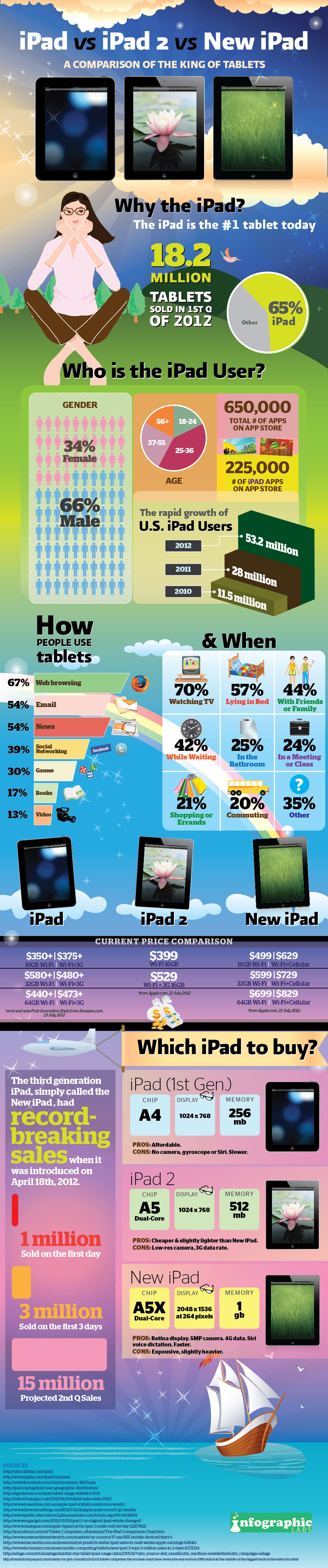
For those who are thinking of buying an iPad (or of upgrading) and can’t decide which one to buy, here’s an instructive infographic from Infographic Labs that compares the three versions, with some interesting statistics too.

iPad Comparison
By
Infographic Labs, 30 August 2012.

The popularity of tablets cannot be denied. Our infographic compares Apple's three tablet offerings: the original iPad, the iPad 2, and the New iPad. Find out more about the typical iPad and tablet user, and which one is right for you. Also interesting are the amazing initial figures from sales of the New iPad.


Published on Apple Gazette.

[Source: Infographic Labs.]