Pages

Monday, 3 December 2012

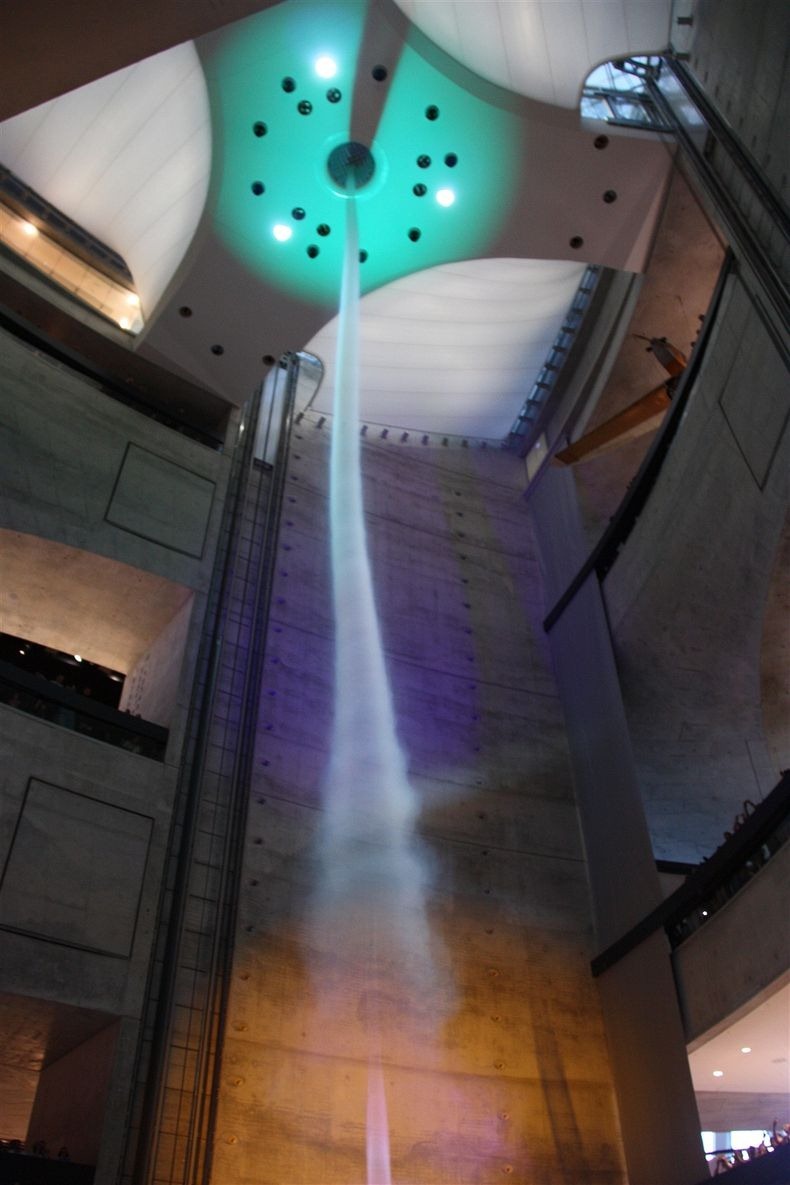
WORLD’S MOST POWERFUL ARTIFICIAL TORNADO AT GERMANY’S MERCEDES-BENZ MUSEUM


New Picture 62New Picture 61

Most Powerful Artificial Tornado at Mercedes-Benz Museum, Germany
By Kaushik,
Amusing Planet, 3 December 2012.

The Mercedes-Benz Museum is home to more than just automobiles. In 2007, the Guinness Book of Records gave it recognition for housing the "strongest artificially generated tornado in the world." The 34.4 meter high (that is 37.2 yards to those metrically challenged) vortex was not designed as an attraction, but to channel smoke out of the building in the event of a fire. In the event of fire, 144 outlets located along the core walls inject air into the interior courtyard of the Mercedes-Benz Museum. The 100-feet twister takes around seven minutes to materialize, drawing smoke out of the building's corridors and funnelling it upwards and out an exhaust vent on the roof.

Due to the open-plan structure of the Mercedes-Benz Museum, the various exhibition areas are connected to each other without any fire zones via an interior courtyard and ramps. From the perspective of smoke elimination this presented a challenging task that could not be implemented through conventional fluid mechanics. It was necessary to take a new approach, and so a globally unique smoke elimination system was developed especially for the Mercedes-Benz Museum.

mercedes-benz-tornado-0

This procedure uses the principle of the tornado force, which has a devastating effect under natural conditions, to create a controlled life-saving form of fluid mechanics that opens up new architectural possibilities.

mercedes-benz-tornado-5
mercedes-benz-tornado-6
mercedes-benz-tornado-1
mercedes-benz-tornado-2
mercedes-benz-tornado-3
mercedes-benz-tornado-4
Video: Mercedes-Benz Museum Tornado

[Source: Amusing Planet. Edited. Top image added.]


COMIC ILLUSTRATION: 5 SIGNS YOU’RE A COMPUTER ADDICT


New Picture 120
A fun way of illustrating the computer addict…

5 Signs You’re a Computer Addict [SUNDAY COMICS]
By Charlie White,
Mashable, 2 December 2012.

Computing too much? Our friends Nitrozac and Snaggy of The Joy of Tech will help you diagnose your situation with this handy guide:

The Joy of Tech comic, used with permission
Comic illustration provided by The Joy of Tech

See also: Previous Sunday Comics

[Source: Mashable. Edited.]


A UNICORN LAIR IN NORTH KOREA?


New Picture 60
North Korean historical institute 'declares it has discovered unicorn lair belonging to founder of ancient kingdom’
By David Baker,
Daily Mail, 30 November 2012.

In yet another outlandish claim to come out of North Korea historians have allegedly announced that they have unearthed a unicorn lair.

A report released by the History Institute of the DPRK Academy of Social Sciences claims that archaeologists discovered the lair of the mythical animal just outside a temple in the capital Pyongyang.

And, unsurprisingly, the lair - according to the report - means that Pyongyang was the focal point of an ancient, united Korea.

Odd: The unicorn lair has apparently been discovered just outside Yongmyong temple on Moran Hill, in the capital Pyongyang
Odd: The unicorn lair has apparently been discovered just outside Yongmyong temple on Moran Hill, in
the capital Pyongyang.

In what appears to be a suggestion of superiority over nearby enemies South Korea, the report says: 'The discovery of the unicorn lair, associated with legend about King Tongmyong, proves that Pyongyang was a capital city of Ancient Korea as well as Koguryo Kingdom.'

The dubious report, released by the state news agency, says the lair clearly belonged to King Tongmyong, founder of the ancient Korean kingdom Koguryo.

It goes on to say: 'A rectangular rock carved with words "Unicorn Lair" stands in front of the lair.

'The carved words are believed to date back to the period of Koryo Kingdom (918-1392).

'The temple served as a relief palace for King Tongmyong, in which there is the lair of his unicorn.'

OTHER UNUSUAL CLAIMS TO COME OUT OF NORTH KOREA

At the women's World Cup of football in 2011 the North Koreans put their poor performance down to being struck by lightning. Five of their players later tested positive for steroids.

Most of the more unusual claims stem from former leader Kim Jong-il and his biographer.

According to the book he reportedly warned the public in North Korea that he could control the weather with his mood.

He also claimed his birth had been prophesied and was heralded with a double rainbow and a new star in the heavens.

Years late Kim was apparently very busy during university writing no fewer than 1,500 books in three years and composing six operas.

But it wasn't just the arts he took a keen interest in. Apparently, in his first and only ever round of golf he shot 38-under with 11 holes in one.

Satisfied with his performance, he reportedly immediately declared his retirement from the sport.

Jo Hui Sung, director of the Institute, told KCNA, the state news agency, that the findings is in keeping with the country's history.

He said: 'Korea’s history books deal with the unicorn, considered to be ridden by King Tongmyong, and its lair.

'The Sogyong (Pyongyang) chapter of the old book ‘Koryo History’, said Ulmil Pavilion is on the top of Mt. Kumsu, with Yongmyong Temple, one of Pyongyang’s eight scenic spots, beneath it.

'The temple served as a relief palace for King Tongmyong, in which there is the lair of his unicorn.'

The legend of unicorns is thought to have stemmed from European folklore, in which the animal resembles a white horse with a single horn.

Until the 19th century the beast, considered a symbol of purity and grace, was still thought to exist - even by academics and theologians.

But since then there has been little to suggest that there are lairs elsewhere in the world.

Discovery: Archaeologists in North Korea have apparently discovered a unicorn lair in the heart of Pyongyang
Discovery: Archaeologists in North Korea have apparently discovered a unicorn lair in the heart
of Pyongyang.

Bold claims: Former North Korean leader Kim Jong-il was at the centre of some other dubious claims before his death
Bold claims: Former North Korean leader Kim Jong-il was at the centre of some other dubious claims
before his death.

The unbelievable news does however follow a number of bizarre claims to come out of the country.

It has been suggested, however, that the release of the story could be in retaliation against a spoof North Korea related story which tricked a newspaper in China.

Written by satirical website The Onion, China's Communist party newspaper, The People's Daily, fell for claims that Kim Jong-un was named as the sexiest man alive.

Top image: Unicorn fantasy (source)

[Source: Daily Mail. Edited.]


NATIONAL GEOGRAPHIC'S SPACE PICTURES THIS WEEK XXXVIII


New Picture 75
Space Pictures This Week: Saturn Storm, Sun Blast
By
National Geographic News, 30 November 2012.

1. Stormy Saturn

New Picture 76

A vortex of storm clouds swirls around Saturn’s north pole in this November 27 image taken from about 250,000 miles (about 400,000 kilometres) away by NASA’s Cassini spacecraft.

Cassini's cameras have revealed a cyclone-like pattern at the pole before but only in infrared wavelengths because the north pole was in darkness during the planet's long winter. As Saturn slowly orbits the sun, light has finally begun to reach the north pole.

Cassini was launched in 1997 and has been orbiting the Saturnian system since 2004.


2. Goodnight, Tokyo

New Picture 77

Tokyo’s bustling streets resemble a fragile, glittering web when viewed from the International Space Station. The night-time shot was captured by an Expedition 33 crew member on November 14. The dark area in the upper left is Tokyo Bay.

3. Solar Swirl

New Picture 78

A luminous eruption of gas, called a prominence, swirled just behind the edge of the sun for about a day beginning on November 18. (Read more about solar storms in National Geographic magazine.) Magnetic fields above the area make such events fairly common, but this stunning profile view was captured in extreme ultraviolet light by the Solar Dynamics Observatory.

4. Herculean Proportions

New Picture 79

Hercules A, the largest galaxy in the constellation Hercules, is flanked by spectacular plumes shot from a supermassive black hole at the galaxy's core.

The optically invisible plumes - jets of high-energy plasma beams, subatomic particles, and magnetic fields - were revealed by combining the imaging power of Hubble Space Telescope's Wide Field Camera 3 and the Karl G. Jansky Very Large Array radio telescope in New Mexico. (More Hubble pictures.)

Hercules A is roughly a thousand times more massive than the Milky Way and emits nearly a billion times more power in radio wavelengths than our sun. It is about two billion light-years away.

5. Desert Dazzler

New Picture 80
Photograph by Babak Tafreshi, TWAN

Jupiter twinkles above a desert mesquite tree in Death Valley, California, in this November 2012 image. Toward the right of the frame, the constellation Taurus is visible.  (Related: Best Night-Sky Pictures of 2012.)

6. Icy Rings

New Picture 81

A steeply inclined orbit gives NASA's Cassini spacecraft a spectacular view of Saturn's rings, composed of ice and rock.

This newly released image was taken at a distance of about 1.5 million miles (2.4 million kilometres) on August 19, 2012, with a wide-angle camera.

[Source: National Geographic News. Edited.]


FROM SCI-FI TO REALITY: THE COMPUTER-BLITZING DRONE THAT CAN CRIPPLE A NATION'S ELECTRONICS AT THE TOUCH OF A BUTTON


New Picture 30
From sci-fi to reality: The computer-blitzing drone that can cripple a nation's electronics at the touch of a button
By Ben Ellery,
Daily Mail, 1 December 2012.

Down the years and across the universe, the heroes of science-fiction classics from Dan Dare to Star Wars and The Matrix have fought intergalactic battles with weapons that wipe out enemy electronics at the touch of a button.

Now scientists have turned fantasy into reality by developing a missile that targets buildings with microwaves that disable computers but don’t harm people.

Aircraft manufacturer Boeing successfully tested the weapon on a one-hour flight during which  it knocked out the computers of an entire military compound in the Utah desert.

Aircraft manufacturer Boeing has successfully tested a missile which knocked out an entire military compound in the Utah desert
Pre-programmed flight path: Aircraft manufacturer Boeing has successfully tested a missile which knocked
out an entire military compound in the Utah desert.

It is thought the missile could penetrate the bunkers and caves believed to be hiding Iran’s suspected nuclear facilities. But experts have warned that, in the wrong hands, the technology could be used to bring Western cities such as London to their knees.

During Boeing’s experiment, the missile flew low over the Utah Test and Training Range, discharging electromagnetic pulses on to seven targets, permanently shutting down their electronics.

Boeing said that the test was so successful even the camera recording it was disabled.

Codenamed the Counter-Electronics High Power Microwave Advanced Missile Project (CHAMP), it is the first time a missile with electromagnetic pulse capability has been tested.

For security reasons, Boeing declined to release film of the test, but instead issued an artist’s impression of it on video [shown at the end of post]. In the clip, a stealth aircraft deploys a missile that emits radio waves from its undercarriage which knock out the computer systems inside the buildings below.

The missile is launched from a stealth bomber and is thought to be able to penetrate the bunkers and caves believe to be hiding Iran's suspected nuclear facilities
Stealth mission: The missile is launched from a stealth bomber and is thought to be able to penetrate the
bunkers and caves believe to be hiding Iran's suspected nuclear facilities.

The company did release real film showing a row of computers that can be seen shutting down when the electromagnetic pulse is switched on.

Although the project is shrouded in secrecy, experts believe the missile is equipped with an electromagnetic pulse cannon. This uses a super-powerful microwave oven to generate a concentrated beam of energy which causes voltage surges in electronic equipment, rendering them useless before surge protectors have the chance to react.

Keith Coleman, CHAMP programme manager for Boeing’s prototype arm Phantom Works, said the technology marked ‘a new era in modern warfare’.

Drones

He added: ‘In the near future, this technology may be used to render an enemy’s electronic and data systems useless even before the first troops or aircraft arrive.

‘We hit every target we wanted and made science fiction into science fact. When the computers went out, it actually took out the cameras as well. It was fantastic.’

The project has cost £24 million and has been developed on behalf of the US Air Force Research Laboratory following a request from the Pentagon four years ago.

Lead test engineer Peter Finlay said: ‘We’re not quite at the place where the Star Trek and Star Wars movies are but this is definitely an advancement in technology able to give us an opportunity to do things we could not do before.’ James Dodd, vice-president of Advanced Boeing Military Aircraft, said there was a real need for a weapon that could knock out a target but not cause harm to people and structures.

He said: ‘We know this has capabilities and impact. We’re trying to see if we can get it implemented sooner rather than later.’

However, experts fear that the project could create an arms race, with countries scrambling to build their own electromagnetic pulse weapons.

BeforeAfter
Wiped out: Boeing's film shows computers before (left) and after (right) the attack by the drone but experts
have warned that, in the wrong hands, the technology could be used to bring Western cities such as London
to their knees.

Professor Trevor Taylor, Professorial Fellow at the Royal United Services Institute, said the Western world would be much more vulnerable to such an attack because of our increased reliance on electronics. He added: ‘This is a challenging area in political and military terms. Ideally there would have been an arms-control agreement to cover this field, because once technology is actually developed, control becomes harder.

‘The historical record shows that important technologies developed in one country are developed elsewhere within a relatively short period - look what happened with regard to the USSR and nuclear weapons.

‘Should the US be known to have developed such a technology to the production stage, it would drive others to try to act similarly.

‘Western countries are more dependent on electronics-based IT than others and would be vulnerable to extensive disruption.’


Top image: Artists’ concept of the drone performing a high-power microwave attack (source)

[Source: Daily Mail. Edited. Top image and video/some links added.]


COOLEST SCIENCE STORIES OF THE WEEK XIV


New Picture 124
Coolest Science Stories of the Week
By
Live Science, 2 December 2012.

Science caught our attention this week with a ghost island, images of actual DNA and the dark side of the Mayan Apocalypse rumours. Check these out.

11. 1st Direct DNA Photo

New Picture 125

Fifty-nine years after James Watson and Francis Crick deduced the double-helix structure of DNA, a scientist has captured the first direct photograph of the twisted ladder that props up life.

Enzo Di Fabrizio, a physics professor at the Magna Graecia University in Catanzaro, Italy, snapped the picture using an electron microscope.


10. Stonehenge Timeline Revamped

New Picture 126
Credit: Albo, Shutterstock

Ancient people probably assembled the massive sandstone horseshoe at Stonehenge more than 4,600 years ago, while the smaller bluestones were imported from Wales later, a new study suggests.

The conclusion, detailed in the December issue of the journal Antiquity, challenges earlier timelines that proposed the smaller stones were raised first.


9. Water Ice Discovered on Mercury

New Picture 127

It's time to add Mercury to the list of worlds where you can go ice-skating. Confirming decades of suspicion, a NASA spacecraft has spotted vast deposits of water ice on the planet closest to the sun.

Temperatures on Mercury can reach 800 degrees Fahrenheit (427 degrees Celsius), but around the north pole, in areas permanently shielded from the sun's heat, NASA's Messenger spacecraft found a mix of frozen water and possible organic materials.


8. Porn Stars Have Higher Self-Esteem

New Picture 128

Despite the stereotype that porn actresses are "damaged goods," they actually report higher self-esteem, more positive feelings and greater levels of spirituality than other women, a new study finds.

As previous research has shown, the general public tends to have a negative opinion of female porn stars, assuming that they come from desperate backgrounds and are driven to the industry by low self-respect, a history of childhood sex abuse or other psychological factors.


7. A Medium's Brain in a Trance

New Picture 129

The supernatural experience of having the dead communicate through the living has now been analyzed with brain scans.

Their brain activity suggests those more expert at entering these otherworldly trances often experienced a drop in focus, self-awareness and consciousness, scientists said.


6. Babies' Cries Reveal Autism Risk

New Picture 130

The pitch of babies' cries may provide clues as to whether they are at risk for autism as early as 6 months old, a new study suggests.

The researchers recorded cries from 39 6-month old infants, 21 of whom were at risk for autism because they had an older sibling with the condition. The others were healthy babies with no family history of autism.


5. Ancient Playing Cards Discovered

New Picture 131

Call it a card player's dream. A complete set of 52 silver playing cards gilded in gold and dating back 400 years has been discovered.

Created in Germany around 1616, the cards were engraved by a man named Michael Frömmer, who created at least one other set of silver cards.


4. Dark Side of Doomsday Rumors

New Picture 132

NASA scientists took time on Wednesday (Nov. 28) to soothe 2012 doomsday fears, warning against the dark side of Mayan apocalypse rumours - frightened children and suicidal teens who truly fear the world may come to an end Dec. 21.

These fears are based on misinterpretations of the Mayan calendar. On the 21st, the date of the winter solstice, a calendar cycle called the 13th b'ak'tun comes to an end. Although Maya scholars agree that the ancient Maya would not have seen this day as apocalyptic, rumours have spread that a cosmic event may end life on Earth on that day.


3. Tale of Google's Phantom Island

New Picture 133

A Kiwi librarian may have discovered the origin of a non-existent island that's been outfoxing cartographers for more than a century.

Sandy Island, still visible as a Manhattan-size void in the Coral Sea on Google Earth, was officially "undiscovered" last week after a group of Australian scientists gingerly navigated their research vessel directly through the spot where it should have been.


2. Ladies Prefer Thin Over Macho

New Picture 134

Macho features have long been touted as an evolutionary asset that heterosexual women look for in a potential mate. But new research suggests weight may be a more powerful driver of attraction.

Macho features such as a strong jaw and squinty eyes advertise that a guy possesses high testosterone, according to the immunocompetence handicap hypothesis. Since high levels of this masculinizing hormone interfere with the immune system, the theory goes, macho men must be extra-fit to withstand the handicap their extra testosterone confers.


1. New Kind of Matter Created

New Picture 135

Collisions between particles inside the Large Hadron Collider atom smasher have created what looks like a new form of matter.

The new kind of matter is called colour-glass condensate, and is a liquid-like wave of gluons, which are elementary particles related to the strong force that sticks quarks together inside protons and neutrons (hence they are like "glue").


[Source: Live Science. Edited. Some links added.]


Sunday, 2 December 2012

10 MIND-BOGGLING PHOTOREALISTIC DRAWINGS


10 Mind-Boggling Photorealistic Drawings
By Alice,
My Modern Met, 1 December 2012.

After seeing so many unbelievably amazing drawings that look like photos come across our desk, we felt as though it was finally time to put those, along with some new ones, all together in one post. In the past few months we've seen a resurgence of photorealistic art but instead of paintings, like we saw with artists like Alyssa Monks, Gregory Thielker or Diego Gravinese, these are drawings. Created either with just pencil or ballpoint pen, these incredible works of art show that it doesn't matter what tools you use, it's all about your God given talent and/or carefully honed skills.

Pencils and watercolour pencil on Fabriano watercolour art paper. Drawing by
Franco Clun.

Ballpoint pen. Drawing by Samuel Silva.

Pencil on paper. Drawing by Dirk Dzimirsky.

Graphite on cartridge Paper A1. Drawing by Paul Cadden.

Graphite on smooth bristol. Drawing by Linda Huber.

Colour pencils on cartridge paper. Drawing by Amy Robins.

Pencil on Paper. Drawing by Diego Fazio.

Graphite. Drawing by Darrel (ddanos).

Pencil on Paper. Drawing by Diego Fazio.

Top image: Mechanical pencil on Fabriano Acquarello watercolour 'Artistico' hot pressed. Drawing by Franco Clun.

[Source: My Modern Met. Edited.]