Pages

Monday, 3 February 2014

17 BIZARRE AIRCRAFT


New Picture 122
17 Bizarre Aircraft We Love, and the Stories Behind Them
By William Herkewitz,
Popular Mechanics, 30 January 2014.

It's easy to love these funny-looking planes just for their sheer weirdness. But many of them were built to prove a point or to advance the science of aerodynamics.

1. Alexander Lippisch's Aerodyne

New Picture 123

To look at Alexander Lippisch's Aerodyne is to be baffled at how engineers managed to get such a crazy thing off the ground. And it's far from alone in the gallery of bizarrely shaped aircraft we've seen over the years. From balance-driven helicopters to inflatable airplanes, even a cursory tour through the history of aviation reveals some strange beasts that look little like the jet shape we're all accustomed to.

You have to wonder, why do aircraft designers keep building such far-out flying machines? We asked Dan Hagedorn, the curator of Seattle's Museum of Flight, who provided more than a few reasons. Over the last 100 years, unconventional aircraft have let researchers probe the still-murky principles of aerodynamics, test novel aircraft design features and technologies, and much more. "The military has also driven a lot of the development," Hagedorn says, and some strange looking machines "were simply built in order to confront genuine or perceived needs," such as refuelling in the air, escaping radar detection, or ferrying odd-shaped or heavy cargo. And in a few, rare cases, some odd flying creations help us discover entirely new methods of flight.

2. For Research: NASA AD-1

New Picture 124

Wind-tunnel experiments and mathematical analysis can only take you so far. Understanding all the dynamics of a jagged object cutting through the atmosphere is a bit like predicting the weather: There are so many variables, you can only extrapolate up to a point. So to figure out how a specific feature, like the shape of a wing, can be affected by the many stresses and conditions the open air will throw at it, researchers sometimes just have to build it, fly it, and find out.

One of the oddest examples of this is the NASA AD-1, first built in 1979. The AD-1 showed that the straight and rigid wing of an aircraft could pivot up to 60 degrees during flight without losing stability.

3. Nemeth Parasol

New Picture 125

In 1934, the Nemeth Parasol [Umbrella Plane aka Roundwing], built by students at Miami University, demonstrated that even a circular wing could be used to fly a plane reliably. Hundreds of years from now, of course, this design principle will be adopted for spaceships.

4. Scaled Composites Model 281 Proteus

New Picture 126

Burt Rutan designed the thin, tandem-wing Scaled Composites Model 281 Proteus, first flown in the late 1990s, to investigate the use of aircraft as high altitude telecommunications relays. Thanks to its efficient design, this model was able to fly at 65,000 feet for over 18 hours. However, the rise of unmanned aircraft means that flying a piloted aircraft for this kind of long-endurance missions is just unnecessary.

5. Grumman X-29

New Picture 127

In 1984, the Grumman X-29 proved that the underlying lifting properties of jet wing wouldn't be compromised even if the wings were angled in reverse.

For the X-29, as with most of these research aircraft, years of careful calculations preceded the flight tests. Still, Hagedorn says, "you got to wonder what was going through the minds of some of those test pilots." PopMech flew in this hot fighter back in 1985.

6. For Niche Purposes: Vought V-173 "Flying Pancake"

New Picture 128

"For aircraft, there are certain things you simply have to have" Hagedorn says. "You need a lifting body of some kind. That can be some sort of foil, like a wing in an airplane, or a rotating blade like in a helicopter. You also need a propulsion device, some means of control, and some means of a landing. Everything else, no matter what the shape it is, is just details."

And when it comes down to the details, engineers can try some crazy things. The Vought V-173 "Flying Pancake" was designed with the World War II Pacific theatre in mind, where the U.S. saw an increased need for ship-borne planes that could take off from short runways. As inexplicably shaped as the V-173 is, Charles Lindberg once flew it and called the aircraft surprisingly easy to handle.

7. Sikorsky X-Wing

New Picture 129

The Sikorsky X-Wing was built to combine the speed and propulsive mechanisms of a jet with the vertical take-off abilities of a helicopter. Unfortunately, the program was cancelled in 1988, a long time after and far, far away from the first successful X-Wing.

8. Lockheed Martin P-791

New Picture 130

In the same vein of mix-and-match aircraft, the modern Lockheed Martin P-791 was built to combine the high speed of an airplane with the buoyancy of an airship. Who says you can't have both? Lockheed Martin is still making and selling this combo-craft, which, it says, can stay afloat at 20,000 feet for up to three weeks.

9. The Scaled Composites White Knight Two

New Picture 131

Designed to ferry a sub-orbital spacecraft between it's twin fuselages, the Scaled Composites White Knight Two, first flown in 2008, can ascend to a maximum height of 70,000 feet. The pilot steers from the right fuselage. Virgin Galactic plans to use this ship to carry its SpaceShipTwo to 50,000, where it will detach from the White Knight and ascend to suborbital altitudes of nearly 70 miles.

10. Blohm & Voss BV 141

New Picture 132

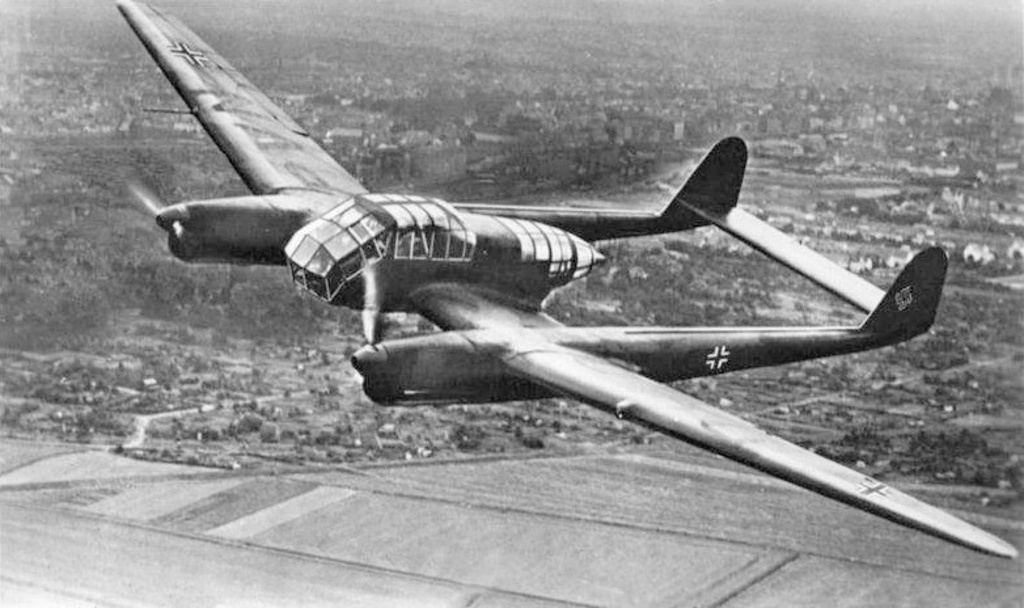
The Blohm & Voss BV 141 is a stark reminder that symmetry is not required for a flying machine. This WWII-era German wonder was designed as reconnaissance aircraft, and while few dozen were built and flown, it lost out to the the equally odd-looking Focke-Wulf Fw 189 and never reached full production.

11. Rutan Model 202 Boomerang

New Picture 133

The Rutan Model 202 Boomerang is asymmetrical for an entirely different reason. This 1996 aircraft was built to still be controllable in the event of an engine failure for either of its twin engines.

12. McDonnell XF-85 Goblin

New Picture 134

The McDonnell XF-85 Goblin was built soon after WWII as a so-called "parasite fighter," meaning it was built to be deployed from the bomb bay of a larger plane, the B-36. In the December 1948 PopMech, General Hoyt S. Vandenburg outlined how the little plane fit into America's new Air Force. But, in 1949, the U.S. scraped the Goblin alongside other parasite fighter projects, and focused instead on developing methods for airborne refuelling.

13. The Pregnant Guppy

New Picture 135

Sometimes you have gigantic, awkwardly shaped cargo you need to move across the country, and the big U-Haul just won't do. NASA's need to move the components of the Apollo moon missions led to the construction of this weird-looking aircraft, adapted from a Boeing 377. Luckily, there's a plane for that: the B377PG 'Pregnant Guppy.'

14. H-4 Hercules 2 "Spruce Goose"

New Picture 136

A 200-ton monstrosity, the H-4 Hercules 2 was nicknamed the Spruce Goose because of its wooden frame (despite the fact that it was mostly made of birch). The heavy transport aircraft is the largest fixed-winged seaplane ever built, and was designed by filmmaker and business magnate Howard Hughes. Only one was every built; today it sits in a museum in Oregon.

15. Goodyear Inflatoplane

New Picture 137

They said it couldn't be done, but in the 1950s, tire and blimp-maker Goodyear created an inflatable, flyable plane as a prototype for the U.S. Army. Sadly, the Army cancelled the project when it realized there wasn't much military use for a plane that could be popped like a balloon. You will be missed, Inflatoplane.

16. For Scientific Discovery: AeroJelly

New Picture 138

Despite their obvious visual differences, most aircraft are built upon very similar theoretical approaches to flight. For heavier-than-air aircraft, most flying machines are based on lift through a rotating blade (like a helicopter), or a fixed wing and some propulsive engine. Rarely does a researcher invent an entirely new method of flying. But last November, at New York University, applied mathematician Leif Ristroph did just that. Ristroph's naturally stable flying machine, the AeroJelly, is only slightly larger than your hand, and pumps its four flapping wings like a flying jellyfish.

"My lab is interested in studying air dynamics and flapping wing flight," says Ristroph, "and I was trying to design something that was stable without any sort of feedback." Ristroph explains that his AeroJelly is more than just an odd curiosity; it's letting him and his colleagues prod into the murky physics behind flexible, flapping wings. "This is very uncharted territory," he says, as the flexible wings change their shape as they flap, and lead to strange aerodynamic properties. "You get this unusual effect where flapping leads to these swirls of air that launch off the wing, and the wings can interact with each other, which is challenging."

17. And Because You Just Can: de Lackner HZ-1 Aerocycle

New Picture 139

The balance-driven de Lackner HZ-1 Aerocycle was built with the dual hope of flying single-man reconnaissance missions and building the greatest Bond-villain chair of all time. A pair of crashes grounded the idea, but the dream lived on.

Related Links:

[Source: Popular Mechanics. Edited. Some links added.]


TOP 10 HAUNTED TRAIN STATIONS


New Picture 34
Top 10 Haunted Train Stations
By Julie McNamee,
Toptenz, 2 February 2014.

Train stations are places that have hundreds or thousands of human visitors pass through their doors. Horrible accidents have occurred in their vicinity. A surprising number of them are built on or near cemeteries. So it’s no surprise that their chequered histories are reflected in the hauntings experienced by visitors and workers.

10. Begunkodor Train Station, India

New Picture 24

Begunkodor is a small village 161 miles from West Bengal’s state capital, Calcutta, India. Locals had difficulties travelling anywhere from the place as the station lay abandoned for some 42 years, ever since a railway worker saw a ghost there, and died shortly afterwards.

The white sari-wearing spectral lady who haunted the station was thought to have been the ghost of a woman run over by a train. Dancing on the platform or wandering the tracks, her appearance caused the unfortunate fellow’s co-workers to abandon the station, so spooked were they by his accident and subsequent sightings.

Begunkodor reopened in 2009, however, with railway officials denying that the closure was caused by the phantom (they blamed both the presence of narrow gauge rail, making it impossible for the newer fast trains to run on it, and it being a story dreamt up by workers who disliked being based at such a remote spot). As far as I can tell, there have been no recent sightings of the lady in white.

9. Caobao Road Subway Station, China

New Picture 25

Caobao Road underground station on Line 1 of the Shanghai subway system has an extremely frightening reputation. As well as nine deaths taking place in mysterious circumstances at the station, trains inexplicably break down, ghosts are seen and innocent commuters are dragged from the platform by an inhuman hand.

A girl in red was spotted for quite a few days after she committed suicide, just sitting on a platform seat. A woman’s voice has been heard laughing along the darkness of the railway tracks, at a time of night when there should have been no-one there…

Perhaps the eeriest story is a member of public who fell off the platform. He didn’t slip and he didn’t jump - another commuter said they saw something push him.

Caobao is understandably nicknamed “Ghost Station” and the fact that it has been built very near a mortuary only serves to add fuel to the stories.

8. Addiscombe Railway Station, England

New Picture 26

The carriage sheds and surrounding area at Addiscombe railway station, formerly in London’s district of Croydon was plagued by ghosts before its demolition in 2001 to make way for the area’s new tramline.

A train driver killed on the line in the early 1900s roamed the area and it is perhaps he who is the grey figure with blurred features seen walking among the sheds: specifically around Siding No. 4 where a water boiler had in the past exploded, killing workers. (The area around that siding was thought to be colder than elsewhere on the railway land).

The same figure has been seen since the demolition, viewed from a safe distance from behind a fence in nearby Capri Road.

And was he the ex-train driver responsible for moving trains in the dead of night, when none should have been working?

Well that’s another story for another day…

7. Connolly Station, Ireland

New Picture 27

Connolly Station, one of Dublin’s main railway stations and Ireland’s largest, suffered bomb damage in an attack during the Second World War on nearby North Strand Road, in 1941. Since then the buildings have been a focus of spectral soldierly sightings. It has also been subject to a full investigation by Irish Ghost Hunters (IGH).

It was a report of a soldier in grey walking along a disused platform that attracted IGH to the location in the first place, back in 2011, and in this video you can see for yourself what may indeed be poltergeist activity on the premises. It’s up to you to decide whether it was natural or supernatural causes that made the door slam shut…

Another security guard witnessed two figures in military gear on a camera but by the time he reached the area where he’d seen them, they had of course disappeared.

6. Union Station, Phoenix, USA

New Picture 28

Phoenix’s Union Station in the state of Arizona, USA, used to be the most important station in the city until the 1950s, when a new airport became Phoenix’s main gateway to the outside world. It was finally closed in 1995 by Amtrak and since then has been used only occasionally for tourist trains and the like.

Union Station is now the home to company offices and it’s their employees who experience the hauntings of Fred. The name was given by maintenance manager Dudley Weldon, according to The Arizona Republic newspaper, because it popped into his head one day.

He and others have seen a figure running away from them, another experienced a presence while in the attic (a room other employees refuse to go into as they believe it’s where Fred lives). There’s also a heavy door that opens and closes by itself, for no apparent reason - or perhaps by Fred.

5. Waterfront Station, Canada

New Picture 29

Waterfront Station in Gastown, Vancouver, is a still-bustling railway station built in 1915 and is said to be one of the most haunted buildings in the city.

Like something from The Shining, a security guard on his rounds one night has seen a woman dressed as a 1920’s flapper, dancing to music from the same era. As he approached the woman she disappeared and the music stopped…

Another guard came face to face with the shining white ghost of an old woman who reached out to him as he came towards her. In a fright, the guard ran from the room. Poltergeist activity was also experienced when a guard had the fright of his life, a number of desks rearranging themselves to bar his way out of a room. Understandably, he left the scene in terror, too.

That isn’t all - phantom footsteps, ghostly figures walking the rails and more have been seen at this particular Union Station.

4. Glen Eden Railway Station, New Zealand

New Picture 30

Glen Eden Railway Station lies in West Auckland, New Zealand. It’s another station with a connection to a cemetery. Built to service Waikumete Cemetery, it carried the deceased and those who travelled with them to the nearby graveyard on a Sunday.

A new café opened in the station building as part of a restoration in 2001 and the workers there have had more than one visit from a ghostly figure whose history is known to them. Alec MacFarlane was a railway worker who was killed at 3 pm on January 11, 1924 when a mailbag hook from a passing train struck him between the eyes.

Some have seen who they believe to be MacFarlane - they describe a man with a grey beard and a trench coat, while one employee encountered a man in a top hat who vanished before her eyes. Another has seen a spectral face at the window.

3. Panteones Metro Station, Mexico

New Picture 31

Panteones Metro Station, on Line 2 of the railway serving Mexico City, was bound to attract stories. Its name means “Graveyards” because it was built close to two old cemeteries - and as we know from the stories above, this is very likely to lead to stories of hauntings. Panteones doesn’t let us down.

In the tunnel between Panteones and Tacuba stations, ghostly knocks on the walls have been heard in the pitch black, and shadowy lumps appear and disappear when workers approach them.

There’s an extremely eerie video made in 2009 that appears to show train engineers hearing screams further along the track. Listen out for the hair-raising sounds at 0.26, 0.55 and 0.58. The screams aren’t a one-off incident - they’re said to be heard regularly after the station closes for the night.

So, what do you expect from a station named after places where the dead dwell?

2. Macquarie Fields Train Station, Australia

New Picture 32

The suburban railway station of Macquarie Fields lies to the South-West of Sydney, New South Wales in Australia. It’s a quiet station that looks relatively harmless to those who don’t know its story.

The problem is, late at night the ghost of a teenage girl is said to haunt the nearly deserted station, and has allegedly been seen by more than one person. She walks around screaming, her screams getting louder and louder. She is dressed in her dancing clothes, clutching her chest, which is covered in blood. She also sits in the station, staring in front of her and moaning, groaning and giving the appearance of being a not altogether happy ghost.

The station was investigated by Ghost Haunting Australia whose team photographed apparent ectoplasmic manifestations and ghostly figures watching them. They plan to go back to the site for further investigation.

1. Bishan MRT Station, Singapore

New Picture 33

There are a number of Singaporean MRT (Mass Rapid Transport) stations that are said to be haunted, but Bishan MRT in central Singapore is the one of the most famous. Having been built on the site of the former Bi Shan Teng cemetery, stories of hauntings began circulating as soon as it opened in 1987. Another station not far away, Novena, was also built on a cemetery and started attracting stories of phantoms soon after it opened.

A spooky incident occurred when a woman leaving the train one day in the early 1990s fainted, then reported to bystanders when she came round that she had been groped by unseen hands on exit from the train.

Maintenance workers have seen coffin bearers walking the tracks, headless figures have been encountered and phantom passengers have been spotted, all in or around the station. Perhaps most flesh-creepingly of all, people have heard footsteps on the roofs of moving trains.

Top image: A haunted train station by TJ Fowler.

[Source: Toptenz. Edited. Top image and some links added.]


VIDEO: NEW MIND-BLOWING FOOTAGE OF FELIX BAUMGARTNER'S WORLD'S HIGHEST SKYDIVE


New Picture 30
My posts here and here in October 2012 told the stories of Felix Baumgartner's record-breaking supersonic jump from more than 24 miles above earth's surface. In this new mind-blowing video, you see it all through Felix's eyes and experience the incredible feat like never before.

GoPro: Red Bull Stratos - The Full Story
By
GoPro, 31 January 2014.

October 14, 2012, Felix Baumgartner ascended more than 24 miles above Earth's surface to the edge of space in a stratospheric balloon. Millions across the globe watched as he opened the door of the capsule, stepped off the platform, and broke the speed of sound while free falling safely back to Earth. Felix set three world records that day - and inspired us all to reach beyond the limits of our own realities, and reimagine our potential to achieve the incredible.

GoPro was honoured to be a part of this epic achievement, with seven HERO2 cameras documenting every moment. From the airless freeze of outer space, to the record-breaking free fall and momentous return to ground - see it all through Felix's eyes as captured by GoPro, and experience this incredible mission like never before. No one gets you closer than this.

Shot 100% on the HD HERO2® camera from GoPro.


Top image screen captured from video.

[Source: GoPro/YouTube.]


10 EPIC RUSSIAN MILITARY DISASTERS


New Picture 233
10 Epic Russian Military Disasters
By J. Wisniewski,
Listverse, 2 February 2014.

It’s impossible not to marvel at Russian resiliency. For 1,000 years Russia has survived in one form or another. Though even a quick review of its military history raises one important question: how?

10. The Battle Of Kalka River (1223)

New Picture 234

Russia’s historical predecessor was a state - really more of a loose confederation of princes - known as Kievan Rus, centered around what is now Kiev, Ukraine. During the early 1220s, the Mongols expanded rapidly westward towards Russia, rolling over the smaller kingdoms in their way. Remnants of those kingdoms sought aid from the Russians and described the growing Mongol threat. Shortly thereafter, Mongol ambassadors arrived at the Russian court seeking a peaceful accord. The Russians responded by killing the Mongol messengers.

Not realizing just what they were dealing with, the Russian princes assembled what they thought was a formidable army capable of stopping the Mongols. And their first battle was actually an overwhelming success, putting the invaders on the run.

Worried that the war would end before they got to kill some Mongols themselves, the Russian nobility began a reckless pursuit of the retreating army. For nine days, they chased the enemy horsemen - who led their pursuers right into the heart of the main Mongol army, which had been lying in wait the whole time. The overconfident, disorganized Russian army was no match for their ambushers. When one of the leading Russian princes surrendered, the Mongols gladly accepted, then slaughtered him and his army. As for the captured nobility, the Mongols buried them alive under the floor of their mess tent, then had a feast on top of the vanquished. The centuries-old Kievan Rus never recovered from the dramatic loss of manpower and rapidly disintegrated in the decades which followed.

9. Siege Of Moscow (1382)

New Picture 235

Kiev’s successor, Moscow, rose to prominence largely via its leaders’ submission to Mongol rule. For 140 years after Kalka River, the Mongols exacted tribute from the Russian principalities without any serious challenges. But as the 14th century drew to a close, Moscow flourished as a trading centre, and its prince, Dmitry Donskoy, grew tired of being a Mongol lackey.

In 1378 and 1380, Donskoy defeated Mongol armies in the field - which just made them really, really angry. In 1382, an increasingly fractious Horde unleashed their attack dog on the rebellious Russians. As ruthless as his name is difficult to pronounce, Prince Tokhtamysh marched on Moscow, sending scouts ahead to murder merchants and travellers who might warn Donskoy. Along the way, a number of Russian princes made the smart bet and allied themselves with Tokhtamysh.

Shortly before Moscow was surrounded, Donskoy fled the city to gather reinforcements. For three days, 20,000 Muscovite defenders repulsed Tokhtamysh’s troops. On the fourth day, a seemingly exhausted Tokhtamysh appeared outside the city gates, waving a white flag of truce. Overjoyed at their good fortune, the city’s inhabitants dispatched a parade of envoys bearing gifts and tributes to the Mongol prince. But before peace negotiations could begin, Mongol swordsmen rushed out from their camp, slaughtered the procession and stormed through Moscow’s gates, laying waste to all inside. When Donskoy returned, he found a pile of charred rubble and corpses where his city used to be. Having lost everything, Donskoy and the remnants of his principality submitted to Mongol rule once again.

8. The Capture Of Vasili II (1445)

New Picture 236

Dimitry Donskoy’s efforts revealed the weakening control of the Mongols, but there were still more missteps along the way to Muscovite independence. Take Vasili II. The Grand Prince of Moscow could scarcely maintain control of his city due to constant internal strife and neighbouring Tatar groups raided the border with impunity.

In response to one such raid, Vasili assembled a response force 1,500 soldiers strong. To prove his detractors wrong - they said he was a weak and talentless leader - he decided to lead the army himself. Vasili’s scouts located the raiders and brought back great news: the enemy was just a small, disorganized rabble.

Imagine Vasili’s surprise the next morning when he found 3,500 heavily armed Tatars arrayed against him. Making the best of it, he seized the initiative and ordered an attack. The Russians fought well and forced the fabled warriors of the steppes to retreat. Excitement rippled through the ranks - they might actually win a famous victory.

As the Tatars fled, the Russian army broke rank and gave chase. And that’s when the Tatars stopped retreating and instead surrounded their now-disorganized enemy. The results were predictable: the “rabble” slaughtered Vasili’s troops, captured the prince himself, and made a fortune ransoming him back to Moscow.

7. The False Dimitris (1598-1613)

New Picture 237

They didn’t call it “the Time of Troubles” for nothing. The troubles in question began in 1598, when the feeble Tsar Feodor I died without a successor. Amid a terrible famine, things got worse when Feodor’s half-brother, Dmitri, showed up to to claim the throne.

This was a particularly disturbing turn of events, since Dmitri had died in 1591. With Polish and Lithuanian backing, the false Dimitri succeeded in seizing the throne. In 1606, the false Dimitri was assassinated by a nobleman named Vasilii Shuiskii, who crowned himself Tsar. Even though Shuiskii publicly displayed Dimitri’s naked corpse for three days, he failed to suppress rumours that the true Dmitri was still alive.

Naturally, a second Dmitri appeared and assembled a rebel army to challenge Shuiskii. Russia fell into civil war, which wound down only after Dmitri II was also assassinated.

While Russia imploded, its neighbours - Poland-Lithuania and Sweden - didn’t just stand idly by. Instead, they invaded, gaining large territories at Russia’s expense, as a thoroughly disorganized Russian army became an Eastern European punching bag, losing battles to enemies it outnumbered five times over. Matters were further complicated by the appearance of a third false Dimitri. Finally, the Russian nobility agreed they hated Poles and Swedes more than each other, and united to take Moscow back from Poland. There, they convened a national assembly of sorts, which elected Mikhail Romanov as the new Tsar of all Russians.

6. The Crimean War (1853-1856)

New Picture 238

As the Ottoman Empire declined in the 19th century, Russia greedily eyed the sultanate’s territories, which would give Russia’s Black Sea fleet access to the Mediterranean. Publicly, Russia expressed concern for the well-being of Orthodox Christians living under Ottoman rule. In 1853, the Russian army invaded Turkey’s Balkan province of Moldavia. In response, Turkey declared war. France and Britain immediately followed suit to prevent Russia from taking over the world.

What followed was a contest of three terrible armies and one passable one (the French), of which Russia’s army was by far the worst. A sort of international school bully who couldn’t back up his boasts, Russia possessed the largest and least effective army of all the powers. Its troops were essentially slave-soldiers, armed with the latest 18th century technology - muskets which fired a quarter as far and half as fast as the Anglo-French rifles.

Generally, Crimea resembled the American Civil War: Napoleonic-era tactics with modern guns. And if the Russians specifically lacked modern guns, they certainly didn’t lack for out-dated tactics - they got them first-hand from Field Marshal Ivan Paskevich, aged 72, and a veteran of the Napoleonic Wars.

Fortunately for Russia, its enemies were only powerful when combined, as each possessed only one truly effective arm: the British navy, the French army, and the Ottoman, artillery. Of course, Russia had numbers - and if Russia in the 1850s had the railroads or infrastructure to get those troops and supplies into the field, it might have been a different story. Nevertheless, Russia fielded enough cannon-fodder, and Allied officers led poorly enough, that a grinding stalemate was reached. In the process nearly a million Russians died, several times the figure for the Allies. The treaty terms forced Russia even farther from its Mediterranean dreams; after Crimea, the Allies dismantled the Russian Black Sea fleet.

5. Battle Of Tsushima (May 1905)

New Picture 239

Russia’s on-going search for warm-water ports took it all the way to Port Arthur (modern-day Lüshunkou), which it leased from China in 1898. The natural harbour, located just west of the Korean peninsula, might well have been Japan’s had a fleet of Russian warships not shown up off the Chinese coast to convince them Russia would a better tenant.

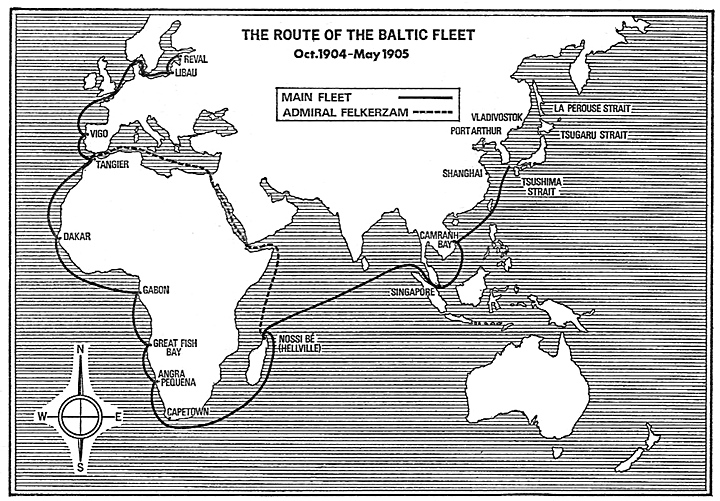
But Russia’s new sphere of influence threatened Japan’s hegemony in the region. So, in 1904, Japan besieged the Russian outpost at Port Arthur…before declaring war. The Russians needed reinforcements to lift the siege, but the nearest were in the Baltic Sea, 18,000 nautical miles away.

The fleet sailed in October and had to travel around Africa as the British barred them from the Suez Canal. From the outset, there was trouble. In the North Sea, a Russian cruiser inexplicably mistook British fishing ships for Japanese torpedo boats and fired on the fishermen. In the chaos, the Russians ended up shooting at each another for over 20 minutes and several Brits were killed in the crossfire. The fleet had to stop afterward to defuse the diplomatic incident.

Seven months later, the fleet neared Japan. Port Arthur had already fallen and the fleet’s new destination, Vladivostok, was much farther north. Rather than go around Japan’s east coast, the weary Russians chose the shortest possible course, through the narrow straits separating Japan and Korea. Japanese spotters reported on Russian progress via radio, ensuring Japan’s navy would be in prime position to stop them. The first shots fired from the Japanese battleships set fire to one Russian ship and badly injured the Russian Admiral. The poorly trained Russian sailors fell into disarray and Russian ships became floating targets for the Japanese gunners. Of the 34 Russian ships which entered the battle only three made it to Vladivostok. The Japanese captured or destroyed nearly the entire fleet at a cost of just three torpedo boats.

4. All Of 1915

New Picture 240

When Germany failed to immediately knock France or England out of World War I, the German high command ordered its troops to dig in on the Western Front. During 1915, the second year of the war, the German military focused exclusively on forcing Russia out of the fight.

Russia had already made some advances in Galicia, but that changed quickly as Germany secretly transferred large amounts of troops and materiel from the Western Front. In April 1915, as if out of nowhere, German artillery lit up the entire Eastern Front. Two-thirds of all German forces were now concentrated on the unsuspecting Russians.

Almost immediately, the Russian army was shattered. In a single engagement in May, an Austro-German offensive took 140,000 prisoners. A passing attempt was made at holding fortified positions around Warsaw, but these too had to be abandoned before the German advance. Thousands of pieces of artillery and millions of rounds were left behind in the retreat, compounding the already rampant shortages of both in the Russian army. With over a million troops lost or prisoners, the only option for the Russians was a massive withdrawal east, razing everything behind them as they went. In the process, Russia conceded all of Poland-Lithuania. Thirteen percent of all Russian subjects fell under German occupation. After 1915, Russia’s combat divisions had been reduced by one third.

The catastrophic losses seemingly stunned Germany even more than Russia. The German military command concluded if Russia wouldn’t surrender after the slaughter of 1915, it never would.

3. The Winter War (1939-1940)

New Picture 241

In 1939, the Soviet Union wanted control of Finland to create a buffer state. Finland wanted very much not to be a part of the Soviet Union. Despite the fact that the Red Army had more soldiers (five million) than the Finns had people (four million), the latter would prove to be a more powerful motivator.

Of course, it didn’t help that, with a strategy apparently based around suicidal overconfidence, the Soviet Union blundered into Finland unprepared for the rigors of prolonged arctic war. Which was strange, because if there were ever generals who should have understood such warfare, you’d think they’d be Russian.

Nevertheless, the Soviets’ black-painted tanks rumbled into Finland, where they made easy targets in the snowy landscape. Many Soviet soldiers marched into battle in khaki or green fatigues without proper cold weather gear.

Finnish defenses amounted to a line of semi-fortified machine-gun nests bisecting the Karelian isthmus, which connects Finland and Russia. The bigger problem for the Soviet army, though, was its reliance on the isolated Finnish roads, where ambushing Soviet columns was like a game of Duck Hunt for Finnish snipers and anti-tank crews. The Soviets couldn’t effectively respond, since they lacked the skis the Finns used to disappear into the wilderness. Routinely outnumbered by insane margins, Finnish soldiers quipped: “So many Russians! Where will we bury them all?” Ultimately, weight of numbers alone overwhelmed the Finns. While Finland suffered some 70,000 casualties, the Soviets were forced to deploy over one million troops, of which 273,000 perished. Not exactly the message Stalin wanted to send at the outset of WWII.

2. Operation Mars (1942)

New Picture 242

One of two major Soviet counter-offensives which followed Stalingrad, Operation Mars was such an incredible disaster that the Soviet Union simply omitted it from subsequent histories.

Like Napoleon, Hitler attempted an invasion of Russia, only to have it grind to a halt thanks to the defenders’ scorched earth tactics and the country’s brutal winter. By the fall of 1942, the Soviets had stabilized the Eastern Front and turned the German lines back from Moscow. However, a protrusion, resembling a dinosaur’s head and neck still jutted out from the German line, threatening Moscow. For Operation Mars Soviet forces were to envelop the Germans, concentrate their force on the narrow neck, and cut the “head” off from German lines.

The Germans could never hope to hold the entire salient against the 700,000-strong army the Soviets had amassed. Rather than maintain a continuous line, they opted to heavily fortify and concentrate their forces at villages and sturdy farmhouses throughout the salient. This would prove a wise choice.

On the day the attack commenced, heavy snowfall and dense fog hampered the Soviet aerial bombardment and prevented their artillery from zeroing in on the German strongholds. In the chaos of the initial fighting, Soviet elements bypassed countless German strongholds entirely. As a result, pockets of resistance became interspersed throughout the Soviet ranks. The counter-attacks from by-passed positions severed supply lines and prevented Soviet field commanders from communicating with one another.

Despite heavy tank losses, Georgy Zhukov, the operation’s planner, continued the fruitless frontal assaults for three weeks in a desperate bid to match the success of the simultaneous Soviet offensive at Stalingrad. As a result, the outnumbered German defenders killed, wounded, or captured 500,000 Soviet soldiers in less than a month, while losing only 40,000 of their own number.

1. The Battle Of Grozny (1994-1995)

New Picture 243

“Give me a unit of paratroopers and we will sort out the Chechens in a couple of hours,” said Russian general, Pavel Grachev.

As it turned out, Russia gave Grachev 38,000 troops and hundreds of tanks to quash the Chechen separatist movement. And it still took him almost two years to end the war (by losing it).

Of the many Russian defeats during the First Chechen War, one of the worst came at Grozny, the de facto Chechen capital. Ever since Russia annexed their country in the 1870s, the Chechens had been longing for independence, so fierce resistance was expected in Grozny. Yet Grachev’s assault was hastily planned - basically, armoured columns, complete with anti-aircraft vehicles to counter the non-existent Chechen air force, were to converge on the city centre from four sides. And that’s about as far as the planning went.

First, the initial air strikes to soften guerrilla resistance accidentally destroyed city roads the Russian tanks needed. An embedded journalist described the advancing Russian forces as “blind kittens” as Russian armoured vehicles raced ahead of their infantry escorts, only to be immobilized and destroyed by Chechen rockets fired from high-rise windows. Most of the Russian soldiers lacked urban warfare training and refused to leave their personnel carriers when Chechen fighters opened fire. The lumbering Russian armour couldn’t manoeuvre in Grozny’s narrow streets and ground to a halt nearly end to end, like “a sausage,” as one Chechen put it. In just hours, Chechens destroyed 400 Russian tanks and armoured vehicles. And as many as 4,000 Russian soldiers may have been killed in the battle.

Top image: A Chechen fighter during the battle for Grozny, January 1995. Credit: Mikhail Evstafiev/Wikimedia Commons.

[Source: Listverse. Edited. Top image added.]