
10 Ancient Settlements That Were Abandoned for Mysterious Reasons
By Debra Kelly, Urban Ghosts Media, 29 September 2014.
Civilizations rise and fall in the blink of a cosmic eye. When we rediscover their ancient settlements decades, generations, or centuries later, sometimes we find that they were abandoned after a terrible disease or famine, or that they were wiped out by war. Other times, we find simply…nothing.
10. Catalhoyuk
Catalhoyuk is one of the most ancient of all settlements ever found. After a few false starts, it’s in the process of being excavated - but that excavation is taking a very, very long time.
In the meantime, archaeologists are fascinated by the sheer wealth of information that the settlement is yielding. To call it a mere settlement is a little misleading, and it’s actually a massive, complex city that was once home to about 10,000 people at any given time and sprawled over about 24 acres. Currently, it’s one of the earliest Neolithic civilizations ever found, and it’s the first that shows a definite departure from the hunter-gatherer lifestyle to a society based on agriculture.
It’s estimated that the society was active for around 1,400 years, and came to an end 7,500 years ago. (For some perspective, that’s about 5,000 years before the Egyptians were just starting to think about building the pyramids.)
Archaeologists working on the dig have discovered some truly amazing things. The society didn’t seem to have much in the way of familial ties, oddly. Houses didn’t have doors like we typically expect to see, instead, they were built into the ground and accessed by ladders that went through the roof. And under the floors…that was a handy place to bury the dead. Each of the city’s 10,000 homes were found to have 30 or so bodies buried beneath them, and that’s also how they’ve been able to determine that family ties weren’t really a big deal. Only a handful of the bodies have been shown to have been related by blood, and instead of biological ties, it’s thought that the more important thing was an organizational system based on tools and trade.
What remains elusive is what happened to the civilization after hundreds of years and hundreds of successful, thriving generations. The team currently excavating the ruins of the city suspects that it might have had something to do with a cold snap that happened around the same time the city was abandoned, but it hasn’t been confirmed that Turkey was vastly impacted by the weather change. It’s also been surmised that their reliance on agriculture has something to do with the demise of the city, but proof has been elusive.
9. Petra
Anyone who’s seen Indiana Jones and the Last Crusade is, of course, familiar with Petra. In the movie, it stands in for the final resting place of the Holy Grail; the truth of the city is much, much more amazing than the movie gives it credit for.

The beautiful carved stone that you see in the movie is actually only the front entrance, and there’s a whole city to go along with it. Visitors and one-time residents pass through a mile-long, 10-foot-wide tunnel beyond the famous sandstone front in order to reach the main part of the city. Once one of the richest, most prosperous cities in the world, Petra was built and occupied about 2,000 years ago, its citizens contemporaries with a flourishing Greek and Roman civilizations. Its architects managed to direct valuable water from the surrounding desert oasis and what valuable rainfall there was into the city; it’s estimated that every day, the massive water systems of Petra carried about 12 million gallons of water into the city for its 20,000 residents.

There’s also massive, many-columned courtyards, open-air theatres, and tombs carved from the solid rock. Their convenient location meant that they were at the crossroads of area trade routes, bringing a wealth of goods into the city from all corners - along with caravans and traders that they allowed to stop in the city - for a price.
Petra’s inhabitants, a group called the Nabateans, defended their city against Alexander the Great and were sacked by the military captains that came after him. They spoke a form of Arabic, left behind almost no written records, were incorporated into the Roman Empire during the period of Pax Romana, and saw the rise of Christianity.
And then they left.
It’s thought that their exodus from their magnificent city had something to do with ever-changing trade routes and dwindling commerce, but nothing’s ever been shown for sure. There’s a distinct lack of personal artefacts in the city, suggesting that whatever reason people had for leaving the city, it was one that allowed them to take their time, collect their belongings, and leave in a rather orderly fashion.
8. Cahokia
A massive civilization, a city that was home to thousands and thousands of people, and one that happened almost overnight in a sudden blossoming of a city that archaeologists have dubbed the “big bang.” Houses, burial mounds, ceremonial and ritual sites…sounds like it’s someplace exotic, right? Maybe the jungles of South America, a forgotten part of the world in southeast Asia, perhaps?
It’s in Illinois, near the intersection of Routes I-55 and 70.
Cahokia is part of a bizarrely, massively overlooked piece of very, very early American history, only brought to the attention of archaeologists when Dwight D. Eisenhower wanted to build part of his famous highway system through it. Several other nearby sites dating from the same time period have been destroyed, but Cahokia is now a part of an archaeological preserve as massive as it is.

Cahokia is somewhat misleading, as we’re not actually sure what the people who lived there called themselves. We’ve found ceremonial burial mounds, including one that has a bigger footprint than the largest of Egypt’s pyramids. We know little about them - we think that the suddenly blossoming city happened not long after corn was adopted in its full importance, and we know that this particular settlement was many, many times larger than surrounding settlements. Archaeologists argue over how big the settlement was, with population estimates ranging from 10,000 to 15,000 for the main hub of the city, with another 30,000ish people settling in what was essentially the suburbs.
It was established around 1050 with surprising speed, and it was completely abandoned by the time Columbus made landfall in the New World. The city shows signs of being rebuilt several times between 1100 and 1275, but beyond that…no one knows why so many people left. Climate change and crop failure have been put forward as guesses as to what happened to the city’s population, but at the end of the day, no one really knows.
7. Gonur
The remains of Gonur sit in what was long thought to be the wasteland of Turkmenistan; with the excavation of this 4,000 year old city, it’s been found that’s not the case.
Gonur flourished for only a couple hundred years, and in its heyday, it was impressive. There were thoughtfully laid out streets with temples for the living and elaborate, well-cared-for cemeteries for the dead. There was an extensive irrigation system and canals channelling water into the city’s fields and orchards, and the citizens enjoyed a highly profitable trade from cultures to their east and to their west. Their city was protected by high, thick walls, and inside those walls, archaeologists have found treasure hoards of gold and jewellery, samples of exquisite metalworking and massive water basins.

Then, they disappeared. Excavations have revealed that while some of the city shows signs of fire damage, it certainly wasn’t extensive enough to cause the large-scale abandonment of the city. It’s not even known whether or not the city’s residents travelled after leaving their city, as it’s still up for debate on how much of their culture - including building techniques - spread throughout the area.
6. Great Zimbabwe
Great Zimbabwe was already in ruins by the time it was discovered by the Portuguese in the 16th century. Although the area was occupied back to the 3rd century, the city itself was only built an estimated 100 to 300 years prior to its Portuguese discovery; it was the largest stone ruins south of the Sahara Desert. Covering 1,800 acres and home to an estimated 18,000 people at its height, there are more questions than answers associated with the ruins. The mystique of the place wasn’t helped by early explorers who insisted that it had been built not by native people but by either white settlers or Arab travellers; it’s not known how much information about the civilization was suppressed or destroyed in the process of excavating the ruins in order to keep up the ruse.
The settlement was carefully positioned to take advantage of the landscape; it was a place for raising cattle and growing grains, and it was even out of the reach of the potentially deadly tsetse fly, too high for them to be a nuisance. The raw stone needed for buildings was nearby, and its height provided a valuable vantage point. Signs of trade have been found, dishes and pottery from China lying alongside the gold, silver and ivory of kings.

Sometime between the 15th and 16th centuries, the city was abandoned. It’s thought that there was a drastic shift in trade routes, and perhaps that had something to do with the people turning their backs on the city. Other theories include the population growing too large to be supported by the surrounding countryside, which forces historians and archaeologists to ask the question of why it had been built there in the first place? Certainly it could sustain some civilization, but growth was limited, and the land around the city would have suffered from overuse very, very quickly. It’s also been suggested that scarcity of salt was a driving factor in what made the city’s people leave, but it’s never been confirmed just how they came to power and why they left in such a short time.
5. Palenque
A fairly recently discovered ruined city lying in the protective embrace of the Mexican jungles, Palenque is one of the most breathtaking of all Mayan ruins. Known for its intricate carvings and as the resting place of Pakal the Great, the city was once a thriving metropolis between 500 and 700 AD and was home to somewhere around 6,000 people at its height.
The site was only uncovered in the 1950s, and since then it’s been opened to tourists. Now, visitors can get a look for themselves at the massive stone structures, decorated with beautiful carvings, that were once the stomping grounds for one of the Maya’s greatest kings. So intricate - and so cryptic - are the carvings that some people look at them as proof that the builders had help from a rather questionable source - extraterrestrials. Carvings depicting bizarre symbols have alternately been interpreted as astrological or religious symbols, or symbolism implying the use of a space ship by the deceased on his way to the next world.

Now a World Heritage Site, only a portion of Palenque’s estimated 1,500 structures have been excavated. Among those that have been thoroughly explored include Pakal the Great’s tomb, and the Temple of the Red Queen. The latter yielded the knowledge that the Maya painted the bodies of their deceased nobility a bright red - the same red that would have been used to paint many of the buildings. For the Maya, red was the colour of blood and the colour of life.
Palenque was abandoned by 1000, left to be enveloped by the jungle and preserved by the same wilds that were once cut back from it. There’s plenty of theories about why people left the city, from famine caused by drought to a shift in political power. The last date that we know the city was occupied was November 17, 799 - the date carved on a vase.
4. Skara Brae
This Neolithic village in the upper reaches of Scotland was abandoned around 2,500 BC. It’s about 5,000 years old, and unlike the others on this list, it isn’t a massive, sprawling city complex that was home to tens of thousands of people. There are only 10 houses, and it was probably home to only about 100 people at any given time. But its uniquely well-preserved state provides an invaluable look into our Neolithic lifestyle.
The stone houses had stone beds and stone dressers, and were connected by alleyways that suggest a very close, communal relationship between the home’s occupants. Archaeologists have found stone tools as well as pieces of pottery and jewellery, although much of their day-to-day life remains a mystery. While most of the houses are very clearly homes that were used by numerous generations, there are a couple mysterious buildings.
The so-called “House Eight” is devoid of all the stone furniture that’s found in the other houses, but what it does have is a number of small recesses built into the walls and patterns carved into the walls - no one knows what it was really used for, though some think it may have been a workshop.
And “House Seven” is equally as strange, the only house to contain the remains of two adult women, along with jewellery. It was also the only house to show signs of a door that latched and locked from the outside, and dating the contents of the room has suggested that it was the last to be abandoned.
And just why Skara Brae was abandoned has long been up for debate. Some suggest that the storms that rage off the coast of the settlement’s island were encroaching on the houses, to the point where the soil was unable to support life and the settlements themselves were deluged with sand. Nothing left behind points to a sudden, hurried abandonment or a gradual one, and it’s unlikely to ever be known.
3. Gobekli Tepe
This ancient city in Turkey truly brings new meaning to the word “ancient”. It’s approximately 11,000 years old (that’s about 6,000 years older than Stonehenge), and it’s thought to be one - if not the - earliest example of an organized, permanent settlement built on the cusp between mankind’s migration between a hunter-gatherer society and an agricultural one. It’s most notable for its implications that we’ve gotten the whole “evolution into an agricultural society” thing all wrong. It’s long been thought that the development of agriculture gave civilizations the luxury of staying in one place for a long period of time - opening the door for ancient people to start building things like temples and massive, massive structures. Findings at Gobekli Tepe, however, suggest that the structures came first, and it was out of the necessity of supporting large teams of builders and their families that people finally began farming for food.
Gobekli Tepe is also notable for its rather bizarre stages of abandonment. Excavations have discovered that there were a series of enclosures that were built, used, then purposely covered with dirt and completely buried. Other structures were built on top of that, repeating the cycle over and over again. Structures got smaller and smaller, until the entire thing as abandoned around 8000 BC.

Religious symbolism is all over the ancient ruins, most noticeably in carvings of the animals whose bones were also found at the site. Not long before the original construction of Gobekli Tepe, a massive climate change struck the earth - thought to be a parting gift from a comet that disintegrated over the planet’s atmosphere. Those now digging at Gobekli Tepe suspect that the massive project was originally undertaken in hope of protecting the earth from another catastrophe - and that as attitudes shifted (and perhaps as the memory of the event drifted farther and farther from recent memory), the pillars and enclosures built for protection simply lost their meaning, and people moved off in search of more fruitful land, but no one knows for sure.
2. Amaru Muru
The story of Amaru Muru is as much legend as it is history, partially because there’s absolutely no traces of any sort of abandoned city or settlement, save a massive, mysterious doorway. According to conventional archaeological theory, the 23-square-foot doorway with the 6-foot alcove that’s chiselled into the side of a huge, flat rock on the border of Peru and Bolivia was probably an abandoned Incan building project.
Other theories are much, much more fun:
Local residents call it the Gate of the Gods, and many refuse to go near it. There’s stories of mysterious lights appearing in the doorway, and of people who have gotten too close to it and disappeared. Whatever’s beyond the doorway is said to have a particular fondness - or appetite - for children. Older legends say that it’s a doorway that only opens for the greatest of heroes, when it’s time for them to pass on from the land of the living to the land of their gods, and other legends say that it opens for anyone with the wisdom to know how to access it. The name Amaru Muru is said to be that of an Incan priest who was in possession of a sacred Incan relic and fleeing from Spanish pursuers. The gate appeared and opened for him, keeping the relic safe.
Legends aside, there’s absolutely no real evidence of who built - or started building - the project and why it was abandoned. There are said to be six other very similar gates that, when connected, form an intersection at Amaru Muru. Supposedly the site of glowing spheres, bright lights, and mysterious images, how little we know about it is absolutely obscured by legend and myth.
1. Gedi Ruins
According to one of the earliest archaeologists to work on excavating the ruined city of Gedi, he always had the unnerving feeling that something was watching him from the surrounding jungles. It wasn’t watching out of malice or benevolence, he said, but he had the eerie feeling that it was simply watching what it knew would inevitably happen…and it was waiting.
Buried deep in the Kenyan jungle, Gedi was only really discovered in 1927, and it was made a protected national park in 1948. Dating back to the 13th century, it’s a masterful display of architecture with houses, tombs, a mosque tiled in coral and even a royal palace. The palace itself sprawls over an entire acre, complete with plazas, tunnels, and secret rooms thought to be used for storing valuables. Buildings were fitted with indoor plumbing, and there was an elaborate well and cistern system. Many of the homes and buildings were clearly designed with comfort in mind; sunken rooms and thick earthen walls were made to keep the heat out and the cool, comfortable air inside.
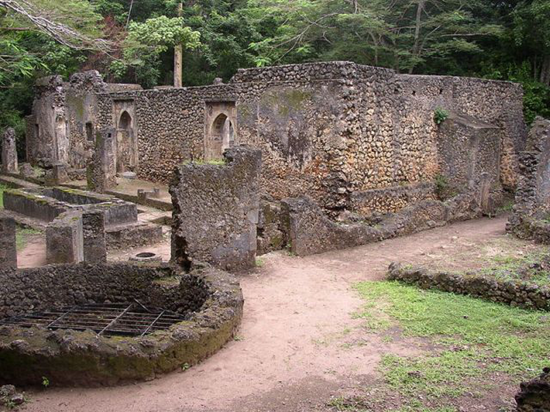
Before it was abandoned in the early 16th century, Gedi was a hotspot for trade. A number of valuables have been found among the ruins, from a Ming vase to ironwork from Spain and beads from Italy. Home to somewhere around 2,500 people, theories on why the city was abandoned range from an attack from neighbouring people or from Portuguese explorers, or a water-borne illness that spread through the population. Safe houses and treasure hoards that had once been used to store valuables were found emptied but undamaged, leading to the assumption that whatever happened, residents left of their own accord.


![wps15C5.tmp[6]](https://blogger.googleusercontent.com/img/b/R29vZ2xl/AVvXsEgyWezNLFsSr46CSLLKg6I-H3XV38Jvq_TdA7lPSyf7Q8WNiMydscepgJSlNRnyBVMDAQOc0192bvfvv-W1aUiUdPnWjFQDCo4mcXYUJ9nvobGWF3faS8Jtg-Y2dNxcsMCioKUaQIpv59RO/s1600-h/wps15C5.tmp%25255B6%25255D%25255B4%25255D.png "wps15C5.tmp[6]")


