Pages

Wednesday, 3 December 2014

10 SELECT NATURE ARCHITECTURES 2014


wps47C1.tmp
Nature Architecture 2014: 10 Select Cabins, Treehouses and Hideaways Around the World
By Seamus Payne,
The Coolist, 2 December 2014.

They say this generation is drawn to the city. In Brooklyn and Portland, Austin and Oklahoma City, we’re moving to the city for opportunity, for community and the great urban experience. But this drive to the city does not detract from our fascination with the natural world. The built environment has its allure, but the call of nature never ceases. It’s always there, always waiting.

To celebrate our natural, primal drive to the wilderness, we’ve selected our 10 favourite works of nature architecture from 2014. These cabins, treehouses and hideaways celebrate the great outdoors, the yin to our urban yang. Join us below.

1. The Sustainability Treehouse - a Green Educational Escape in West Virginia

wpsBB8A.tmp
wps2E6A.tmp

A tall, technological marvel of a treehouse rises above the canopy at Summit Bechtel Reserve in Glen Jean, West Virginia. The Sustainability Treehouse reaches over 100 feet above the forest floor, providing an educational experience to visitors as well as an unparalleled view. It is one of the most remarkable works of treehouse architecture created in this young decade, a modern monument by Mithun architects.

2. Glass Conservatory House is a Crystal Castle near Mexico City

wpsEAA6.tmp
wps6CDE.tmp

A rural retreat in the forests north of Mexico City is home to a new glass conservatory house. It is an extension of an existing living space, one that uses an abandoned tennis court as its foundation. The Glass Conservatory House by Lorenzo Alvarez Arquitectos is a bright, airy living space that comprises five rooms under a clear glass shell. It is built with stone, wood, steel and glass, taking the shape of a conservatory for plants and people alike.

3. Delta Cabin by AToT is a Towering Tiny House near Buenos Aires Argentina

wpsF07D.tmp
wps6773.tmp

This towering tiny house overlooks a peaceful riverside retreat near Buenos Aires, Argentina. The Delta Cabin by AToT is raised above the ground on a series of concrete pillars that provide a panoramic view of the surrounding scenery. Should the river swell, these stilts will provide flood safety to boot. It’s designed to be both functional and fun, a much needed rural escape from the bustle of Buenos Aires.

4. Solo House by Pezo von Ellrichshausen Rises over Spanish Forest

wpsF5D9.tmp
wps17B5.tmp

A concrete cubic structure rises above the forest in Cretas, Spain, the latest work by Pezo von Ellrichshausen. This rare and elegant modern home perches above vineyards and olive groves in the rolling Spanish landscape, looking up at bald, rocky mountains beyond. Its elevation presents an unparalleled connection with the natural environment around it, presenting sweeping views of the land in every direction. It is a contemporary concrete gem in a green rough of pines, olives and the endless Spanish brush.

5. Glass Garden Shed is the Ultimate Forest Bedroom

wpsE874.tmp
wps176F.tmp

Deep in the wilderness of Finland, a tiny glass cottage overlooks a peaceful lake and the forest beyond. The Glass Garden Shed by Ville Hara and Linda Bergroth is a dream by design. It features a pitched glass roof and three glass walls that provide an intimate connection with the environment around it. While its shape is traditional, inspired by the garden sheds of old, its material and metaphor make this a decidedly contemporary cabin. [Read more: 10 Contemporary Cabins from Around the World]

6. Kew Gardens’ Sky-High Walkway Overlooks a London Park

wpsC610.tmp
wpsC754.tmp

It’s one thing to look up and admire the trees around you, but it’s something else to walk amongst them 59 feet up in the air. Kew Gardens Treetop Walkway is a unique experience that not only offers beautiful view of the surrounding landscape, but also teaches people about the vital role that trees serve on our planet. Designed by Marks Barfield Architects, they took great care to blend the walkway amongst the trees and reduce its overall environmental impact.

7. Forest Cabin by Bernd Riegger Offers Sanctuary in the Wild

wps1011.tmp
wps4A67.tmp

Nestled deep in the forests of Austria, architect Bernd Riegger has constructed a beautiful minimalist cabin that offers scientists and students alike a chance to get up close and personal with mother nature. The House for Forest Owls features a timber structure that manages to blend effortlessly with its surroundings, despite a somewhat complex external facade. Apart from a place where people can observe the forest and its wildlife, the one-room structure is also the perfect place to escape from sudden thunderstorms and inclement weather while out walking in the woods.

8. Trakke Jero Yurt is a 21st Century Cabin for Cool Camping

wps7046.tmp
wps15BE.tmp

Yurts are a type of portable dwelling that have been used by nomadic people in Central Asia for at least 3000 years, but it seems the West is finally catching on to their unique charm and functionality. Trakke, a Scottish company that makes products for the everyday adventurer, has released a lightweight, 21st century version of the movable home that’s perfect for camping or maybe even just having someone stay in the back garden. Conceived with the help of designer and adventurer Uula Jero, say hello to the Trakke Jero Yurt.

9. Lake Cabin by Fam Architekti is a Czech Forest Retreat

wps511.tmp
wpsED3F.tmp

Located a short drive from Prague, FAM Architekti and Feilden+Mawson have designed a lake cabin that allows the owner to indulge their yachting passion - or gaze out over uninterrupted views of the lake and surrounding pine forest. The conversion follows the same outline as the original, and manages to fit everything in one room, with a sleeping area in the loft, and a kitchen sectioned off from the main living space. Simplicity is the name of the game, and this house seems to be winning.

10. Baumraum Reveals Two New Treehouses

wps4EF3.tmp
wps3954.tmp

The masters of treehouse architecture, Baumraum Treehouses of Bremen, Germany, has revealed two new elevated escapes for fans of forest living. The Baumraum Treehouse Solling rises 12-feet over a pond in Uslar, Germany, while the Baumraum Treehouse Djuren is an elliptical unit standing 17-feet over the forest floor. Together, they are modern in design, playful in spirit and sustainable in construction, a continuation of the great design efforts from Baumraum over the years.

Top image: Baumraum Treehouse. Credit: Baumraum.

[Source: The Coolist. Edited. Some links added.]

6 BEST SLEEPING PADS


wps94A4.tmp
Mobile Beds: The 6 Best Sleeping Pads
By M. W. Byrne,
Hi Consumption, 1 December 2014.

A night out under the prairie stars is the perfect way to reconnect with the roots of men of old. The truth about men of old, however, was that their joints ached, they had chronic knee problems, and would spend half of their nights digging rocks out of their back because the human body wasn’t meant to lie on the hard ground. To keep your body from becoming a prison of pain, if you’re planning an excursion into the wilderness, you need to get a decent camping pad or sleeping pad so you don’t suffer as your ancestors did.

Picking a good sleeping pad is primarily about how it is going to be used. If you’re going to be backpacking with it, it needs to be light enough that you can lug it up a mountain without going into traction but sufficiently supportive that it gives you a good night’s rest without every pebble becoming embedded in your spine. Campers can add a little more heft since they’re gear is going to be lugged around by their vehicle, and therefore get more comfort. You can go with a full-blown air mattress, but you’re often going to be just as comfortable with a foam camping mat or any of the other 6 best sleeping pads out there.

1. ALPS Mountaineering

wps4826.tmp

Pro: Extremely lightweight
Con: Small sizes very diminutive

Cliffside: The Mountaineering line by ALPS wasn’t really made for camping, they were made when you plan on bivouacking halfway up a cliff on a ridge, your ice axes dangling over the precipice as you slumber. The self-inflating, ultra-light body works best for when it isn’t enough to keep weight down, you need to keep it as light as possible so as not to add any strain to your guidelines as you hunt for toeholds miles above the yawning chasm. The body is made of polyurethane in an open cell format with a comfortable ripstop top and polyester taffeta bottom that won’t rip or tear, and also will give you a good grip so you won’t have to worry about it sliding away. The valves are made of brass that won’t corrode even if you find yourself stuck in some harsh winter weather or covered in snow. You’ll likely want to buy the longer sizes, since the small ones are made mostly for children or leprechauns. [Purchase: US$14+]

2. Thermarest Z-Lite SOL Sleeping Pad

wps7EA4.tmp

Pro: Thermal reflection improves heat
Con: Limited padding

True Minimalist: The Thermarest Z-Lite SOL is the backup sleeping pad for car campers, backpackers, mountaineers, and anyone who wants a simple, affordable, and reliable camping mat. These can be found in travel backpacks and motorcycle saddle bags alike. It folds up like a windshield reflector making it easy to carry and easy to store. The key to the SOL is the unique reflective silver barrier that bounces your body heat back to you for a warmer night’s sleep, even in harsh conditions. The closed cell design is durable and no inflation means there is no chance it will spring a leak. On the other hand, since it is so small, you can expect to feel a few more lumps and bumps underneath you during the night. You can try the Therm-a-Rest RidgeRest SOLite for a thicker option that isn’t quite as portable. [Purchase: US$35+]

3. Klymit Inertia X Frame

wpsD81F.tmp

Pro: Extremely lightweight
Con: Minimal padding

Light and Tactical: The Inertia X Frame is made for the ultra serious, ultralight backpacker or camper. There are no frills to be found on this battle-hardened beast. It is just over 11 ounces and when fully compacted, it smaller than a can of soda. The exterior is rugged polyester meant to take abuse. The glove design is meant to hit your body at multiple key points to give you only as much support as you need. The tiny size can be packed into the interior of a mummy bag so that it retains even more warmth if being used in the dead of winter. This has been tested by Delta team for use during field ops or recon missions. The gaps are made to cut down on weight and improve loft and insulation to create pockets of air, even outside of the actual tubing. These help with overall airflow so your body is evenly warmed. [Purchase: US$55]

4. Big Agnes Q-Core

wps37C4.tmp

Pro: Works in cold temperatures
Con: Too heavy for lightweight backpacking

Loadable Luxury: You’ve probably never wanted to sleep on something called “Big Agnes” but once you try it out, you’re not likely to want to sleep anywhere else. At 3.5 inches thick when inflated, the Q-Core will give you more than enough padding to keep the ground where it belongs: far away from you. With alternating I-Beams inside the mattress itself, this gives you great support that also won’t slide around. There are baffles laid out both horizontally and vertically so even restless sleepers will have a hard time sliding away while the evenly distributed air will work even for side sleepers who dig down into their mattress. It’s rated for as low as 15 degrees, which will give you plenty of camping even when the mercury hits bottom and your less rugged friends are hiding in their dens until hibernation season passes. Silver filaments woven into the fabric reflect heat and prevent warm air from escaping. [Purchase: US$90+]

5. Therm-A-Rest NeoAir Dream Mattress

wps8E51.tmp

Pro: Extremely comfortable
Con: Expensive

Happy Camper: The NeoAir Dream certainly blurs the line between what is technically a sleeping pad and what is an air mattress. It’s better for the standard camper who can’t quite figure out how to fit a four poster bed into the car. The body holds a full inch of memory foam on the top and a standard NeoAir mattress inside that can be taken out when you want to keep bulk at a minimum or take this off the beaten path. The price might be a little daunting, but anyone who needs something with a little more plush that can give better orthopaedic support for longer days on the trail, on the road, or in the bush, this will provide it. Two of these can also be snapped together for those couples who just can’t spend the night apart, or pals who need to conserve warmth because they were caught in a blizzard. At nearly 4 pounds and offering 4 inches of cloud support, there’s little to complain about. [Purchase: US$150]

6. Sea to Summit Comfort Plus

wpsE9B1.tmp

Pro: Extremely supportive
Con: Narrow and slick

Everywhere, Man: The Sea to Summit is aptly named. The intent of these Comfort Plus pads are to be capable of going wherever you do and give you a supportive night sleep whether on the beach or buried up to the eyeballs in powder. They only inflate to about 2.5 inches, but the design makes the most of this space with 600 air sprung cells that work like a series of tiny springs to keep air where you need it and increase body contact with the sleeping pad so that when fully inflated, you can sleep on the hardest of surfaces without uneven buttressing. Can work below freezing, through a combination of Thermolite insulation and heat-reflective fabrics. The body runs a little narrow and the nylon shell can be slippery which might give tossers and turners pause, but paying for the wider models can usually alleviate this discomfort. [Purchase: US$239]

[Source: Hi Consumption. Edited. Some links added.]

10 FUTURE JOBS IN HEALTH CARE


wpsF785.tmp
10 Future Jobs in Health Care
By Melanie Radzicki McManus,
How Stuff Works,  21 November 2014.

People have been saying it for years: If you want a secure job, go into health care. Why? With people living longer, medical needs will rise accordingly. According to United Nations projections, the number of people in the world aged 60 and older is expected to double by 2050, from 841 million in 2013 to more than 2 billion! Those 2 billion folks will need a lot of help from physicians, dentists, physical therapists, pharmacists and surgeons.

But if being a dentist or physical therapist isn't your calling, don't dismiss the health care field just yet. In the future, it will be about a lot more than front-line doctors and nurses. Health care will incorporate a lot of new technologies, many just now in their infancy. From electronic records to robotic surgeries to prosthetics you can move with your mind, nothing's off the table. That means loads of new jobs will be coming on stream, as well as current health care occupations you may never have heard of. Here are 10 jobs of the future you should explore right now.

10. Bioinformatician

wps804E.tmp
Bioinformaticians gather and analyze data from a range of biological fields.

If you enjoy both science and statistics, bioinformatics could be the field for you. Bioinformaticians gather and analyze data from a range of biological fields including population biology, genetics and pharmaceutical development. The analysis is performed via mathematical models and dynamic simulations created by the bioinformatician, who uses sophisticated computer software and the Internet as her main tools. In practical terms, this means a bioinformatician might design a clinical trial for a new drug or program a statistical model for population growth. Or maybe she'll create 3-D models of DNA and protein sequences for analysis.

Bioinformaticians (aka biostatisticians, biometricians and computational biologists) have been around a while; one of their main successes to date was analyzing genome sequence data, mainly that from the human genome project, which started in 1990 and was completed in 2003. Many expect their numbers to grow in the future, as these professionals tackle areas like individualized drug therapies. Pharmaceutical companies, incidentally, are a major employer of bioinformaticians [sources: Bayat, Education Portal].

9. Cryopreservation Specialist

wps20B5.tmp
A scientist cryogenically stores samples of DNA.

Who can forget all of the jokes that have been made over the folks choosing to freeze themselves after death (or just their brain, to save money) in the hope that science will someday be able to cure whatever killed them, then bring them back to life? Even favourite pets are being put in the deep freeze for this purpose. That's where cryopreservation comes in.

Cryopreservation is the art of freezing something to preserve it for the future, specifically excised tissues or organs. And a cryopreservation specialist is the person doing the freezing. The most common use for cryopreservation today is probably freezing embryos for use in in vitro fertilization (IVF), and chilling sperm and ova for those who are ill and may lose the ability to naturally reproduce.

While bringing frozen people back to life isn't on most scientists' minds - at least not yet - there is hope that one day more complex tissues and organs will be able to be successfully frozen and thawed when ready for use. Transplant organs have a shelf life of just a day or two and may go to waste if a recipient is not immediately available. Imagine if these organs could be preserved! Scientists have been hard at work on this for years. And once they are successful, cryopreservation specialists will be hot commodities [source: Cossins].

8. Custom Implant Organ Designer

wps8973.tmp
Consultant surgeon Andrew Ready and his team conduct a live donor kidney transplant at the Queen Elizabeth Hospital in Birmingham, England. Organs have a short shelf-life but designing custom implants could increase their lifespan.

As of Sept. 8, 2014, there were 123,175 Americans waiting for transplants; 101,170 of these patients needed a kidney transplant [source: National Kidney Foundation]. But even if they receive a kidney tomorrow, it doesn't mean their worries are over. Seven percent of transplant recipients' kidneys fail within the first year, and 17 percent lose their new organ within three. The 10-year success rate is just 54 percent [source: Tushla]. The most common reason for a kidney transplant to fail - or that of any transplanted organ - is rejection, as the body's immune system fights what it perceives as a harmful, foreign body.

Scientists hope that in the future, custom transplantable organs will be available - organs designed specifically for your body, probably using your own cells. These cells (suspended in gel) would either be used as the "ink" for a 3-D-type printer or they would be poured straight into an injection mould. Custom organs would alleviate long transplant waiting lists, plus combat the all-too-frequent organ rejection. Medical researchers are currently hard at work trying to grow everything from kidneys to ears to help people with failed organs or disfiguring injuries. Spinal discs have already been successfully replaced in rats; surely humans can't be far behind. As successes mount, the job of custom implant organ designers will be an important one [source: Sofge].

7. End-of-life Therapist

wpsF964.tmp
End-of-life specialists have backgrounds in social work, palliative care, education and human psychology.

As people live longer, they've got more time to ponder - and plan for - their last few years, or even decades, on Earth. That's where an end-of-life therapist comes in handy. Armed with backgrounds in fields like social work, palliative care, education and human psychology, these professionals will work with older people to prepare for their final life stage. Issues discussed may include how to ensure the eventual dying process is as smooth and painless as possible; how to best prepare yourself emotionally for this phase and the possible legal issues that may occur with advanced age.

End-of-life therapists also work with clients' families to help them through the process as well. Skilled therapists will not only have appropriate educational backgrounds, but also will be people who can discuss such sensitive information both compassionately and dispassionately [source: Canadian Scholarship Trust Plan].

Today many of these issues are being discussed with older people, but it's often through a rather disjointed process. An end-of-life therapist, or someone practicing end-of-life care, will bring everything together - sort of like one-stop shopping.

6. Genetic Counsellor

wps77BD.tmp
Genetic counsellors are becoming more prevalent as genetic testing has increased.

Genetic counsellors work with physicians and other health care professionals to help patients understand inherited conditions, genetic disorders and birth defects affecting themselves or their families. They're also available to objectively discuss sensitive, emotional information. For example, if genetic testing shows that you have the breast cancer gene, should you have a double mastectomy like Angelina Jolie or wait a few years and see if anything happens? Which genetic tests, if any, should you perform on your unborn child? Genetic counsellors can help you sort these issues out.

Although genetic counsellors have been around for a while - the National Society of Genetic Counsellors was founded in 1979 - relatively few people used their services initially, as genetic testing was in its infancy. Now it's not. Much more refined and complex tests are out there, with many more in development that will help predict innumerable markers and conditions. As the tests grow in number, so will the number of genetic counsellors. You need a master's degree in genetic counselling to get into the field [sources: Get Degrees, The American Society of Human Genetics].

5. Health Specialties Professor

wpsDFA0.tmp
Who's going to train the people in all these new careers? A health specialties professor.

It's an obvious question, yet one few people think to ask. If there will be so many more innovative health care jobs in the future, who will be training all of these professionals? A health specialties professor, for one. This person will train pharmacists, nurses, physical therapists and dentists - all fields in great demand in the future - as well as cryopreservation specialists and bioinformaticians. Sometimes the professors are practicing physicians, but they may also be researchers or teachers. Because health care is a rapidly changing field, these professors must constantly keep on top of the changes in their fields of specialization. Sometimes, they may conduct their own research, too.

Because of the importance of this field, pay for health specialties professors is on the high end compared to other post-secondary educators - more than US$100,000 is typical. Job growth for health specialties professors is projected to be 36.1 percent between 2014 and 2024 [source: Rapacon].

4. Health Care Navigator

wps4550.tmp
Affordable Care Act navigator Nini Hadwen (R) speaks with Jorge Hernandez (L) and Marta Aguirre as they shop for health insurance during a navigation session put on by the Epilepsy Foundation Florida.

Sometimes it seems easier and less stressful to be the patient than the caretaker. If you're ill, people scurry around taking care of you. But if you're the patient's loved one, it's up to you to make sure his care goes smoothly and seamlessly, and that there are no insurance or legal entanglements. That's not an easy task, as hospitals and medical centres are complex institutions. That's when you turn to a health care navigator.

A health care navigator calmly and compassionately guides you through the often-complicated medical system, answering questions like, "Who should I speak with about my loved one's lack of an appetite?" "Will we need special medical equipment or home health care when he comes home?" "How do I arrange that, and will insurance pay?" Current navigators are often former nurses, but future health care navigators will have a good grounding in both health care systems and social work or related fields [source: Canadian Scholarship Trust Plan].

Health care navigators are also being used to help consumers figure out the U.S. health insurance marketplace (which came into effect as part of the Affordable Care Act or "Obamacare") and decide which health plan makes the most sense to buy. These navigators come from a variety of backgrounds, but they have to be certified by completing a training program and maintaining continuing education credits [source: Centres for Medicare and Medicaid Services].

3. Medical Scribe

wpsC241.tmp
A medical scribe enters a patient's medical information into an electronic health record.

Electronic health records (EHRs) seem like a huge time-saver for physicians. No more note-taking during visits and dictating patient information afterward. Actually, EHRs are more time-consuming, as doctors are required to enter more detailed information into the computer system. This translates into less time with patients, which is never a good thing. Enter the medical scribe, a new and fast-growing health care position [source: Scribe America].

A medical scribe joins the medical provider in the exam room and enter the patient's medical information into the EHR. They also pull info for providers in preparation for upcoming appointments and, if the provider requests, may respond to various messages and research information [source: American Health Information Management Association]. Because the position provides an intimate look into the medical field and offers the chance for collaboration with physicians, some medical schools in the U.S. are suggesting future med school students first work a bit as medical scribes to obtain some pertinent background and experience. However, Scribe America says the minimum qualification for the job is a high school diploma; a college degree, ability to type and use a computer and experience with medical terminology are all preferred.

2. Medical Roboticist

wps2D90.tmp
A hospital in Spain uses a medical robot during a prostate cancer surgery.

Meet HeartLander. It's a tiny robot that enters someone's chest through a small incision below the sternum, or breast bone, motors along the heart's surface to a specific area, then administers whatever therapy is prescribed by the physician. HeartLander is controlled by a physician, but it was created by a medical roboticist. Medical roboticists create any number of intelligent tools that can be used by medical professionals, or with them, to do everything from perform surgeries to diagnose ailments [source: Carnegie Mellon University].

Besides surgical robots like HeartLander, medical roboticists create devices like the DEKA Arm, a mind-controlled prosthetic arm that can perform such fine-motor-skill tasks as zipping a zipper and picking up an egg without breaking it [source: D'Orazio]. And patents are pending on ever-more futuristic robots for the health care field, such as a robotic companion for the elderly and infirm, a micro-robot you swallow so it can photograph your innards and a neurosurgery robot that affixes directly to your skull [source: Ekinci].

Medical roboticists generally have backgrounds in engineering or computer science, as well as some medical training.

1. Telesurgeon

wpsA8CB.tmp
A hospital in France performs a laparoscopic surgery. In the future, more of these could be done remotely, even from another country.

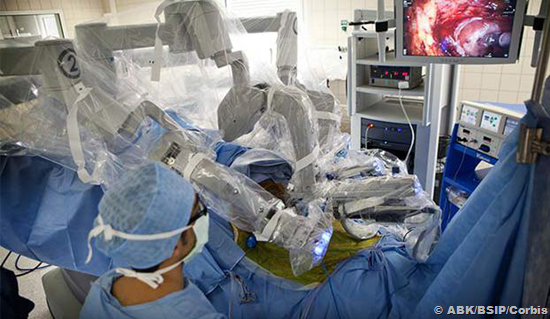
Telesurgeons are physicians who operate on their patients from a remote site. Unlike computer-assisted surgery, where surgeons direct operations from a computer console a few feet from the patient and can see what they're doing in real time, a telesurgeon's patient could be in a hospital across town, in another city or even in another country. The first completely remote surgery - a gallbladder removal performed from New York City on a patient in France - was done in 2001 [source: Sherk].

Although telesurgery isn't yet common in 2014, hopes are high for the future. When systems are perfected and economically feasible, telesurgeons may be treating injured soldiers on or near battlefields, for example, or astronauts in space. Telesurgery will also be a great boon for those living in rural areas or developing countries, where skilled surgeons are in short supply [source: Sherk]. Considering becoming a telesurgeon? Keep in mind your competition will be global. Surgeons from countries around the world will be able to bid on surgeries, since location will no longer matter. Hopefully, that will translate into more competent, highly skilled physicians [source: Polland].

Author's Note: I've never been interested in a health care occupation (I'm too squeamish), but I think even I could enjoy some of the jobs coming down the pike, like health care navigator. Perhaps I have a new calling...

Related Articles:

Article Sources:
1. American Health Information Management Association. "Using Medical Scribes in a Physician Practice." November 2012. (Nov. 12, 2014)
2. Bayat, Ardeshir. "Bioinformatics." National Institutes of Health. April 27, 2002. (Nov. 11, 2014)
3. Bureau of Labour Statistics. "Occupational Employment and Wages, May 2013: 25-1071 Health Specialties Teachers, Post-Secondary." (Nov. 13, 2014)
4. Bureau of Labour Statistics. "Occupational Employment and Wages, May 2013: 25-1122 Communications Teachers, Post-Secondary." (Nov. 13, 2014)
5. Canadian Scholarship Trust Plan. "End of Life Therapist." (Nov. 7, 2014)
6. Canadian Scholarship Trust Plan. "Healthcare Navigator." (Nov. 7, 2014)
7. Carnegie Mellon University. "Medical Robotics." (Nov. 12, 2014)
8. Cossins, Daniel. "Will we ever...cryopreserve our organs?" BBC. Feb. 24, 2014. (Nov. 11, 2014)
9. Diana, Alison. "12 Advances In Medical Robotics." Information Week. Jan. 27, 2011. (Nov. 7, 2014)
10. D'Orazio, Dante. "Mind-controlled prosthetic arm from Segway inventor gets FDA approval." The Verge. May 10, 2014. (Nov. 12, 2014)
11. Education Portal. "Bioinformatician: Job Description, Duties and Requirements." (Nov. 7, 2014)
12. Ekinci, Onat. "Healthcare Robotics: Patently Incredible Inventions." Information Week. Sept. 12, 2013. (Nov. 12, 2014)
13. Eveleth, Rose. "Cryopreservation: 'I freeze people to cheat death.'" BBC. Aug. 22, 2014. (Nov. 7, 2014)
14. Get Degrees. "Top 60 Jobs That Will Rock the Future." (Nov. 7, 2014)
15. National Kidney Foundation. "Organ Donation and Transplantation Statistics." Sept. 8, 2014. (Nov. 11, 2014)
16. Polland, Jennifer. "Get Ready For The Next Big Steps In Robotic Surgery." Business Insider. Aug. 2, 2012. (Nov. 12, 2014)
17. Rapacon, Stacy. "10 of the Best Jobs for the Future." Kiplinger. May 2014. (Nov. 7, 2014)
18. Scribe America. "What is a Medical Scribe?" (Nov. 7, 2014)
19. Sherk, Stephanie Dionne. "Telesurgery." Encyclopaedia of Surgery. (Nov. 7, 2014)
20. Sofge, Erik. "6 Future Mods for Our Minds and Bodies." Popular Mechanics. Oct. 1, 2009. (Nov. 11, 2014)
21. Stinson, Liz. "Imagine if a Designer Could Make You a Custom, Frankenstein Heart." Wired. Aug. 1, 2013. (Nov. 7, 2014)
22. Tushla, Lara. "When A Transplant Fails." National Kidney Foundation. (Nov. 11, 2014)
23. United Nations. "World Population Ageing 2013." 2013. (Nov. 13, 2014)
24. UW Health. "Cryopreservation." (Nov. 7, 2014)
25. Webley, Kayla. "Nine Jobs of the (Near) Future." Time. Nov. 16, 2011. (Nov. 7, 2014)

Top image: The da Vinci System lets a doctor perform a minimally invasive surgery with enhanced vision precision dexterity and control. Medical robotics is a field that will grow in the future. Credit: © ABK/BSIP/Corbis.

[Post Source: How Stuff Works. Edited.]

Tuesday, 2 December 2014

TWEEL: MICHELIN’S AIRLESS TYRE THAT WILL NEVER GO FLAT


wps7F81.tmp
Michelin Unveils Tweel - An Airless Tyre That Will Never Go Flat
By
Wonderful Engineering, 1 December 2014.

A punctured tyre can really turn your day into a very bad one, especially those days when you are in a hurry. To save you from this trouble, Michelin has come up with solution to help you avoid those situations by setting up a new plant dedicated to manufacturing airless tyres called “Tweels.” The US$50 million plant is said to be the first one in the world to manufacture “Tweels.” It will be used to make Michelin X Tweel Airless Radial Tire and others for both commercial and agricultural uses.

wpsBC4.tmp
Tweel is the name given to the mix of tyre and wheel that was introduced by Michelin as a concept back in 2005. The tweel is comprised of a tread rubber band that has been moulded akin to how the traditional tyre is affixed on a steel beam, which then acts as a contact path. The hub and the assembly has a multitude of polyurethane spokes that absorb energy and are connected to the rim structure’s inside. This can be further adjusted based upon the load that the vehicle is going to be subjected to and the tread is also customizable.

wps7EF1.tmp
The Tweel will last three times as long as conventional tyres. Unlike conventional tyres, the tread can be replaced without having to replace the entire unit, which reduces the wastage of material. In addition to these, the hydroplaning can be reduced as the design doesn’t need to maintain air and can be made to shed water quickly. The Tweel is easy to install, is damage resistant and provides increased operator comfort.

wpsE90.tmp
wps8613.tmp

The main focus of Michelin is advanced airless radial tyres for agricultural and construction markets, as they suffer significant downtimes due to punctures. However, the performance of the Tweel promises more applications in many other fields.

wpsECBD.tmp

“Differentiating us from competitors, the Tweel airless radial tyre is the industry’s first commercialized airless radial solution and verifies Michelin’s leadership for the next generation of mobility,” Ralph Dimenna, head of Michelin Tweel Technologies, said. “The Tweel airless radial tyre enables Michelin to enter new markets and expand its reach in existing business segments within the low-speed application category. The industry is hungry for solutions contributing to productivity, safety and bottom lines,” he added. So will you get one for your car?


[Source: Wonderful Engineering. Edited. Links added.]

VIDEO: 4 HILARIOUSLY INSANE WAYS TO REMOVE YOUR MOUSTACHE THAT AREN'T SHAVING


4 hilariously insane ways to remove your mustache that aren't shaving
4 hilariously insane ways to remove your moustache that aren't shaving
By Casey Chan,
Sploid, 2 December 2014.

Is shaving the best way to remove hair? Mehdi Sadaghdar emphatically answers yes after performing stunts for this video. He hilariously tries crazy alternative hair removal methods - burning it off and electrocuting it off, for example - and decides that shaving is so much easier than any other way.

This guy is funnier and crazier than the guys from Jackass.


[Source: Sploid.]