Pages

Saturday, 2 January 2016

10 ‘WHAT-IF’ SCENARIOS ABOUT OUR SOLAR SYSTEM


wps82E1.tmp
10 ‘What-If’ Scenarios About Our Solar System
By David Tormsen,
Listverse, 1 January 2016.

We live on a small, green planet with a single moon, orbiting a yellow star with a few less inviting rocky neighbors nearby and more distant neighbors of greater size and gaseousness, which we’ve named after various mythological deities. As we search the more distant regions of space, we are desperately trying to find other stellar systems that might harbor similarly pleasant worlds for life to develop. Appreciating this endeavor and understanding how lucky we are to live in the system that we do can be greatly assisted by exploring various hypothetical and wild scenarios about how our solar system could be very, very different.

10. Mars Never Lost Its Magnetic Field


Mars once had a promising atmosphere that was warm, wet, and dominated by carbon dioxide, which was destroyed when the red planet lost its magnetic field around 3.6 billion years ago, allowing the Sun’s punishing solar winds to strip away the atmosphere. This happened relatively quickly in cosmic terms, with most of the atmosphere lost within a few hundred million years of the magnetic field shutting down. Today, the Martian atmosphere is about 1 percent of Earth’s at sea level, and solar winds continue to eat it away at a rate of about 100 grams per second.

We know there was once a magnetic field around the planet, as some magnetized rocks still exist on the surface. Some believe that the loss was caused by heavy asteroid bombardment, disrupting the heat flow within Mars that generated the magnetic field. If that hadn’t happened, then Mars could have retained its primitive oceans and perhaps been another source of life in our solar system.

However, another theory suggests that the old magnetic field may have only ever covered half of the planet, meaning it wouldn’t have had long-term viability, anyway. Understanding the composition of the Martian inner core is key to this question. On Earth, liquid iron flows around a hotter, more solid core, keeping our protective magnetic field in place. If Mars only has a molten core, this would help explain the loss.

Software engineer Kevin Gill made an admittedly non-scientific attempt to model a habitable Mars using NASA data and its Blue Marble: Next Generation images. Gill said he played it somewhat by ear on the details:

I didn’t see much green taking hold within the area of Olympus Mons and the surrounding volcanoes, both due to the volcanic activity and the proximity to the equator (thus a more tropical climate). For these desert-like areas I mostly used textures taken from the Sahara in Africa and some of Australia. Likewise, as the terrain gets higher or lower in latitude I added darker flora along with tundra and glacial ice. These northern and southern areas textures are largely taken from around northern Russia. Tropical and subtropical greens were based on the rainforests of South America and Africa.

9. Earth Has No Moon


Around 4.5 billion years ago, it’s believed that a Mars-sized planetary embryo (called Theia) crashed into Earth, sloughing off enough matter to allow for the creation of our moon. The Moon’s tidal effects may have affected early volcanism and increased the number of meteor impacts, which would have been devastating for early life. However, some believe that life developed first around deep-ocean hydrothermal vents, a process which would have been positively affected by tidal flows.

Fast lunar tides when the Moon was much closer to the Earth may have created shallow saline seas where protonucleic acid fragments would molecularly bond at low tide and then dissociate at high tide, eventually giving rise to DNA. According to paleobiologist Bruce Lieberman, “I suspect that eventually life would have made land without the tides. But the lineages that ultimately gave rise to humans were at first intertidal.”

It is likely that the tidal flows helped transport heat from the equator to the poles, meaning that without the Moon, ice age events would have been less severe, which would have reduced evolutionary pressures on life. If life evolved on an Earth lacking a moon, it likely would have shown much less change over time and much less diversity. The length of the day would also be different without the Moon, which helped to slow the early Earth’s rotation from a stingy six hours to a generous 24 hours, as well as to stabilize the Earth’s tilt and therefore its seasons. Any life developing on a moonless world would have to deal with extremely short days and nights and probably large climatic shifts as well.

Lacking the Moon, life-forms would miss the benefit of using moonlight to remain active at night, which could change levels of nocturnal activity and the success of night-time predation or simply encourage the evolution of eyes able to work by the light of the Milky Way alone. Any intelligent life that developed would lack the cultural influence of the Moon and the handiness of the lunar calendars commonly used by early civilization.

8. Earth’s Rings


After the collision with the erratic planet Theia, the Earth actually temporally had rings, which eventually coalesced into the Moon. This happened because the wreckage lay outside the Earth’s Roche limit, in which gravitational forces tear apart any budding natural satellite. If a small moon or satellite orbiting the Earth had wandered too close to the Earth’s gravitational pull, it could have been pulled apart, creating a sustained ring.

Saturn has rings of ice, which wouldn’t last long as close as we are to the Sun, but theoretically, rings made of rock could survive, though they would appear very different from Saturn’s rings. The effect on the development of life on Earth would be pronounced, as the shadows of the rings would cause colder winters and reduced sunlight in both hemispheres. If intelligent life developed, it would find the rings an impediment to ground-based optical astronomy. Rings would also make space flight and artificial satellites a much more difficult proposition, what with all the space debris.

These rings would appear differently depending on the region of the Earth from which they were viewed - a thin line across the sky in Peru, a mighty arc dominating the sky in Guatemala, a 180-degree atmospheric day clock thanks to the Earth’s shadow in Polynesia, and an ever-present glow on the horizon in Alaska. We can only speculate on how the ancient peoples of the world would have incorporated such stunning vistas into their mythologies and cosmologies.

7. Jupiter Star


The largest planet in our solar system is considered by some to be almost, but not quite, large enough to have developed into a brown dwarf star. (Others say that to get that far, you’d need mass equal to 13 Jupiters.) This would have been a dim and distant star slightly brighter than Venus. It wouldn’t produce much light or heat and would lie five times the distance between the Earth and the Sun, so it may not have affected the development of life on Earth. This is fortunate.

Jupiter becoming a star wouldn’t be easy or as simple as setting the planet on fire, as fun as that sounds. As Jupiter is mostly hydrogen, you’d need to surround it with about half a Jupiter’s worth of oxygen to ignite it, which would create water. But that would be a big fireball, not a star. To get the nuclear fusion that powers the Sun, you’d need much more hydrogen. That would be 13 Jupiters’ worth for a brown dwarf, 79 extra Jupiters for a red dwarf star, and about 1,000 more Jupiters to get another star the size of the Sun.

However, one blogger used the solar system simulation program Sandbox Universe to increase the size of Jupiter to that of the Sun, causing chaos in the solar system. The moons of the outer planets were sent flying off their orbits in all directions, and the asteroid belt was completely destroyed. While Mercury and Venus remained relatively unchanged, the Earth usually ended up crashing into another planet or ending up in a scorching new orbit close to the Sun.

6. Earth Reverses Spin

wpsEC85.tmp

The most obvious effect of the Earth’s spin being reversed would be the Sun rising in the west and setting in the east, but this would be quite the challenge. According to Penn State astrophysicist Kevin Luhman, “The Earth spins the way it does because it was basically born that way. [...] When the sun was a new-born baby star, it had a whole bunch of gas and dust circling around it in a big disc-like structure.” The only planet which spins in the opposite direction is Venus, probably due to a collision billions of years ago. Repeating that process on Earth would likely remove any observers to the long-term effects.

But assuming it was magic or aliens, there would still be serious consequences. It would completely interfere with the Coriolis effect, which dictates how the spin of the Earth translates into wind patterns. This would reverse trade winds and change climates in many regions. Europe in particular would be seriously affected, with the balmy warming winds blowing across the Atlantic from the Gulf of Mexico disappearing, only to be replaced by a Siberian chill blowing in from the East.

According to some studies, while things become unpleasant in Europe, the results of a reverse-spinning Earth is positive in some places. North African rainfall would go up, and the amount of river water entering the Mediterranean could almost turn it into a freshwater lake. Warm air would instead be pushed up into the northern Pacific and the southern Atlantic, making Alaska, Far Eastern Russia, and parts of Antarctica much more inviting places to live.

5. Changing Places With Mars

wps58CD.tmp

Swapping Earth and Mars around would have some pretty serious effects: Martian temperatures would rise, melting the polar caps, freeing gases from the soil, and creating a climate almost as warm as what we have on Earth now. Earth, on the other hand, would quickly get colder and freeze over. A potentially larger problem might be destabilization of the inner solar system caused by the effect that the planets have on each others’ orbits.

Planetary physicist Renu Malhotra of the University of Arizona ran a simulation that showed major destabilization in planetary orbits. She tried to ignore the results for Mercury, but that ended up causing Mars to be ejected from the solar system. Another simulation saw Earth and Mars both having majorly destabilized orbits, due to the influence of Jupiter in the former and that of Earth and Venus for the latter, while Mercury’s orbit is wildly affected. This suggests that the orbital situation of the inner solar system is rather precarious, which is a pity for some far-seeing futurist proposals about towing Mars closer to the Sun in 100,000 years or so.

Interestingly, if the orbital mechanics could be worked out, Earth might actually do all right being swapped with Venus. One study used computer simulations to prove that the Earth or an Earth-like planet might potentially be habitable at Venus’s orbit, usually considered slightly too close to the Sun for the habitable zone. Despite receiving twice the amount of radiation, the cloud cover kept the surface temperature from rising too high for life to develop. Venus may have rotated faster earlier in its history, causing the greenhouse effect to run amok and its oceans to boil away.

4. Life At The Galactic Centre And Edge

wpsE985.tmp

We apparently live in a pretty dull sector of the Milky Way, way out of the boondocks of Orion’s army far from the hustle and bustle of the galactic centre. If we were at the centre of the galaxy, the night sky would be significantly brighter, with a large number of stars shining as bright as Venus in the night sky, as stars near the core are separated by distances of only a few light-weeks rather than light-years. The density of stars near the centre is around 10 million stars per cubic parsec, compared to 0.2 in our benighted sector. There is also a fairly higher number of supernovae and the presence of a supermassive black hole, but that’s urban living for you.

Meanwhile, if we were closer to the edge of the Milky Way, things wouldn’t be too different, if life arose at all. Star systems at the edges of galaxies have a lower level of metallicity, meaning that there are smaller amounts of elements that are heavier than hydrogen and helium. With around a third of these heavier elements available in galactic rim worlds, rocky, Earth-like planets could emerge. However, the reduced metallic elements would mean that gas giants like Jupiter, which slowly accrete around rocky cores, would be less likely to form. Without gas giants to absorb the blow, rocky worlds are more vulnerable to impacts from comets but may also be less likely to have water-bearing asteroids pitched in their direction. At any rate, Earth on the edge would likely have a lonelier sky with fewer wandering bodies to spur the imagination of astronomers and stargazers.

There might be a positive side to Earth’s position in the galaxy’s outer suburbs. Some believe that conditions for life rest on a number of very key conditions, and it is only within a relatively thin range known as the Galactic Habitable Zone that these can really pan out. In 2001, Guillermo Gonzalez argued that the frequent supernovae and high levels of radiation present in the galactic centre would make it difficult for life to emerge there unscathed. More recent research suggests that argument might be overly sceptical, as the frequent supernova sterilizations would be balanced out by the more frequent chances for the emergence of life. One team even suggested that 2.7 percent of stars in the inner galaxy could have habitable worlds.

3. Two Suns


In 2011, astronomers observed the first known planet within a twin star system, also known as a circumbinary planet, called Kepler-16b. Alan Boss, astrophysicist at the Carnegie Institution for Science, was asked how Earth would fare under such conditions. He said, “It’s a little frosty. [...] Though it is closer to its stars than Earth is to the sun, the stars aren’t quite so bright, so the temperature of this planet would only be about 200 Kelvin. If you replaced our sun with those stars, we would be even colder than 200 Kelvin, because we’re farther out than this Tatooine-like planet.”

Of course, not all binary systems are the same, and some situations might be significantly better off for the development of life. Research presented at the 223rd American Astronomical Society in 2014 suggests that some binary star systems might be more favourable for the development of life than unitary star systems. Paired stars whose spins were synchronized would reduce each other’s solar radiation and stellar winds, which can strip planets and moons of their atmosphere if they are too strong.

Research by astrophysicist Paul Mason suggests that stars orbiting each other between 10 and 60 Earth-days would exert tidal forces on each other to slow their spin and reduce stellar winds, while also potentially extending the range of the system’s habitable zone thanks to the combination of light from two stars instead of one. Mason speculated that if we had two suns, Venus might have retained its water, while Earth could also be a significantly wetter world. NASA believes that at least one of the known planets in the Kepler-47 binary system lies within a habitable zone.

2. The Sun Goes Out

wps45A0.tmp

Despite the fears of the ancient Mesoamericans, the Sun is not under any threat of suddenly going out, and such a scenario is physically impossible as far as we can tell. But if it did, the Earth would not instantly freeze. Assuming we remained in orbit around the now cold, dead cinder that was our once-loving star, the temperature would drop below –17 degrees Celsius (0 °F) within a week, and then –73 degrees Celsius (–100 °F) within a year. Without photosynthesis, plant life would die quickly, as would all surface life as the surfaces of the seas froze solid.

These top layers of ice would insulate the deeper waters and prevent the oceans from actually freezing for another few hundred thousand years, so some oceanic and geothermal life forms may survive. Weirdly, trees would hang on for a few decades thanks to slow metabolisms and sugar stores. The best places for humans to survive would be in nuclear submarines or perhaps habitats built in countries like Iceland with rich stores of geothermal energy.

Other than death by freezing, XKCD suggested some advantages to a Sunless world. There would be a reduced risk of solar flares, improved satellite communication, and better circumstances for astronomy. It would also reduce the trade costs of time zones, prevent sneezing-related mishaps for fighter pilots, and eliminate the chemical burns caused by the combination of chemicals found in parsnips (called furocoumarins) on human skin being exposed to sunlight.

In general, it appears that it would be better to keep the Sun around. Gizmodo speculated on the results of the Sun ceasing to exist entirely for a single second. Without the Sun’s gravity, all the objects in the solar system would go from circular orbits to travelling in a straight line. A second later, when the Sun was back online, everything from the gas giants to space dust would be in new orbits, some of which might be unstable and lead to things getting ejected from the solar system. It would also remove the heliosheath that protects the solar system from extrasolar radiation. A second with the shields down might let in a fair bit of nasty radiation from outside, which could lead to a pretty global aurora, disturb satellites and electricity grids, or possibly sterilize the Earth.

1. Earth Meets Black Hole


Almost every child with an interest in the universe has considered the effects that a black hole would have upon the Earth, or at least certain people living on it. Frank Heile from Stanford University has speculated on what would happen if a black hole the size of a coin, which would have approximately the same mass as the Earth, was placed at the centre of the planet. It wouldn’t be as simple as the Earth getting hoovered into a cosmic maw, but it would be messy.

Matter falling into the black hole would become extremely hot, causing radiation and pressure to push out the outer layers of matter and cause a spectacular explosion, blowing much of the Earth away as superheated plasma. Conservation of angular momentum would dictate that the mass of the Earth would start to rotate faster around the black hole and create an accretion disc that would restrict the speed in which the black hole could consume the mass of the Earth. The Earth would be a rapidly rotating ruin, but it would take some time to be consumed.

A smaller black hole wouldn’t be so bad. Primordial black holes (PBHs) are believed to be prevalent throughout the universe, with the mass equivalent to a small mountain. These PBHs are theorized to be lurking inside certain gas giants and might cause premature supernova in stars. If one hit the Earth at high speed, it might just pass straight through. According to Russian and Swiss research, such a collision would release energy equal to the detonation of a ton of TNT, but this would be spread across its entire trip through the Earth, so you might be lucky to see the spark as it hit the ground. It would, however, leave behind “a long tube of heavily radiative damaged material, which should stay recognizable for geological time.”

Things would be even grimmer if the solar system was approached by a supermassive black hole with around one million times the mass of the Sun, perhaps ejected by the gravity of two colliding galaxies. According to astronomer Christopher Springob, we would realize something was amiss when the black hole came within 1,000 light-years of our solar system and we started to notice other stars being disrupted. Then, we might only have a few hundred thousand years to prepare for its arrival within a few hundred light-years, when the black hole would disrupt the orbits of the planets and potentially send us spinning out of the solar system to freeze, or diving into the Sun to charbroil. By the time it was within a light-year, its gravity would rip the world apart, so the Earth would be well-chewed before it was finally swallowed.

Or not. Ohio State University’s Samir Mathur believes that he has mathematical proof that we might not even notice getting sucked up by a black hole. He is a proponent of fuzzball theory, stating that black holes are probably tangled balls of cosmic string that create near-perfect holograms of anything touching their surface. Some believe that fuzzball black holes are still surrounded by a highly destructive “firewall,” but Mathur believes that if the universe is a hologram as string theory suggests, then black holes might just be mostly harmless copying machines.

Top image: The centre of the Milky Way galaxy. Credit: NASA/JPL-Caltech/S. Stolovy (SSC/Caltech).

[Source: Listverse. Edited. Top image added.]

5 APPS TO GIVE YOUR PHONE EXTRA SUPERPOWERS


wps5220.tmp
5 Apps to Give Your Phone Extra Superpowers
By David Nield,
Gizmodo, 1 January 2016.

If you’re wanting to go beyond the basic stuff everyone does with their phone - either by extending its capabilities or by taking more control over what it already does - we’ve got just the collection of tools for you. These automators, taskers, and shortcut makers can quickly hack Android or iOS to do your mobile bidding.

1. Tasker

wps742B.tmp

What it is: Tasker (US$3, Android) is perhaps the best known automation app for Google’s mobile OS. It lets you manipulate alerts, apps, notifications, dialog boxes, phone settings, inputs, outputs, and more to take charge of your device. All of that complexity means it can be daunting for beginners, but it’s undoubtedly worth investing some time and effort to learn the ropes.

At its heart, Tasker lets you link inputs (events, times, sensors) with outputs (alerts, app actions, settings changes). It gives you precise and automatic control over almost every part of your Android phone. Further adding to its appeal is the strong user community behind the app and the multitude of plugins and add-ons available for it that you can also use.

What you can do: For the Tasker newcomer, it’s may be easier to get a grasp of what the app can do than understand exactly what it is. For example, you can launch a particular app at a certain time, turn off Wi-Fi when the screen dims, put your phone on silent as soon as you enter a specific area, protect certain apps with a passcode, or change the device wallpaper on a timer.

The app can also take photos if a wrong password is entered, change the ringtone volume based on who’s calling, autoplay your WhatsApp messages, set up reminders for missed notifications, change the display brightness over the course of the day and much more. It’s even possible to wrap these Tasker events up as separate mobile apps and use them right way.

2. Workflow

wps47D8.tmp

What it is: Install Workflow (US$3, iOS) on your iPhone, and you get access to a suite of tools for greasing the wheels between the apps you use most often. At one end is an action or input, and at the other end is a resulting output, and actions can be combined to create workflows.

It’s like a long series of APIs (Application Programming Interfaces) that allow apps to talk to each other in ways they otherwise wouldn’t. Finished workflows can be saved as shortcuts on the home screen, kept inside apps, or used as share extensions in iOS, so there’s a lot of flexibility when it comes to deciding how you want your finished outputs to be applied.

What you can do: Again, examples are perhaps the best way of understanding what Workflow is all about. The app lets you quickly delete screenshots from the camera roll, open the Spotify track for a particular YouTube video, get an Uber ride to the next location on your calendar, open links in Chrome and send web pages to a Kindle, to name a few examples.

You can see how these workflows take data or a particular input from one place and pipe it into another - the latest app update lets you activate some workflows from the Notification Center and sync events between multiple devices. If there’s any kind of automatic link between two iOS apps that you want to set up, chances are Workflow has an option that can help.

3. IFTTT/Do

wpsC8B1.tmp

What it is: IFTTT (If This Then That) is the most accessible option in this list - if you’re looking for the most impressive results with the least effort, then IFTTT is the one you’re looking for. IFTTT’s custom-made ‘recipes’ combine both a trigger and an action, and a whole host of apps and services are supported as channels, including a number of key Android and iOS integrations.

The main IFTTT app is called IF (free, Android/iOS) and acts as a kind of stripped-down version of the full web app. Alongside that there are the DO apps: DO Button (free, Android/iOS), DO Note (free, Android/iOS) and DO Camera (free, Android/iOS), which are even simpler and let you associate basic actions on your mobile with automatic tasks on other channels.

What you can do: IFTTT has hooks in many popular apps and services - save your Instagram favorites to Dropbox, update Facebook via SMS, get weather alerts via tweets, and so on. As far as Android and iOS are concerned, supported channels cover SMS, the phone app, photos, location, battery status, contacts and reminders, so you can incorporate them in your recipes.

The DO apps basically let you set up shortcuts on mobile: you might create a Button to set your Nest thermostat, or log your location in a Google Drive document, or turn off your Philips Hue lights, for example. The Camera and Note versions let you quickly send pictures or text to popular apps and services (the likes of Facebook, Evernote, Slack, LinkedIn and many others).

4. Automate

wps9691.tmp

What it is: Automate (freemium, Android) gives you the power to automatically trigger all kinds of events on your phone, from changing device settings to sending out texts or emails. It takes a user-friendly-ish flowchart approach to give you an overview of how your automated tasks are coming together, although it does take some time to get to grips with the app.

There are hundreds of actions, conditions, triggers and loops to make use of, covering most of the settings, buttons, sensors and apps on your phone (some of these install as extra apps). If you’re just getting started with the app, there are plenty of user-submitted tasks available through the Automate community website, giving you an idea of what the app can do.

What you can do: Essentially, combine all kinds of input triggers with all kinds of resulting actions: turn off Wi-Fi to save battery after a minute of no connectivity, set your phone to vibrate during evening hours, link the media volume to the ringer volume, or launch Spotify when headphones are plugged in, to name four examples from the Automate user community.

Other tasks we’ve seen done with Automate include automatically erasing temporary cached files at regular points in the day, turning up the brightness when a call comes in, reading out text messages, putting a simple countdown in a notification, turning on Bluetooth when driving, fading out music after a specified length of time and sharing your location with others.

5. Launch Center Pro

wps22D.tmp

What it is: Describing itself as “speed dial for everyday tasks”, Launch Center Pro (US$5, iOS) enables you to set up shortcuts that can be opened from the home screen or the Notification Center - not just shortcuts to apps but shortcuts to specific functions within those apps. The likes of Evernote, Dropbox, Google Maps, Instagram, Tweetbot and many more are supported.

The app also ties in neatly with native iOS features, including contacts, bookmarks, and search, so it’s possible to set up all kinds of customized links to specific tasks on your phone. In some ways it’s a variation on the 3D Touch feature Apple has now introduced with the latest iPhones, only you can specify the shortcuts and actions yourself and launch them with a tap.

What you can do: Hundreds of apps (including some of Apple’s own) support the special URL calls that Launch Center Pro deals in. The app lets you create shortcuts for phoning specific people, scanning barcodes, searching Yelp for a certain type of place, translating phrases with a tap, archiving your tweets to a file in Dropbox, running certain queries on Wikipedia, and so forth.

Launch Center Pro also supports location triggers (to automatically tie any of these actions to a certain place) and customized notifications (to link personalized alerts to them, too). You can even code your own action URLs manually, and the app also works well with the aforementioned IFTTT.

Top image credit: edar/Pixabay.

[Source: Gizmodo. Edited. Top image and some links added.]

5 OF THE WORST CONCEPT VIDEOS OF 2015


wpsAC80.tmp
5 of the Worst Concept Videos of 2015
By Eric Limer,
Popular Mechanics, 29 December 2015.

Drones are taking off by the thousands and cars are learning how to drive all by themselves. We're definitely living in the future. But for every peice of emerging tech that stands to completely change the world, there are at least a dozen ideas that are never going anywhere.

And so here are just a handful of the year's worst concept videos, big flashy videos of some of the year's most far out yet dead-end ideas.

1. The Terrafugia TF-X Flying Car


Terrafugia has been talking about its upcoming, transforming flying car - the TF-X - for years now. This year, the company got FAA approval to test 1/10th scale models and says it expects its cars to be on the road (and in the air) by 2017. Yeah right, flying cars are always just two years away.

In the meantime, Terrafugia put out a new concept video [shown above] showing off its non-existent car's optimistic features like vertical take-off and landing. Between FAA approval and engineering challenges, you can expect to see this one precisely never.

2. A Jet-Equipped iPhone 7


There is a long tradition of amateur product designers coming up with concepts for new iPhones. The best/worst is probably that iPhone 5 concept with the holographic display and laser keyboard, but this one is a close second.

Mechanisms that will attempt to save a phone as it falls have actually been patented in several forms, but this CO2 jet version is patently absurd. Not only would it need a whole ton of tech to be crammed into a tiny case, but it would also require you to have CO2 on-hand to refill it after the drop. Totally ridiculous, but it's not like this is anything Apple is even thinking about anyway.

3. The Skarp Laser Razor


The Skarp Laser Razor is an idea that will basically never work for reasons we've covered at length, and while the video posted on the Kickstarter and later IndieGogo page doesn't have a whole ton of concept footage, the stuff that's there (starting around 1:45) makes it look like it'll work perfectly even though it never will.

4. The "RoboHan" Robot Phone


Unlike some of our other concept videos, this idea isn't exactly impossible; it's just bad. Sure, Sharp's RoboHan is arguably cute and definitely novel, but it serves no purpose other than looking sort of weird and is actively worse than any other phone at doing actual phone things. Not bad as a stunt, but absolutely horrible as an idea for a product.

5. Earthquake-Proof Beds


Initially designed by a Chinese inventor in 2010, these earthquake-proof beds got a new concept video this year, one that shows all the horrifying ways a mechanical coffin designed to save your life could be even more terrifying than the disaster it's saving you from. The original video has actually been taken down by its creator, but copies of it still exist elsewhere on the internet to preserve this horrifying idea for posterity.

Top image: The jet-equipped iPhone 7 2016 concept. Credit: ConceptsiPhone via YouTube.

[Source: Popular Mechanics. Edited. Some links added.]

NATIONAL GEOGRAPHIC'S BEST SPACE PICTURES THIS WEEK XCII


wps11F9.tmp
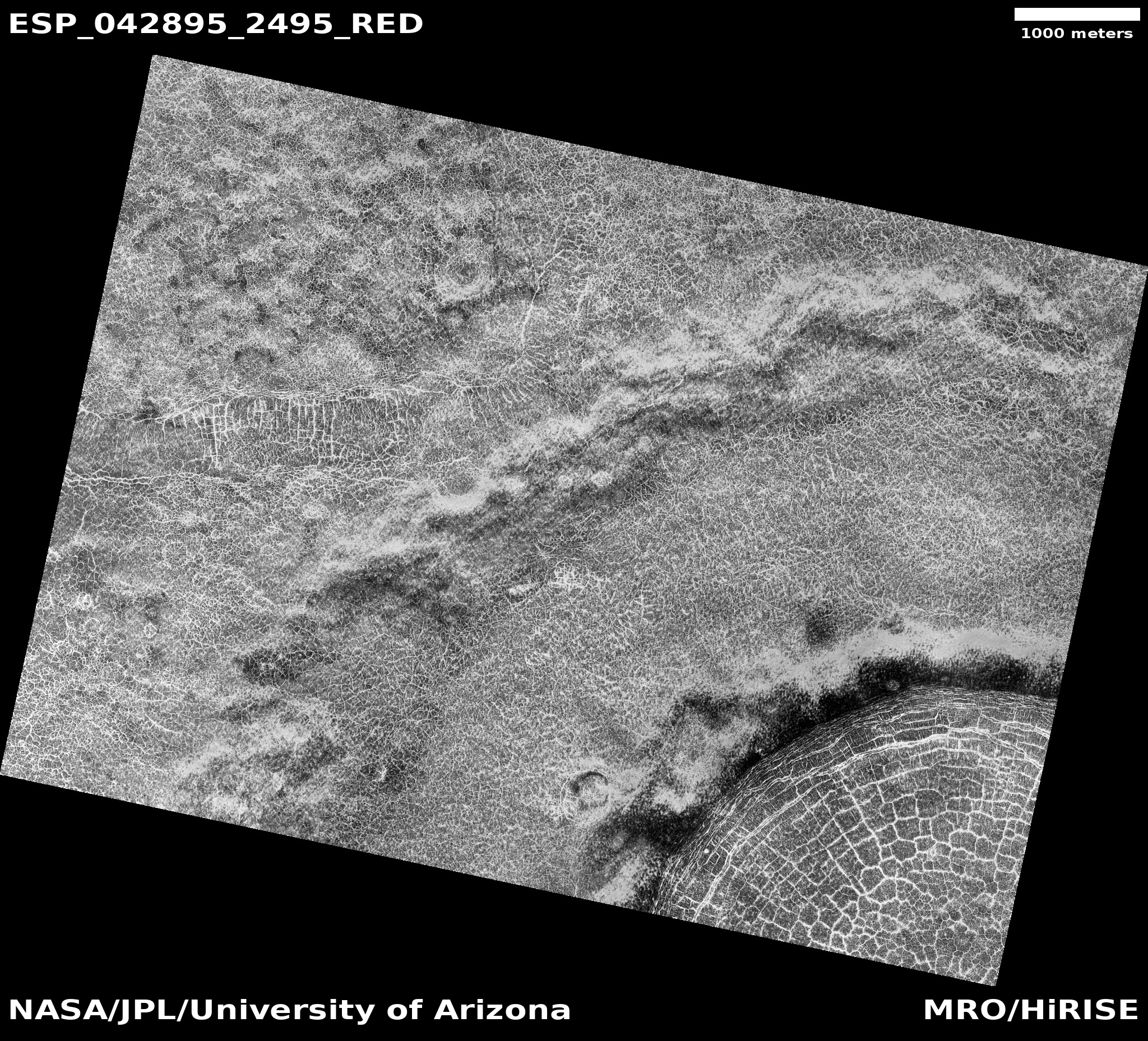
Week’s Best Space Pictures: Frozen Fractals Crisscross Mars
By Michael Greshko,
National Geographic News, 1 January 2016.

Feed your need for heavenly views of the universe with our pick of the most awe-inspiring space pictures. This week, a celestial collision births a new galaxy, frosty cracks branch across a Martian crater, and Saturn’s moon Dione shows off its wispy surface.

1. Sun and Stone

wps9230.tmp

The rocky slopes of northwest Greenland’s Daugaard-Jensen Land glow gold from the morning sun. The photo was taken from a Falcon 20 plane by Operation IceBridge, a NASA mission mapping changes to Arctic ice with aircraft.

2. Frozen Fractals

wps8106.tmp

The cracks in this Martian crater were formed by sediment repeatedly freezing and thawing. They’re highlighted by persistent frost in this picture from NASA’s Mars Reconnaissance Orbiter. The crater itself is in Vastitas Borealis, Mars’ vast northern lowlands.

3. Sun, Sand, and Cities

wps19DD.tmp

Dubai, Sharjah, and Ajman - three of the United Arab Emirates’ federated monarchies - and the Persian Gulf can all be seen in this photo from the International Space Station. The empty areas of sand in the upper left are the artificial Deira Islands.

4. Hostile Merger

wpsAEE9.tmp

The Hubble Space Telescope captured this shot of NGC 6052, a galaxy 250 million light-years away in the constellation of Hercules. The unusually shaped galaxy is in the midst of being born from the chaotic fragments of two galaxies that collided.

5. Rise and Shine

wps46A6.tmp

A composite image from NASA’s Lunar Reconnaissance Orbiter shows the Earth rising over Compton crater on the moon’s far side. The photo is reminiscent of the famous “Earthrise” image taken by Apollo 8 astronauts in 1968.

6. Wisps and Rings

wps5911.tmp

NASA’s Cassini probe took this shot of Saturn’s rings and the wispy, cracked terrain of the moon Dione. The wisps are bright ice canyon walls, likely formed by cracking during subsidence.

7. Time Makes You Boulder

wpsE40C.tmp

NASA’s Mars Reconnaissance Orbiter spots a boulder-covered landslide along a canyon wall between Aurorae and Hydraotes Chaos. This region of Mars contains stretches of enigmatic, blocky hills unlike anything seen on Earth.

[Source: National Geographic News. Edited. Some links added.]

9 TECH TRENDS THAT NEED TO DIE IN 2016


wpsD60D.tmp
Tech Trends That Need to Die in 2016
By Stephanie Mlot,
PC Magazine, 31 December 2015.

Have you made your New Year's resolutions yet? Perhaps you want to join a gym (and actually go), or dust off those cookbooks in order to prepare home-made meals. How about putting down your smartphone more often to enjoy the real world around you?

But what about technology trends? Surely, there are things you hope will go away in 2016. Last year, we pushed for a few annoying things to die in 2015, but only one really came to pass: more diverse emoji.

We're still working on GamerGate and distracted driving. Security breaches? Well, read on. Before the giant glittering ball drops on 2015, take a moment to reflect on the tech trends, products, and disruptions that deserve an untimely death in the New Year.

1. Shady Pre-Installed Software

wps4EEE.tmp

There is a certain level of expectation that comes with buying a new PC: It will not be broken, it will include all required cables, and it will not be shipped with a major security flaw. In 2015, Lenovo and Dell failed that last criteria. Lenovo admitted to delivering PCs pre-installed with adware that left people open to bugs, which led to a lawsuit. Dell, meanwhile, apologized in November for a tech support feature - eDellRoot certificate - on its PCs that accidentally left those machines open to hackers.

2. Passwords

wps34EA.tmp

Passwords are more hassle than they're worth: Even if you get more creative than 12345 or BuddyTheDog, they're no match for sophisticated hackers. So why do software and hardware makers insist we keep typing jumbles of numbers and letters to log into a website or personal computer? Apple, Google, and Microsoft are on the right track with things like fingerprints and facial recognition for sign-ins. Even Yahoo is killing passwords in its mail app. Unfortunately, the trend hasn't quite caught on yet, and we're still stuck trying to remember our security question when we forget our Facebook password.

3. Twitter 'Love' Heart

wpsAC4E.tmp

What the world needs now is love, sweet love. Twitter, on the other hand, needs yellow-starred "favourites." In early November, the micro-blogging service - and its looping-video subsidiary Vine - introduced new heart symbols to communicate approval. The move, which replaced the "favourite" stars, aimed to make life easier for users. After all, "You might like a lot of things, but not everything can be your favourite," product manager Akarshan Kumar said at the time. Instead, the heart conveys a range of positive emotions: congratulations, laughter, solidarity, and, of course, love. And, sure, the stars were somewhat confusing - some people favourited tweets they enjoyed, while others used the feature to bookmark a message or link. But the loving star just feels like too much commitment than most tweeters are ready for.

4. Hoverboards

wpsE7.tmp

They explode. They embarrass people with inner-ear problems. They don't actually hover. Pretty much everything about "hoverboards" - self-balancing two-wheeled boards - is contrary. Yet somehow they've gained a level of popularity typically reserved for home beer brewing kits. Nothing like the flashy device Marty McFly sported 26 years ago in Back to the Future II, modern hoverboards are a bit of a menace. Early this month, a U.K. consumer protection agency revealed that more than 15,000 scooters (about 88 percent) were detained at the border based on issues with the plug, cabling, charger, battery, or cut-off switch. Amazon later pulled a number of hoverboards from its site over safety concerns - the e-retail giant doesn't want to be liable when the device explodes under your feet. The U.S. Postal Service took similar action, limiting domestic shipments of those motorized balance boards that contain lithium batteries. You may as well wait for the real thing.

5. Selfie Sticks

wps4BAC.tmp

Selfie sticks' only saving grace is that they're much less likely than hoverboards to erupt into a ball of fire. In all other respects, the adjustable poles are horrible. As likely to poke your eye out as an Official Daisy Red Ryder Range Model 1938 Air Rifle BB gun, they obstruct other people's view, and, frankly, look ridiculous. The controversial accessories have even been banned from Disneyland, the Louvre, the Empire State Building, and Coachella, among other locations and events. The Bluetooth headsets of the 2010s, selfie sticks can be easily abolished with technology. Wide-angle front-facing smartphone cameras can do the trick. Or just wait until more drone makers catch on to the cheap flying camera concept.

6. Smartphone Addictions

wps9180.tmp

Look around any public place and you'll find most people with their head down, eyes focused, and fingers tapping furiously on a smartphone screen. We are living in the digital age, where everyone carries a mobile device (or three), and folks spend more time on gadgets than having face-to-face conversations. Smartphone addiction is very real (according to WebMD), and not an easy habit to kick. But while seemingly harmless - I'll just play a round of Monument Valley while waiting for the bus; I should clear out my email inbox in the doctor's waiting room; I wonder what filtered photos of food my friends posted over the weekend - the habit can be damaging: think texting while driving (or walking), your eyesight, and sleep patterns. So maybe try to fight the urge to carry your tablet to the toilet, or put down the smartphone while your kids perform a puppet show.

7. Spoilers

wpsE1D4.tmp

If you absolutely must discuss your favourite TV shows and movies, be a decent human being and post a warning. Those guidelines are even more relevant in an age of social media and streaming TV. While you may have the time, energy, and will power to binge-watch an entire season of Orange Is the New Black in a weekend, your Twitter followers and Facebook friends might not be able to do the same. As the old saying goes: If you don't have anything nice to say, keep your mouth shut and stop spoiling entertainment for everyone else.

8. Android Bugs

wps32F3.tmp

Google's Android had a rough year in mobile security. The operating system in March was hit with the so-called Time-of-Check to Time-of-Use vulnerability, which allowed an attacker to silently modify or replace a benign Android app with malware. It reportedly affected 49.5 percent of Android users and could be executed without the user's knowledge, perhaps while you slept.

That's nothing, however, compared to Stagefright. The exploit let an attacker take control of an Android device simply by sending it a text message. But even the "world's largest" mobile update couldn't shield the 950 million exposed smartphones: Stagefright 2.0 emerged in October as a set of two vulnerabilities that manifest when processing specially crafted MP3 audio or MP4 video files.

9. Data Breaches/Leaks/Dumps

wps81B0.tmp

Another year, another set of major security breaches. And it's not just services like cheating site Ashley Madison: the Office of Personnel Management, U.K. ISP TalkTalk, and VTech were among 2015's biggest cyber attack targets. Sadder than the potential divorces Ashley Madison users may be facing? The fact that we seem to have learned nothing from last year's treasure trove of cyber attacks.

[Source: PC Magazine. Edited.]

Friday, 1 January 2016

INFOGRAPHIC: FAMILY AND TEEN’S CYBER SECURITY


wpsEB65.tmp
Infographic: Family and Teen’s Cyber Security
By
Family Orbit, 14 December 2015.

The Internet is an essential tool in our daily lives, but it’s becoming increasingly complicated for users, due to safety concerns. It poses many dangers that both parents and kids need to be aware of and informed about. From inappropriate content to cyber-bullying to sexting, there are serious issues that all families have to face these days.

Keeping kids and teens protected from cyber crimes, and even internet addiction, is no easy task. You can surf the web safely, but it does take an awareness of the potential problems that can harm kids of all ages. Even adults can fall victim to internet crimes.

Social media is playing an increased role in the daily lives of youths and adults alike. With more than 2 billion estimated users worldwide, it’s no surprise that social media addiction is becoming a problem, especially for young people. Parents need to know what to look for when it comes to social media addiction.

The following infographic from Family Orbit team, breaks down what parents and kids need to know about family safety. It gives details on what types of threats to look out for, stats and figures that you may find surprising, as well as some helpful advice on how to keep your family protected.

Family and Teen's Cyber Security


[Source: Family Orbit.]