Scroll Though The Solar System, and 4 More Amazing Space Websites By Justin Pot, Make Use Of, 2 February 2016.
Have a passion for astronomy? Today Cool Websites and Apps gives you a chance to travel the solar system by scrolling. Can your fingers handle it?
There are some amazing astronomy websites on the web, but we just keep finding more. Today you can relive the Apollo mission, witness the history of rocket launches, dive into NASA’s data archive and even see if your fingers can hold up long enough to scroll past Pluto. It’s not a planet, but it’s really really far.
1. If The Moon Were Only One Pixel: Keep Scrolling to Put Earth in Context
Humans aren’t psychologically equipped to comprehend the vastness of the cosmos, an inadequacy Douglas Adams hilariously skimmed the surface of in the Hitchhiker’s Guide novels.
Space is big. You just won’t believe how vastly, hugely, mind-bogglingly big it is. I mean, you may think it’s a long way down the road to the chemist’s, but that’s just peanuts to space. - Douglas Adams
The point: it’s really hard to describe just how big space is. But visualizations can help - especially ones that leave your fingers sore from scrolling afterwards.
The If The Moon Were Only One Pixel site lets you scroll from our sun to all the known planets in the solar system. But this isn’t like those pictures you’ve seen before: everything is to scale, which is to say that it’s mostly just empty space. Just getting to Mercury seems to take forever, and I’ll be honest: I gave up before I got to Saturn. Can you do better?
I’m showing screenshots from the bits that actually have planets, but to be clear you’ll spend most of your time scrolling through empty space (with a bit of text to kill the time). It’s not called a “tediously accurate scale model of the solar system” for nothing, but if you scroll through this thing I will gladly name you today’s Champion of The Internet™.
2. We Choose the Moon: Recreation of the First Moon Landing
Understanding the vastness of the solar system might help explain why we’ve never managed to get humans further than the moon. But the moon is 384,403 km (238,857 miles) away, which is pretty freaking far already.
But we did make it there, and We Choose the Moon helps you relive the day it happened. You’ll hear actual audio from the day, and see a computer-simulated recreation of the rocket’s path through space. There are also photos and video footage you can browse along the way.
Kind of incomprehensible that this ball of rock in the sky - a rock that for most of human history was considered not so much a place as a god - is somewhere humans have been. But we have. And this site lets you re-live that.
3. History of Rocket Launches: Every Rocket Launch Ever, Mapped
It took humanity until the 1950s to launch satellites into orbit, but we’ve sure launched a bunch of rockets since then. If you want an idea of how many, this site lets you see where every rocket launch since the early days happened.
Just hit play and lean back as the occasional launch shifts to a constant barrage on the upper atmosphere. If you’re a big fan of fascinating maps that can teach you things, don’t miss this site.
4. OpenNASA: Access to Vast Amounts of NASA Data
America’s space agency gathers a massive amount of data every year, and OpenNASA is their attempt to share it. There are APIs and downloads on offer, if you’re a developer. Or, if you’ve a civilian, why not check out some of the amazing things other people have built using the information?
It’s hard to talk about space websites without mention NASA’s Astronomy Picture of The Day (APOD), which for over 20 years has been offering amazing pictures for web users to gaze at and read about. We’ve outlined it and other sites to view and download space images from, but I wanted to point it out along with some sites that integrate with it.
If you’ve never checked APOD, it’s well worth starting now. Make it your home page. But if you can’t remember to check the site every day, there are loads of ways to still see every image. Just a few:
APOD Wallpaper for Windows sets today’s image to be your wallpaper.
There’s an RSS feed you can add to your feed reader. RSS isn’t dead, whatever people tell you.
This site lists dozens of mirrors, including some in other languages, and a bunch of unofficial social media accounts that give you access to the same photos and info on sites like Facebook and Twitter.
Map Shows the Spread of ISIS in the Past Few Years By Casey Chan, Sploid, 1 February 2016.
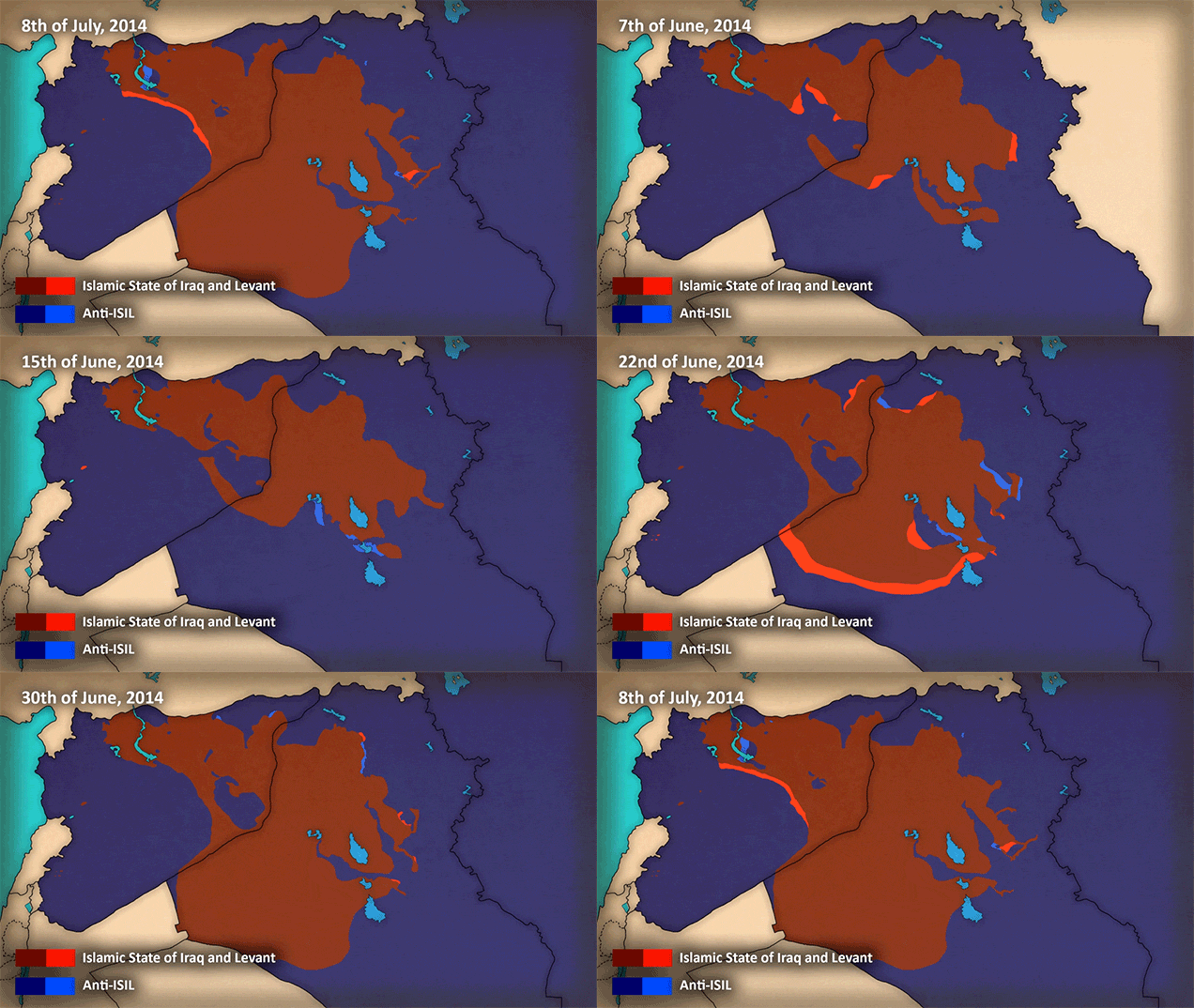
The Islamic State or ISIS or ISIL have quickly rose to power in the regions of Iraq and Syria in the past few years. This map by Peter Ridilla tracks the groups’ spread across the region. The Islamic State is shown in red against the rest of the region. What started off in just a few areas a few years ago has now crossed multiple borders, multiplied itself, and grown terrifyingly fast in recent months.
10 Reasons You Can Kiss Privacy Goodbye Forever By Andy O., Toptenz, 1 February 2016.
In 2013 it was revealed that the U.S. government had been spying on its own citizens as well as citizens of other countries around the world. It was then that many realized privacy was fast becoming a rare commodity. As technology continues to advance, slowly encompassing more and more of our lives, it’s becoming slowly apparent that everybody can kiss their privacy goodbye forever.
10. Hackers
As more of our valuable personal data is stored online, the number of criminals and outside entities bent on stealing that information grows as well - and we’re not just talking about the hackers that send out “Nigerian Prince” phishing emails anymore either. In the beginning half of 2014, 1.2 billion email addresses and usernames had been stolen along with 500 million records containing personal and business information - that includes banking data, medical data, and social security numbers.
The big problem here is that even if you are careful and you keep your username and password written down on a sticky note locked in a military grade vault a thousand feet below ground - guess what? - your information is still at risk. This is because companies that store your personal information on their servers are still vulnerable to hackers. So if you use the same username and password combination for every website out there, all that a hacker has to do is steal it from one site and start plugging it in into others to see if it’s a match. Hopefully they don’t figure out where you bank.
9. Facial Recognition Software
It’s no surprise that Facebook has become one of the biggest databases for photos on the planet, but the creepy part is how easily the social networking site can pick out your face from among a sea of others. Even creepier is Google’s facial recognition system, which can identify childhood pictures of existing users, even if they have never uploaded pictures of their younger selves before. The creepiest, however, is that government agencies are now using security cameras positioned in public places to watch everybody, all the time.
Stadiums, festivals, and even churches have now become common locales for cameras on the lookout for known criminals, terrorists, and other wanted figures. The problem is that the database federal software is combing through doesn’t just look at criminals, but also at civilians with no criminal record - meaning that your location in public could be known anywhere, at any time, just by cross-referencing your Facebook pictures.
8. Commercial Tracking Technology
With facial recognition software becoming as complex as it has, it’s no wonder that the government isn’t the only entity interested in its application. Retailers are extremely interested in how tracking software can analyze gestures, line of sight, and other consumer signals that influence buying. It’s important to note that being on camera when walking into a store is nothing new - they’ve been used for a while now to prevent shoplifting and vandalism.
The difference here is that these new systems try to predict a consumer’s emotions and make inferences about their intentions so that they can advertise to you when you’re most likely to buy. So not only will the omnipresent urban camera systems know where you are at all times, but also how you feel and possibly what you are about to do. Soon our retailers will know us better than we know ourselves.
7. Kinect
Microsoft and Sony’s next-gen consoles the Xbox One and PS4 respectively come with the option to play with an additional periphery device - basically a camera with a microphone attached. The Kinect and PlayStation Camera are used in games to track movements, receive voice commands, and create a better and more immersive gaming experience for users. Unfortunately, they also possess the ability to spy on you.
Of course, Microsoft and Sony have both denied that they would use these systems to mine data or spy on users…but Microsoft also claimed it never voluntarily turned data over to the government for their PRISM program (even though they were one of the first major companies to sign on to it). Whether their cooperation was voluntary or not, it still begs the question: Will Microsoft voluntarily let the government use the Kinect to spy on us, or will the government just go ahead and do it anyway?
6. Snooping Apps
It’s almost appalling how accepting many have become of the fact that our cell phones are already spying on us all the time. We know that they have GPS capabilities that give carriers and corporations our physical location at any given moment. We know that apps collect our phone numbers and the names of our contacts. But did we know that they are listening to us through our phone’s microphone?
That’s exactly what some apps are doing, including the Facebook app. These apps collect audio data from your phone in an attempt to figure out everything about you, including when you go to bed and when you wake up, what times you watch TV, and even what form of transportation you use to get to work. The aim is to market better to users, even though the trade-off is a considerable loss of privacy. The best part? The ability to spy on you is being touted as a cool feature instead of an invasion of privacy.
5. X-Ray Vision Police Radar
While the Fourth Amendment to the Constitution prohibits unreasonable searches and seizures without a warrant, it hasn’t stopped police departments from deploying a new radar system that can see through walls. These radars track movements as delicate as human breathing through walls up to 50 feet away, meaning they not only can tell if a human being is in a house, but where they are in the house and whether or not they’re moving.
While a 2001 Supreme Court ruling states that officers must obtain a warrant when using electronic surveillance that sees through walls, officers used this new radar to conduct a search without a warrant in late 2014. The 10th Circuit appellate court’s ruling in the same year in favour of the police’s warrantless tactic brings a new gravity to the old phrase, “you can run, but you can’t hide.”
4. Drones
As more commercial and privately operated drones begin to fly our friendly skies, more concerns are being raised about our privacy in their midst. More and more reports of citizen complaint against private drone operators have been popping up, while concurrently, big corporations have been eyeing the technology for commercial application. Global giants Google and Amazon haveboth tested drones out, but law enforcement agencies are already using them to patrol borders, conduct searches, and assist in other capacities.
Drones aren’t silent by any means, but they are definitely not as noisy as a helicopter, plus they can fit into tighter spaces. When outfitted with other technologies, such as cameras, facial-recognition software, and even possibly weapons, these friendly hovercraft adopt a more ominous visage. Imagine a fleet of eyes in the sky that never rest, never falter, and always know where everything and everyone is - at all times.
3. Satellite Cameras
With all this talk of facial recognition software and cameras, it really makes you wonder where the next camera is going to snap a picture of your face from. It could be from any closed circuit system in a store, any drone flying low over a city, and now even from the final frontier: space. Multiple firms have begun installing satellite networks that can take high-resolution pictures of anywhere on earth, including Google for their popular Maps and Earth programs, as well as smaller companies that plan to sell these worldly prints.
While the imagery is stunning, the privacy concerns are pretty obvious here - these satellites aren’t drones that hover above you in plain sight, but invisible watchers that see and film you from their orbital network miles above our atmosphere. Google has assured the public that while they are able to look at things as detailed as vehicles, they are not able to define license plate numbers or facial features…at least not yet. The day is coming soon that satellites will be able to see a booger on your face or where you buried your loot in the backyard.
2. Biometric Scanning
One of the coolest new features that phones and tablets are touting comes in the form of biometrics - specifically fingerprint scanning. While these features are intended to make devices more secure, some have proven that they can actually help to break into a device, while still others warn about the dangers of utilizing biological data as passwords (the whorls in your fingerprint or your specific genetic markers for example).
Much like credit card data, once your biometric data is on file in a government or corporate server, it’s not entirely in your hands to protect anymore. Worse still, while you can cut up and replace credit cards, there’s no changing your biometric data (currently). Unfortunately, that hasn’t stopped big business at large from delving into the biometric craze. In fact, the Department of Defense is perfecting a camera that can take data-base quality iris scans of every person in a crowd from a distance of 10 meters. Time to start rocking that Terminator 2 look and wear dark sunglasses all the time.
1. RFID Chips
Radio-frequency I.D. chips are about as small as a grain of rice, and have been used by companies such as Walmart, embedded in products such as jeans and underwear, to track consumer movements and habits. While they’re easy enough to stick into clothes, it starts to get extremely creepy when people start putting them in their bodies - and the employees of one company in Sweden have begun to do just that.
The benefit of embeddable RFID chips are that they can contain information such as your complete medical history for doctor’s visits, or in the case of the Swedish company, they can act as security badges. Unfortunately, they can also act as tracking chips, and, to somebody with enough interest, can be hacked very easily. Privacy advocates are extremely concerned that as companies and healthcare firms begin to offer RFID solutions, the norm will eventually shift toward accepting and having them, effectively making them mandatory (much like the rise of the internet). As soon as that happens we’ll all be tagged, and left with about as much privacy as cattle in a pen.
10 Perplexing Mysteries That May Have Finally Been Solved By Shelby Hoebee, Listverse, 1 February 2016.
The world is filled with fascinating mysteries that have long gone unsolved. In recent years, however, many of mankind’s most perplexing riddles and unsolved anomalies have finally been explained. While finding mysteries is fun, the solutions to these mysteries can be just as compelling.
As NASA’s Dawn spacecraft approached the dwarf planet Ceres, it captured some very mysterious images. One of these, taken 47,000 kilometres (29,000 mi) away from the planet, showed abnormally bright spots inside an 80-kilometre-wide (50 mi) crater. Many immediately took these images and ran with them, thinking that they were signs of an alien civilization.
For a few months, even NASA wasn’t exactly sure what these mysterious bright spots were. Theories ranged from aliens to ice, but in late 2015, a study was published in Nature that debunked all those theories. It claimed that the spots were nothing more than salt. The study stated, “These unusual areas are consistent with hydrated magnesium sulphates mixed with dark background material, although other compositions are possible.” Unfortunately, this explanation is not as exciting as aliens, but there are plenty of other space mysteries to keep us baffled for a long time.
9. The Windsor Hum
Mysterious hums like the one in Windsor, Ontario, can be found all over the world. These hums often sound like idling engines or loud refrigerators and are understandably a nuisance for anyone within earshot. A recent study in Canada, however, claims to have finally found the source of Windsor’s mysterious hum.
While their first report was totally inconclusive, the second report claims to have finally found some answers. It states that the origin of the hum comes from nearby Zug Island in Detroit, Michigan, the home of a steel plant. It’s a step in the right direction, but we still don’t know exactly where the hum is coming from. The intermittent noise could be coming from one specific machine, or it could be a combination of different machines that only produce the noise under specific conditions. Regardless, the Canadian government has requested that someone on the US side of the Detroit River keep looking into the problem.
8. The Jewish Relic
In 2015, a maintenance worker found a bizarre object in a Jerusalem cemetery. The object was shaped much like a rolling pin and made out of metal, and it had Israel’s Antiquities Authority at a loss. First believing he had found a bomb, the maintenance worker called in a bomb squad. They did a controlled explosion, only to find that the object was completely unharmed. The object was X-rayed and found to be made of solid metal with a coating of 24-karat gold.
Now that the authorities knew what it was made of, they turned to the best possible source to figure out what it actually was: the Internet. After posting a picture on Facebook, they received thousands of guesses about the object’s possible use. Finally, a man named Micah Barak solved the mystery. He posted that the object was an Isis Beamer, a device named after the Egyptian god Isis that’s commonly used for energy healing by naturopaths. Just as suddenly as the mystery began, it was solved with the help of Facebook.
7. Shark Navigation
The ocean is a vast and empty place, yet sharks are able to navigate the oceans with incredible accuracy. For example, great white sharks frequently swim between Hawaii and California, while salmon sharks swim from Alaska to the subtropical Pacific. It’s a phenomenon that has baffled scientists for years. Hypotheses about how sharks manage to do this range from odour cues to the Earth’s electromagnetic fields, but until recently, nobody’s ever conclusively proven one theory over any of the others.
A recent study claims to have finally solved the mystery. Scientists tested the theory that the sharks manage the feat using odour by taking wild leopard sharks 10 kilometres (6 mi) away from their natural habitat. The sharks were fitted with tracking devices, and half of them had cotton balls stuffed up their noses. When the sharks were released, the half without the cotton balls were able to easily find their way back, while the ones with the cotton balls appeared to become lost.
This seemed to have solved the mystery, but many remain unconvinced. Some believe that the sharks were simply upset by having wads of cotton jammed into their noses. Others pointed out that the handicapped sharks still basically swam in the right direction, so there must be something else guiding them.
Amelia Earhart is one of the most famous female aviators in history. On July 2, 1937, she disappeared during her attempt to fly around the equator. Since then, her mysterious disappearance has fascinated the world and inspired a host of conspiracy theories.
In 2014, however, the International Group for Historic Aircraft Recovery (TIGHAR), stumbled on a piece of debris from an aluminium aircraft on the uninhabited island of Nikumaroro. It’s now believed that the aluminium almost certainly belonged to Earhart’s twin-engine Lockheed Electra. The metal sheet was installed on the plane in Miami to replace a navigational window. The Miami Herald even published a photo of the plane with the metal sheet attached. All of the specifications and dimensions of the metal exactly match the photograph.
This is a major breakthrough because it is the first piece of evidence found since Amelia Earhart vanished. It also goes against the popular belief that Earhart and her navigator crashed in the Pacific Ocean. Instead, it is believed that they ran out of fuel and were forced to land on Nikumaroro, becoming castaways for the rest of their lives.
5. Solving The Chaocipher
The Chaocipher was once famous for its complexity. Now, it’s famous for its simplicity. This cipher machine was extremely small, but it generated ciphers that went unsolved for almost 50 years. John Byrne was a writer who began creating the cipher in the 1920s and soon had a code that he claimed was unsolvable. In his many attempts to show the government and the Navy, he was ignored due to his seeming lack of skills as a cryptanalyst.
Byrne never gave out any details about the Chaocipher until he published his autobiography, Silent Years, which contained examples of famous documents in both plaintext and ciphertext. But even though the Chaocipher was finally available, no one knew how to figure it out. After Byrne’s death, the American Cryptogram Association contacted Byrne’s son to see if he would reveal his father’s secrets. To their dismay, he refused. The code remained a mystery until Patricia Byrne, John Byrne’s son’s widow, finally revealed the secret in 2010.
The mechanism contained two circles with all the letters of the alphabet on their outer edges. The right circle had the alphabet going clockwise in plaintext, while the left circle had it going counter-clockwise in ciphertext. By replacing certain letters in a sequence, the machine could create a code that was indecipherable without the machine to translate it back. The system wholly violates Kerckhoffs’s principle, which states that a cryptogram should be secure even if the secret of how it works is public knowledge. Cracking the code was so difficult simply because no one knew exactly how Byrne built his machine.
4. The Bloop
In the summer of 1997, the National Oceanic and Atmospheric Administration (NOAA) recorded several extremely odd low-frequency sounds underwater. “The Bloop,” as it was named, completely baffled scientists. Dr. Christopher Fox of the NOAA did not believe the sound to be man-made or geologic in nature. It also couldn’t have come from an animal, since it was several times louder than the loudest known animal noise.
In 2012, the NOAA finally solved the mystery, and it is much less exciting than the gigantic sea monster everyone thought it was. The NOAA states that the sounds are consistent with large icebergs fracturing and cracking, an event also known as an icequake. Even though the Bloop was heard at two different underwater listening stations over 5,000 kilometres (3,100 mi) apart, the explanation works. A cracking ice shelf is definitely loud enough to generate such a noise.
The appearance of the so-called “fairy circles” in the Namib Desert has perplexed scientists for years. According to Norbert Juergens, the explanation is simple: termites. In his paper published in the journal Science, Juergens states that the circles are formed when a local sand termite, Psammotermes allocerus, removes the vegetation that begins growing after a rainstorm.
By doing this, they allow more plants to grow. “Because of rapid percolation and lack of evapotranspiration, water is retained within the circles. This process results in the formation of rings of perennial vegetation that facilitate termite survival and locally increase biodiversity.”
Even though these termites are the only insect species found distributed across the entire area of the circles, many remain sceptical. Ecologist Stephan Getzin criticized the theory, saying, “...there is not a single study showing that social insects can cause such large-scale homogenous distribution patterns.” Of course, Getzin has his own competing theory for what’s causing the fairy circles. (His theory essentially says the plants organize themselves into these formations based on the availability of soil resources.) As of right now, Juergens seems to have the best explanation for the mysterious phenomenon.
The Macrauchenia and Toxodon fossils stumbled upon by Charles Darwin were that of several bizarre creatures that seemed to defy explanation. The Macrauchenia resembled a short, humpless camel with a small, elephant-like trunk, while the Toxodon seemed to have the body of a rhinoceros, the head of a hippo, and the teeth of a rodent. After analyzing the fossils, Darwin described the Toxodon as “perhaps one of the strangest animals ever discovered.”
In the years since, the mammalian classification of these animals has completely stumped scientists. Until now, that is. Much of the mystery stemmed from incomplete fossil records and the fact that they were unable to isolate fossil DNA because of degradation from South America’s warm, humid climate. Instead of DNA, scientists decided to look at the sequence of the fossils’ collagen, a protein that lasts much longer than DNA and makes up bones.
To do this, they took collagen samples from various mammals - both living and extinct - to create a collagen tree. They then compared those sequences to the collagen of the Toxodon and Macrauchenia. Surprisingly, the scientists found that the bizarre animals were part of a group known as the South American ungulates, which lived for about 60 million years and disappeared 12,000 years ago.
Previously, these bizarre animals were thought to be part of Afrotheria, along with elephants and manatees, but it has now been proven that they are part of the order Perissodactyla, which includes horses and rhinos. This is a huge discovery in the field of phylogenetics and will hopefully help scientists uncover the history of mammals even further into the past.
In 1977, an Ohio radio telescope detected an unexpected blast of radio waves that was over 30 times as strong as normal background radio waves. The anomaly lasted for 72 seconds and was so shocking that it caused astronomer Jerry Ehman to write “Wow!” on the printout next to the circled signal, which gave the phenomenon its name. Many believed that it was proof of alien life.
This year, scientists think they have finally cracked the mysterious Wow! signal. Antonio Paris, a professor at Florida’s St. Petersburg College, believes that the signal was produced by a cloud of hydrogen gas left behind by two comets that flew past Earth. Paris states that from July 27 to August 15 in 1977, “comets 266P/Christensen and P/2008 Y2 (Gibbs) were transiting in the neighbourhood of the Chi Sagittarii star group. Ephemerides for both comets during this orbital period placed them in the vicinity of the Wow! signal.”
Since these comets were only discovered in 2006, scientists did not take them into account when initially researching the signal. The comets are due to pass through the same area on January 25, 2017, so researchers may have the chance to test if this was the real cause of the signal.
Top image: Colour-coded topographic map of Occator crater, home to Ceres' mystery lights. Credit: NASA/JPL-Caltech/UCLA/MPS/DLR/IDA.
Tasty Tech Eye Candy: Glass Bridge, Drone Races By Tracy Staedter, Discovery News, 31 January 2016.
Feast your eyes on the world's highest, longest bridge, a virtual reality experience that shows the surreal world of Salvador Dali's art and zoom along with drone racers.
1. Glass Bridge
Glass bridges are becoming all the rage in the China. There's one in Hunan Province, for example, that's 984 feet long and spans a 590-foot deep crevasse. Now Israeli architectural firm Haim Dotan is on track to build a 1410-foot-long glass-bottom bridge over the Zhangjiajie Grand Canyon, 984 below. The architects say it should hold 800 people at a time. You first.
A new exhibit at the Dalí Museum in St. Petersburg, Florida, offers visitors a way to immerse themselves in the surrealistic art of Salvador Dalí. But you can also get a view of it online and by watching this interactive YouTube video that lets you scan the field by moving arrows up or down.
Superthin and flexible pressure sensors were developed by scientists in the Someya Laboratory at the University of Tokyo. Extremely sensitive, the sensors could one day be incorporated in gloves to physically screen for breast cancer or tumours.
To show just how aerodynamic their seven-seater X-Trail crossover vehicle is, Nissan built a seven-seater bobsleigh. British Olympic medallist Sean Olsson took it for a spin at the Igls Olympic track in Innsbruck, Austria, and found that the sled accelerated from 0 to 62 mph in 30 seconds. We're wondering if it has cup holders.
Cheetah Ultra Sports has a new carbon composite snowboard called The Whip FR-II. The open slot running down the middle is supposed to minimize weight and friction, while also providing stability.
For jet lag, people used to take melatonin. Remember that? Now there's technology. Neuroon is a sleep mask that uses Bluetooth to connect to a mobile phone app. The mask monitors brain waves, analyzes sleep patterns, and uses light therapy to improve sleep quality.
Floridians are getting a new train. Beginning some time in 2017, the Brightline will whisk passengers between Orlando International Airport, West Palm Beach, Fort Lauderdale and Miami, reaching speeds of 120 miles per hour.
For the first time ever, drones are getting their own competition. The Drone Racing League is setting up its first race course of the year on February 22 at Sun Life Stadium, home of the Miami Dolphins. Other events will be announced at different venues throughout the year.
Scientists at Harvard University have discovered that a simple fold in origami called mountain-valley fold is so versatile, it could be the key to creating just about any shape. Objects that fold and collapse into smaller packages could have applications in space travel, architecture, surgery and robotics.
The Lifeshirt from Aegis is a shirt you can wear while boating, surfing, waterskiing, etc. But unlike other shirts, this one works like a floatation device in emergency situations. Just pull the handle in the shoulder and a CO2-cylinder inflates a bladder designed to keep the head above water. The shirt can also be set to automatic and inflate as soon as it detects that the wearer is submerged in water.