Pages

Friday, 6 May 2016

10 APARTMENTS AND HOUSES WITH CRAZY FEATURES


wpsE4FE.tmp
10 Apartments and Houses With Crazy Features
By Allison Hirschlag,
Mental Floss, 5 May 2016.

Many children dream of having incredibly fun living spaces when they grow up -  like a room with a disco floor, or a ceiling made entirely out of Pez dispensers. Thankfully, some of those children grew up and became architects or designers who made their seemingly outlandish apartment dreams a reality. Here’s a collection of 10 homes with amazingly fun features.

1. An apartment with an indoor swimming pool

wpsDE15.tmp
Image credit: Real estate webmasters

Sure, you've heard of apartment buildings with indoor pools, but what about an apartment with a pool directly in the unit? When this three-bedroom apartment in Sydney came on the market two years ago, it was snatched up almost immediately, probably because of the personal-sized indoor swimming pool in the living room. When not in use, the pool is shielded by a glass cover, which lifts up with the help of a winch. The pool isn't the apartment's only awesome feature; it also has an indoor grill and a retractable roof (but really, nothing tops being able to take a swim in the middle of your living room).

2. A house with hammock floors

wpsE994.tmp
Image credit: Nathalie Wolberg

What better way to relax after a long day than sink into your hammock floors and read a good book? That was architect Nathalie Wolberg’s notion when she designed Maison NW, her home and workspace, in Saint-Quen near Paris. Formerly a 1950s printing house, the three-floor home has been transformed into nine artist studios; according to Archinet, Wolberg treats it "as a laboratory to test out new devices and new environments on a daily basis." The top floor has an area with hammock netting where residents can lie down and stare up at a giant skylight in total comfort that Archinet says "allows the individual to extract himself from the surrounding environment, and makes the body become gravity-conscious."

3. A penthouse with an indoor slide

wpsC81A.tmp
Image credit: David Hotson

When New York City architect David Hotson was tasked with designing the penthouse in an 1896 skyscraper in lower Manhattan that was being converted to residential use, he added a feature most kids would kill for - a giant, indoor slide. The polished stainless steel tube starts at the top of the four-story penthouse and makes a pit stop on the third floor (where riders can get out, if they choose) before continuing down to the first floor. The home, which Hotson dubbed "Skyhouse," has other fun accents as well, including skylights, exposed steel beams from the original structure, funhouse mirrors, and bright furniture; the architect worked with interior designer Ghislaine Viñas on the project.

4. A room with ping pong ball walls

wps73BC.tmp
Image credit: Daniel Arsham // Inhabit

How do you make your apartment pop? Simple - stick 25,000 ping pong balls to its walls. That’s what Snarkitecture partner Daniel Arsham decided to do to his small apartment in Brooklyn. According to Inhabitat, it took Arsham two months to affix all the balls to the walls of his room, which he calls “Box/Box.” (Not all the walls are ping pong ball-covered, though; some have mirrors to make the space look bigger.) Arsham's living space is only 90 square feet, but he shares a 2500 square foot workspace with other designers.

5. An apartment with a fireman’s pole

Image credit: Dezeen

Because the owners of a two-story apartment called Haus JJ in the Kreuzberg area of Berlin wanted to be able to get between floors quickly, they asked their architect, Jörg Petri of NOWlab, to put in a slide. "Unfortunately the floor plan did not allow enough space so we had to compact the idea," Petri told Dezeen. "[T]he result was a fireman's pole." To keep the pole out of the way, it's tucked into a corner of a small room that is shielded by a bookcase. The pole leads down into the owner’s office, just in case he has an idea for work and needs to start on it ASAP.

6. An apartment with a jungle room, designed by Jean-Paul Gaultier

wps1B96.tmp
Image credit: Tiffany Chu, Dwell

You probably know designer Jean-Paul Gaultier for the looks he sends down the runway, but the former creative director of Hermès also has apartment design on his resume. In 2010, Gaultier decorated each room of a Paris apartment formerly owned by architect Jacques Carlu with a different theme (a task that reportedly took three months). One room was entirely covered in jersey fabric (including the furniture), while another featured a bed with a doll whose dress served as the comforter. And then there was the jungle room, which featured plants on nearly every surface. "My imagination comes from the cinema," Gaultier told Dwell. "I love the idea that nature is capable of trumping concrete.” Gaultier was the third fashion designer to revamp the space.

7. The apartment of exterior stairs

wpsE9CC.tmp
Image credit: huskiesdontplayfetch/Instagram

Tokyo Apartment is actually a collection of four different apartments designed by Sou Fujimoto. The design was a collaboration between the well-known Japanese architect and the owner of the property, who had given up his job to care for his wife, who had a stroke. Instead of selling their plot of land when the couple's savings began to run out, he commissioned architects to design something unique to attract potential renters. Fujimoto’s vision fit the bill. The result is something out of the 2010 film Inception - stacked block-like structures with pitched roofs that have stairs wrapping around the outer walls and rooftops. Inside, the apartments range from 330 to 602 square feet and are outfitted with ladders to get from floor to floor.

8. A steampunk apartment with a zeppelin light

wps3238.tmp

This New York City apartment was a steampunk enthusiast's dream. In addition to a submarine-style entrance - which even had a working porthole - and vintage pipes, the apartment featured a 32-foot-long zeppelin LED light fixture. Sadly, after the 1800 square foot apartment was purchased in 2012, it was de-steampunked; all that remains is the kitchen, which featured antique parts.

9. The reversible destiny lofts

wpsA6F7.tmp
Image credit: Reversible Destiny Lofts

Each one of these unusual Tokyo lofts comes with a set of instructions: Residents are to "treat each room as if it were you yourself, a direct extension of you," and, when they entered a unit, should "fully believe you are walking into your own immune system." According to Slate, the lofts were produced by Reversible Destiny, a foundation that seeks to extend lifespan through architecture. The idea is that homes constructed with such unusual features will force residents to keep changing up their routines, thereby avoiding becoming comfortable and eventually meeting their ultimate fates (a.k.a. death). Some of the many unusual features of these apartments are spherical rooms, swing sets, and random ladders.

10. A house designed for cats


This colorful, cat-friendly abode in San Diego was designed by former owners Bob and Frances Walker. Among the many cat-friendly features that they built for their nine cats: floor-to-ceiling scratching posts, hanging staircases, and elevated walkways, all in bright, bold colors. They started their work in 1986, and when they sold the property in 2013, every inch was covered in cat paraphernalia; the owners called the style “Cat Baroque.” Unfortunately, after the Walkers sold the property, the new owner got rid of the cat walkway.

Bonus: The rolling apartment

wps49FE.tmp

This adventure in experimental housing has all the things you'd need in an apartment in one giant wheel. Roll It was created by students at the University of Karlsruhe in Germany. All you have to do is walk in it like you would a hamster wheel, and let it roll into the feature you want to use. The unit contains a bed, a lounge chair, a table, built in storage, a shower, a kitchen sink, and even a toilet. The cushions for the bed and lounge chair are attached with velcro and can be stored until you need them. There's no evidence that this home ever made it out of prototype, which is a shame - it would be an interesting place to throw a party.

Top image: A house designed for cats. Credit: The Cats' House.

[Source: Mental Floss. Edited. Top image added.]

Thursday, 5 May 2016

10 CREATIVE SOLUTIONS FOR TEXTING AND WALKING


wps930C.tmp
10 Creative Solutions for Texting & Walking
By Grace Murano,
Oddee, 5 May 2016.

Texting while walking can produce serious injuries. See how some cities are dealing with this problem using texting lanes, poles and signs.

1. Ground-level traffic lights to warn people who text while walking that there's a train coming

Ground-level traffic lights to warn people who text while walking that there's a train coming

Do you like to type out text messages on your phone while walking? That's fine, as long as you don't get hit by a train. Tragically, that happened to a 15-year old girl in Augsburg, Germany and she died. As a result of that unfortunate accident, the city of Augsburg took action. It installed traffic lights at train crossings on the ground, where they would fall into the peripheral vision of texters.

2. #keepitinyourpants Post Pads

#keepitinyourpants Post Pads

In 2013, as part of Cellphone Courtesy Month, Telus launched an exciting new social media campaign called #keepitinyourpants. The campaign's website was full of amusing stop-using-your-cellphone memes, and many of them make a very valid point about how glued we are to our smartphones.

The idea behind Cellphone Courtesy Month is to encourage wireless providers to remind their customers to be mindful and respectful when using their phones. It was founded in 2002 by Jacqueline Whitmore and promotes proper phone etiquette.

3. A college's special stairway

wps87EC.tmp

There are three kinds of people in the world - those who walk, those who run, and those who text. Utah Valley University, a school of about 30,000 students, based in Orem, Utah, thinks it has a solution - designated lanes. The staircase at the school's new student life and wellness center is carved up into three sections, one for each type of intrepid climber.

4. Smartphone addict lane in China

wps2C1C.tmp

In 2014, a Chinese city created a smartphone lane for pedestrians where they can tweet, text and surf the Internet without having to worry about where they're walking or who they're blocking. While the 165-foot path located in Chongqing is meant to make a statement, pedestrians are warned to use it at their "own risk."

A sidewalk split down the center is clearly marked with a mobile phone icon showing it is acceptable to multitask, while the other side of the path makes it clear that smartphone multitasking isn't welcome.

5. Belgian mobile phone company creates texting lanes for its safety campaign

wpsA88.tmp

In 2015, Antwerp gave smartphone users designated lanes where they could walk while texting or looking at their phones without irritating or endangering others. The narrow corridors were marked "text-walking lane" in English on some busy pedestrian streets in the city center. The markings on the ground were in highly visible white paint. The temporary scheme was the brainchild of a local mobile phone business, Mlab, which claims many smartphones are broken in collisions between pedestrians.

6. Padding lampposts in London

wpsEFD3.tmp

In 2008, the city of London decided to experiment with applying protective padding to lampposts to protect pedestrians who have a habit of walking into them while focusing on their phones. The padding was used at London's East-End on the iconic Brick Lane, where the highest incidents of "walking and texting" injuries in the country have been reported. A local charity, London Living Streets, teamed up with directory enquiries provider 118 118 to sponsor the project.

7. Camera window that allows you to see what's in front of you while texting

wps1BA4.tmp

Check out this conceptual phone design by Bryan Brunsell. The camera is moved to the top of the phone, so while you're texting and walking you can see whatever it is you're about to walk into. The world is a better place thanks to this idea!

8. A street artist's fun road signs urges mobile users to pay attention while walking

wpsCB1F.tmp

It is a plea that will strike a chord with many busy shoppers and commuters, but it is debatable as just how much notice mobile phone users will pay to the signs of street artist Jay Shells, despite the appeal for them to "pay attention."

The official-looking signs in New York ask people to "Pay Attention While Walking - Your Facebook Update can wait." Shells wanted to make them more aware of their surroundings, especially when crossing the road. Shells said "The Metropolitan Etiquette Authority" signs had prompted "positive" reactions thus far.

9. Floor decals to alert distracted mobile users

wps9C0C.tmp

On busy crosswalks and intersections, Delaware highway safety officials placed decals that read: “Look Up. Drivers aren't always looking out for you.”

10. Journalist uses the "Chewbacca" test to highlight the pitfalls of texting while walking

wps2033.tmp

Mobile phones make us think we can multitask, but there's now proof that they impair us, even when we're not behind the wheel. Using a phone changes the way we walk - either by slowing us down, or veering us way off course.

Wall Street Journal columnist Geoffrey A. Fowler asked a colleague to dress up like Chewbacca from Star Wars and hang out on a San Francisco street during the morning commute. Then he interrupted pedestrians staring down at their phones and asked whether they'd noticed a legendary Wookie lurking about - many hadn't.


Ira Hyman Jr., a psychology professor at Western Washington University, explained this as “inattentional blindness.” In 2008, he conducted one of the first versions of the test, asking passersby if they'd noticed a clown on a unicycle. Half of the non-cellphone-using pedestrians saw the clown while just a quarter of people talking on a phone did.

Top image: Text walking lane in Antwerp, Belgium. Credit: Oneindia News via YouTube.

[Source: Oddee. Edited. Top image and some links added.]

INFOGRAPHIC: 6 WORKPLACE RULES THAT DRIVE EVERYONE CRAZY


wps5A80.tmp
6 Workplace Rules That Drive Everyone Crazy
By Jgueringer,
CashNetUSA, 7 April 2016.

The workplace can quickly become a battlefield when employees breach previously unspoken boundaries and bosses respond with stone cold rule-setting. As a result, there is an increased need for soft skills in the workplace and for mutual understanding between employers and employees rather than overly restrictive formal parameters.

Arbitrary rules ranging from the proportion of fluorescent colouring permitted in workers’ Nikes to the policing of beard length can foster disgruntlement in the workforce. Similarly, placing formal restrictions on how employees are allowed to decorate their workspace can make coming into work an unappealing prospect. Laying down the law creates a divide between boss and workforce that counters efforts to maximize the potential of teamwork.

Mutual respect and open communication can be more productive than iron discipline when it comes to maintaining standards and boosting productivity in the workplace. Put simply, treating employees like cogs in the machine often results in reduced effort and creativity from the workforce. In this new infographic, we identify some of the potential areas of conflict in the work environment - and how a broadminded approach to them can be profitable for everyone involved.

6 workplace rules that drive everyone crazy V4


[Post Source: CashNetUSA.]

FLYBOARD AIR: THE HOVERBOARD THAT ACTUALLY FLIES AND JUST SET A WORLD RECORD


This Hoverboard Actually Flies And It Just Set A World Record
By Alanis King,
Jalopnik, 1 May 2016.

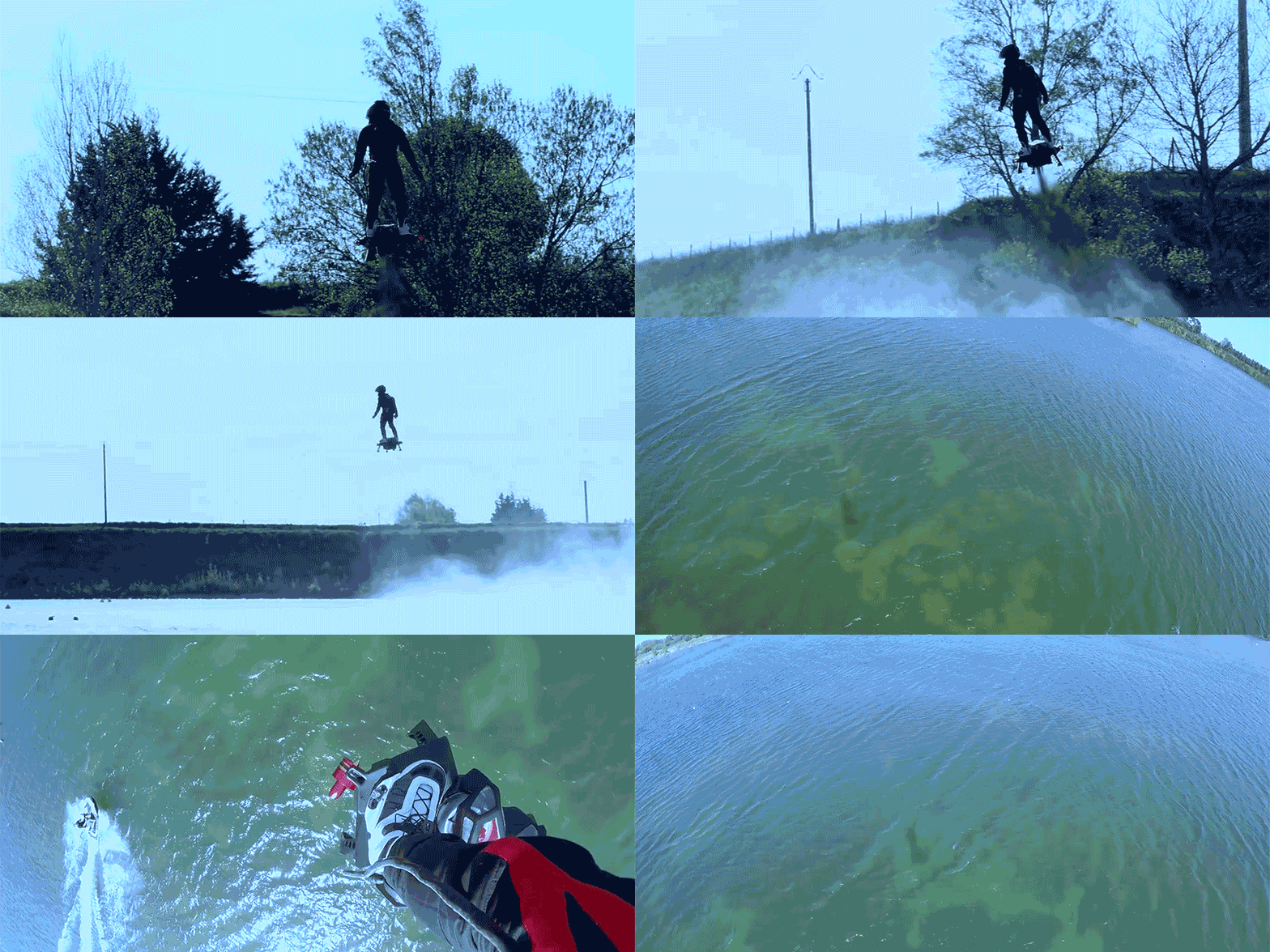
When a video surfaced of a hoverboard in action a few weeks ago - not those ones that roll around on the ground, but a hoverboard that actually flies - there were plenty of YouTube comments questioning its authenticity. It is most definitely real, and its creator just set a world record for distance in a hoverboard flight.

The “Flyboard Air” hoverboard comes from Franky Zapata and Zapata Racing, creators of the original “Flyboard” - the contraption that uses water propulsion to shoot dare devils up into the air over a body of water. Zapata took his new board - the one that flies on its own - out for a spin over southern France on Saturday, setting a new Guinness World Record farthest hoverboard flight.

Below is a video from a test flight of Zapata’s hoverboard, which isn’t the one in which he set the world record:


The flight that broke the world record was 2,252 meters long, and Zapata completed it with both boats and jet skies trailing behind. Zapata rose to 50 meters - or just over 164 feet - in the air during this particular attempt, but claims are that the device can reach a maximum altitude of 10,000 feet.

In addition to the high altitude capabilities, the hoverboard is also claimed to be able to fly at up to 93 mph and has a flight time of 10 minutes. For now, Zapata keeps his flights low and over lakes in order to run tests on the prototype.

All things considered, it’s cool to live in a time when people can break world records involving hoverboards. Just think about it - all of those corny phrases about believing you can fly are actually, like, possible now.

[Source: Jalopnik.]

Wednesday, 4 May 2016

INFOGRAPHIC: EMERGING TECHNOLOGIES SHAPING THE FUTURE OF LOGISTICS


wps9B14.tmp
The future of logistics is paved with innovation and technology. Let's take a look at some of the emerging trends that will affect the future of logistics.

Emerging-Trends-in-Logistics
Infographic by 2flow


[Source: via DR4WARD.]

VIDEO: WATCH HOW DEAD SILENT AN OWL FLIES COMPARED TO OTHER BIRDS


Watch How Dead Silent an Owl Flies Compared to Other Birds
By Casey Chan,
Sploid, 29 April 2016.

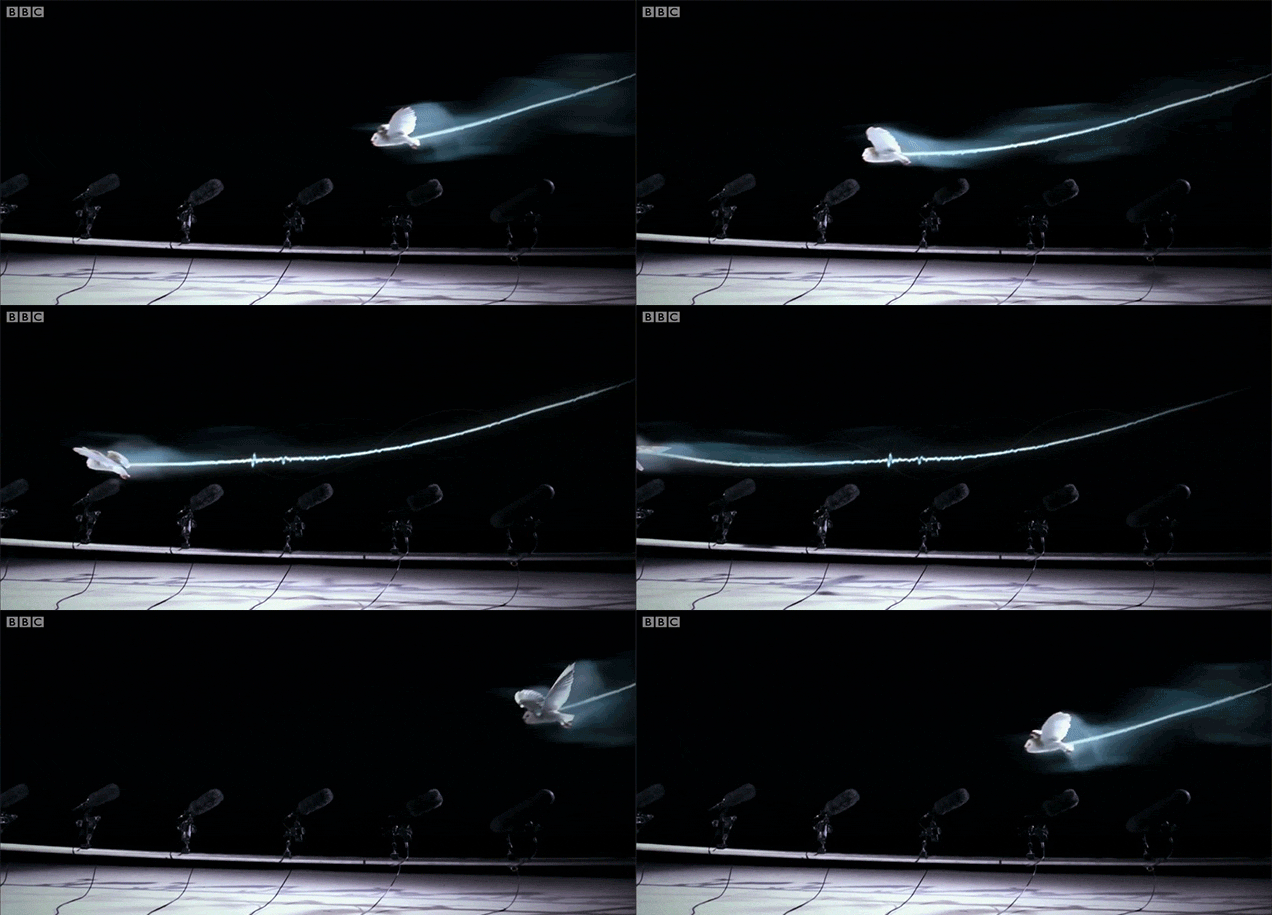
When a pigeon flies, you can hear it sloppily slap its wings as it makes its way through the air. When a peregrine falcon flies, the flight is powerful and beautiful, but you can still hear the movement. When a barn owl flies? Complete silence. It’s amazing to see. BBC Earth set up microphones along the flight path of the birds to let us hear the difference.

It’s because the barn owl has such giant wings attached to such a small body. That allows it to gently flap its wing to glide along. A pigeon’s wing is much smaller, so it needs to furiously flap its wings to fly, while a falcon’s large wings are used powerfully to generate speed in order to catch prey.


[Source: Sploid.]

Tuesday, 3 May 2016

10 INTRIGUING MYSTERIES ABOUT SOUND-RELATED PHENOMENA


wps6517.tmp
10 Intriguing Mysteries About Sound-Related Phenomena
By Gregory Myers,
Listverse, 3 May 2016.

Sound is something that we take for granted even though it is an essential part of our existence. We require sound to communicate with others through speech, and we need it to listen to important verbal cues in life. It also helps us to enjoy forms of entertainment like music and television.

Considering how important sound is in our lives, most people believe that we have the concept fully figured out. However, there are still many mysteries about sound that we have yet to solve.

10. The Mysterious Space Roar


In 2009, NASA discovered a phenomenon - dubbed the “space roar“ - for which they have no solid explanation. They had sent a probe above the Earth’s atmosphere to search for radiation from the oldest stars in the universe. Instead, they found the space roar.

These radio waves were in the form of synchrotron radiation, which is electromagnetic radiation that comes from charged particles. This radio noise was six times greater than expected in the vacuum of space. After testing many theories, NASA still can’t explain it.

Some scientists believe that it is coming from the earliest stars in the universe. Others have suggested that massive clusters of galaxies are confusing our equipment with their size and density. But so far, we have no reliable or accepted explanation for the space roar.

9. The Strange Skyquakes Heard All Over The World


Many people instantly dismiss skyquakes as a bunch of conspiracy nonsense. It certainly didn’t help that some people were saying that skyquakes were the trumpets of the apocalypse and a sign that the End Times were near.

In 2012, a YouTube channel began to upload “skyquake videos,” which were shaky cam videos that had been doctored to seem like the genuine phenomenon.

All hoaxes aside, real skyquakes tend to only happen near coastal areas. Skyquakes are described as loud booming sounds like giant cannons. Some people have suggested that this is the sonic boom of an airplane, but skyquakes were reported throughout the world long before the Internet or airplanes existed.

Others have suggested that this phenomenon could be a meteorite exploding in the sky or the sound of distant thunder. But most people dismiss these theories as being unrealistic.

The most common theory among scientists is that skyquake noises happen when gas escapes from vents in the Earth. As gas is more likely to escape from Earth underwater, this would explain why most of the sounds are heard near coastal areas. But as of early 2016, no one really knows what causes skyquakes.

8. The Unexplainable And Persistent Hum


Many people around the world have heard of this distinctive, mysterious humming sound or have been bothered by it themselves. It is said to be a fairly low-pitched humming that continues on and on. It can drive people crazy who keep hearing it. This sound has been heard from Taos, New Mexico, to Bristol, England, and has been disturbing people’s peace of mind for decades.

At first, some people dismissed the claims as those of a few crazy people. Then more complaints popped up, so others called it mass hysteria. However, scientists have always believed that it was caused by something physical. To this end, they have been trying to get a handle on the issue for quite some time.

Recently, researchers saw that microseismic currents from long waves in the ocean are causing tiny planetary vibrations that can create persistent sounds. However, this theory doesn’t entirely explain the situation.

For example, it doesn’t explain why the sound is so persistent and flat instead of being intermittent or constantly changing - as you would expect if it was made by the movements of the ocean. This theory also doesn’t explain why some people in a given area can hear the hum but others can’t.

7. Wind Farms And Their Sound Pollution

wpsFA88.tmp

Wind power is currently an incredibly controversial source of power. No one seems to know quite how to go forward with it. While it can be useful because wind is a “renewable” resource, there are serious environmental consequences. One of the biggest issues has been noise pollution.

The UK government studied if people were getting violently sick from wind farm noise. They found that these claims were a bit hyperbolic, but the noise was definitely keeping many people awake at night - partly because it was intermittent noise. The government admitted that this could be bad for people’s health in the long term.

Due to the constantly fluctuating nature of wind, these wind farms aren’t a reliable source of power and often underperform expectations. To create new places for wind farms, massive deforestation may be needed, which is also bad for the environment.

Wind farms also kill a stunning number of birds each year. According to Smithsonian Magazine, avian deaths range in the hundreds of thousands and could increase if taller wind turbines become more popular.

This has been especially harmful to species like bald and golden eagles that are under partially protected status right now. They often run afoul of wind turbines in the US.

6. Infrasound And Alleged Hauntings


If you’ve experienced strange, unsettling feelings at a horror movie even though you’re usually hard to scare, you may have been the victim of a movie that uses infrasound to further frighten you.

Infrasound is a frequency that sits at about 19 Hz, which is just below normal human perception. But it is clear that most humans can detect infrasound in some way, and it leaves us feeling incredibly disturbed.

Scientists have discovered that infrasound can leave people feeling shaky, disoriented, confused, and scared. Under the right conditions, it can also cause us to think that we’ve seen or heard strange things.

In fact, the findings from some studies have supported the theory that many allegedly haunted houses are situated in areas with infrasound. This may cause people to have strange experiences in these old buildings. However, even if this is the answer to hauntings, scientists still don’t understand why infrasound bothers us so much in the first place.

Infrasound may feel supernatural to us because it is just outside our perception, which could explain why we feel so unsettled and stressed. Some scientists also suggest that our reaction to infrasound may be an evolutionary survival response. They point out that a tiger’s roar right before it kills is close to 19 Hz.

5. If A Tree Falls In The Forest

wps7C4C.tmp

If a tree falls in the forest and no one is there to hear it, does it make a sound?

This old question has caused endless debate without getting closer to a definitive answer. Some people will gladly take a strong stance on the issue, insisting that the tree makes a sound because animals are probably there to hear it.

Others counter that the term “no one” means no humans or animals. According to their argument, there isn’t any sound if no person or animal hears it because perception is what creates a sound.

To prove the answer one way or the other, you need some kind of observer, even if it is only electronic. An electronic observation could then be translated by the person who listened to it for evidence. However, if there is any type of observer, then the “no one around to hear it” condition is violated. This makes the question impossible to answer.

However, this kind of question was likely formed without expecting a definitive answer. Originally, the question may have been a philosophical exercise to consider how much an action mattered if no one was around to observe or be affected by it. Over the years, it has turned into an actual debate among some scientists.

4. Singing That Breaks A Glass And Trumpets That Tear Down City Walls


We’ve all seen the trope where an opera singer breaks a glass just by holding a high note for a long time. As implausible as it may seem, a human voice - without amplification - can sing the right note and vibrate a glass into pieces.

But this is more than entertainment. Many governments are working on sonic weaponry, especially as a means of crowd control against rioting populations. Although we know that sound can be a useful weapon, we do not know its limits yet. Some people even have historical questions about this issue.

In the Bible, Joshua and his army conquered the famed city of Jericho with the power of music. They marched around the city blasting their trumpets for seven days. Eventually, the walls came down - allegedly from the power of their trumpets. Many people doubt this version of events, and some scholars have doubted whether the battle ever took place.

Although recent evidence has suggested that a real archaeological site may have been Jericho, the question of whether trumpets could have been involved in its downfall may never be answered.

Scientists suggest that earthquake activity could have caused Jericho to fall. The biblical account says that the nearby river was dried up, and geological experts believe that this could have signified an impending earthquake.

Despite these theories, the excavation of the site is still in its early stages. Tesla believed that a resonance device could pull down buildings or create enormous earthquakes. But no one has scientifically tested if a huge army of trumpet players could have destroyed the walls of Jericho.

3. The Rightful Inventor Of Radio Communication

wps3906.tmp

When asking who invented radio, you will get many different answers. Some people are adamant that the true inventor of radio was Nikola Tesla, the fan favorite on the Internet. Others will state that Guglielmo Marconi did most of the work and presented the first functional radio to the world. However, the truth is far more muddled.

Although Tesla did experiment extensively with early radio communication and had some related patents, he never produced the kind of working radio that Marconi did. Tesla argued that Marconi designed his radio using several of Tesla’s patents. But this is like saying that you invented television because you designed cathode-ray tubes.

Even if you believe that Tesla built the foundation and Marconi finished the work, this ignores the contribution of many other people. David Edward Hughes, Thomas Edison, and others did work that helped Tesla and Marconi to understand how radio waves worked, although Heinrich Hertz eventually got the credit for that discovery.

Although we may never know who deserves the most credit for the invention of radio, it is safe to say that this invention was not the work of one person. It took decades of discovery by several scientists building on one another’s work to bring us the radio communication that we have today.

2. A World With No Noise Pollution

wps956F.tmp

The modern world is constantly besieged by a cacophony of sounds. Even if you live in a fairly remote location, you will probably still hear the sounds of airplanes flying overhead. It has become increasingly hard to escape artificial noise pollution.

Noise pollution also interferes greatly with people’s circadian rhythms. There are other health issues as well. Despite regulations to curb this problem, it has reached a point of being almost entirely out of control. Loud, unnatural noises day and night have become a reality of life on Earth. However, it wasn’t always this way.

Constant noise pollution is a recent development. If we go back even one century, artificial noise occurred mostly during the day and even that was not close to the level of sound that we have now. About 200 years ago, noise pollution essentially didn’t exist, especially at night when people were trying to sleep.

We can only wonder what it would be like to live in a world that doesn’t constantly bombard us with noise. How much better would our health and peace of mind be? We will never know because there is no longer a way to escape noise pollution.

1. The High-Pitched Sound With No Apparent Source


Earlier this year, the community of Forest Grove, Oregon, was dealing with a bizarre situation that kept them up at night. Multiple residents heard a strange noise. One woman was even awakened by the noise several times late at night and became seriously bothered by it. She didn’t believe that it was anything sinister, but she still wanted it to stop.

She went to the police and fire departments of Forest Grove for help. But they were unable to pinpoint a cause. The city’s employees did rule out a gas leak, a water valve, or animals making noise.

The woman who was most bothered by the noise captured sound from a video and sent it to the news. Her husband thought that it was a problem with someone’s brake pads. The sound was long, high-pitched, and screechy - similar to a train at a certain speed. But there are no trains in the area.

Although the brake pad explanation seems plausible, it would still not explain why the woman heard the sound throughout the night at odd hours. Although the sound may not be particularly worrisome, the issue has remained unsolved.

Top image credit: geralt/Pixabay.

[Source: Listverse. Edited. Top image added.]

INFOGRAPHIC: THE WORLD'S WORST EVER DATA BREACHES


wpsE6E9.tmp
The World's Worst Ever Data Breaches
By
Cartwright King Solicitors, 7 April 2016.

Internet data isn't just a collection of code that makes the web spin, but as the internet has grown and our reliance, dependence and use of online technology has grown, we find ourselves putting more valuable data online. This is great as it means all our data is accessible from all over the world, but it also means that if the data were to be hacked or fall into the wrong hands, the consequences could be awful. The recent Panama Papers scandal is just another example of how even the biggest corporations and banks can be victims of cyber crime, leaking millions of valuable documents.

Although internet security software and protocols have improved over the years, some big data breaches have occurred which have costs companies millions, sometimes billions worth of money.

Here are the world's worst ever data breaches.


[Post Source: Cartwright King Solicitors.]

Monday, 2 May 2016

VIDEO: THE BREATHTAKING MAJESTY OF THE WORLD'S HIGHEST WATERFALL


The World's Highest Waterfall Is So Majestic
By Casey Chan,
Sploid, 29 April 2016.

Breathtaking. This drone footage of Angel Falls in Venezuela is exactly that. Angel Falls is the world’s highest uninterrupted waterfall at 3,212 feet tall and it is totally stunning to see the water make its way down the side of the mountain and disappear into the mystery below.


[Source: Sploid.]