Pages

Tuesday, 19 December 2017

5 WEIRD SCIENCE STORIES THAT GRABBED OUR ATTENTION IN 2017

wps159C.tmp
Weird science stories that grabbed our attention in 2017
By Jacqueline Gulledge,
Mother Nature Network, 18 December 2017.

Science can be weird sometimes. (And no I don't mean two teenage boys building the woman of their dreams and watching as she come to life like the '80s flick "Weird Science" - though that would really blow people's minds.)

I'm talking about bulging methane bubbles, mysterious booms in the sky and glowing orbs. These science stories of 2017 may surprise or confuse you - but there's nothing boring about them!

1. Mysterious loud booms are being heard around the world, but why?

wps2BB.tmp

You may have heard of a sonic boom - when an object travels faster than the speed of sound and shock waves create a loud sound. But what if no plane or jet was flying?

Around the world, reports emerged of booming sounds of mysterious origin echoing from the sky, from Colorado and Alabama to the Middle East, United Kingdom and Australia, according to News Corp Australia.

In Alabama, a thunderous noise shook houses and frightened residents on Nov. 20 and remains unexplained.

One theory is the booms are caused by meteors exploding in the sky. The Leonid meteor shower has coincided with the hysteria. This theory would certainly explain why the phenomenon is global, though astronomers have insisted that meteors produced by the Leonids are way too small for this to happen.

There are several other theories roaming about out there, but so far there's no singular explanation for these mysterious sounds.

2. Spider drinks graphene, spins web that can hold the weight of a human

wpsBA02.tmp
Photo: Chen-Pan Liao/Wikimedia Commons

These are not your friendly neighborhood spiders: scientists have mixed a graphene solution that when fed to spiders allows them to spin super-strong webbing. How strong? Strong enough to carry the weight of a person.

And these spiders might soon be enlisted to help manufacture enhanced ropes and cables, possibly even parachutes for skydivers, reports The Sydney Morning Herald.

Graphene is a wonder-material that is an atomic-scale hexagonal lattice made of carbon atoms. It's incredibly strong, but it was definitely a shot in the dark to see what would happen if it was fed to spiders.

So far it doesn't seem as if the spiders can continue to spin their super-silk without a steady diet of graphene. That might offer some solace those concerned about getting ensnared in next spider web they walk through.

3. Giant glowing orb appears over Siberia

wpsD2A9.tmp
Photo: The Siberian Times/Twitter

Has E.T. finally arrived? That's what thousands of locals in northern Russia recently feared after the sudden appearance of an enormous glowing orb in the Siberian night sky, which briefly stirred up a "War of the Worlds"-esque frenzy on social media.

"The glowing ball rose from behind the trees and moved in my direction," said one witness who thought the end of the world was at hand.

As pictures poured into local social media circles, so did the theories. Alien invasion pronouncements were especially rampant; others speculated about a rip in the spacetime continuum, or about wormholes to another dimension.

Official word from the Russian Defense Ministry later confirmed that the event was caused by a test launch of the country's much-hyped Satan 2 Topol-M rocket.

4. Thousands of bulging methane bubbles could explode in Siberia

wpsB9EE.tmp

Siberia's frozen landscape, locked in time for thousands of years, may be coming back to life in violent fashion.

Scientists using both satellite imagery and ground-based surveys discovered more than 7,000 bulging bubbles of gas on Siberia's Yamal and Gydan peninsulas. These potentially dangerous protrusions contain mostly methane and create a surreal ripple effect on the ground when stepped on.

Because methane is extremely flammable, there is increasing concern that these bulges will begin to explode. One such explosion happened at the end of June on the Yamal Peninsula. Witnesses to the explosion reported fire shooting up in the sky and chunks of permafrost popping up out of the ground. The result was a 164-foot-deep crater on a river near a reindeer encampment.

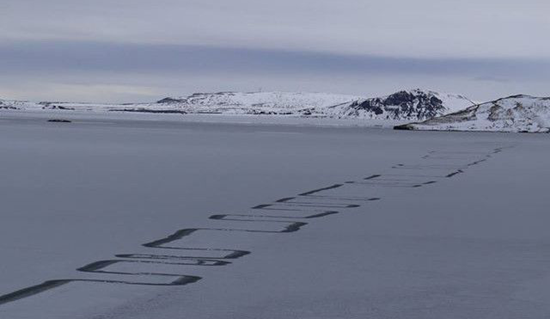
5. What caused this strange code-like pattern to form on an Icelandic lake?
wps2D9E.tmp
Photo: Thingvellir National Park/Facebook

A strange pattern on a frozen lake left residents baffled in Iceland. Could it be a message from an alien life form? Some kind of Icelandic version of crop circles? Is there a message in the pattern that can be deciphered?

Though the pattern looks eerily unnatural, as if written by an intelligent designer, it's probably nothing too spooky. In fact, the design looks suspiciously like a natural phenomenon known as "finger rafting," which can happen when two expanses of sheet ice converge toward another, and one of them slides smoothly on top of the other.

However, finger rafting hasn't been confirmed as the cause of the strange pattern yet, and the conditions present on the lake aren't usually conducive to generating this phenomenon, but it's still the leading theory about what's going on here, according to Ice News.

Top image: An example of a crater formed after an explosion of underground methane on Siberia's Yamal peninsula. Credit: Video screenshot Science and more/YouTube.

[Source: Mother Nature Network. Some images added.]

Monday, 18 December 2017

10 FASCINATING FACTS ABOUT FACIAL RECOGNITION TECHNOLOGY

wpsDF2B.tmp
10 Fascinating Facts About Facial Recognition Technology
By Geordie McElroy,
Listverse, 18 December 2017.

Facial recognition technology (FRT) is one of the most controversial new tools. First developed in the 1960s, it has recently become accessible to the mass market - to both law enforcement and private consumers. FRT has the potential to eliminate the need for pass codes, fingerprint data, and even keys. However, it could also end privacy as we know it.

While it might be the future of policing, medicine, and banking, FRT exhibits racial bias and security vulnerabilities. Some even claim it can be used to determine sexual orientation. Given the power of this emergent technology, concerns about its use in the wrong hands are justified.

10. The Race Question

wps8BAE.tmp

The United States suffers from a systemic problem of racial disparities in traffic stops, stop and frisks, and arrests. African Americans are arrested at twice the rate and surveilled at nearly three times the rate of any other race. Unfortunately, it turns out that FRT often fails with this exact demographic. As police come to rely more on a technology with latent bias, the implications become staggering.

In 2012, a study conducted using mug shots in Pinellas County, Florida, discovered racial bias. The technology proved five to ten percent worse at identifying African Americans compared to Caucasians. One of the technology companies evaluated, Cognitec, is already employed by law enforcement in Maryland, Pennsylvania, California, and beyond. “If you’re black, you’re more likely to be affected by this technology, and the technology is more likely to be wrong,” testified House oversight commission ranking member Rep. Elijah Cummings. “That’s a hell of a combination.”

9. Vulnerability

wps27A1.tmp
Photo credit: Bkav

According to Apple, the iPhone X’s new biometric authentication method cannot be fooled. However, a mere ten days after the phone’s release, Vietnamese Security firm Bkav announced that it foiled Apple’s FRT technology with a 3-D printed mask. The mask contained a plastic frame of the face, paper cutouts for the eyes, and a silicon nose. All totaled, it cost around US$150.

No one has replicated this experiment. Apple claims it is not possible. Wired magazine hired Hollywood makeup artists to recreate the experiment. They failed. However, lower tech methods have proven successful. Carnegie Mellon researchers discovered that accessories like scarves, hats, sunglasses, or even face paint can confuse the nascent technology. “Technologies slowly over time learn how to be secure,” notes cybersecurity expert Stu Sjouwerman of KnowBe4. “A pin code or credit card number is something that can be deleted. Your face and fingerprints stay with you forever.”

8. Apple’s Giant Investment

wpsAC0.tmp

On December 13, Apple announced a US$390 million investment in the company that makes the hardware for the iPhone X’s FRT. Finisar’s vertical-cavity surface-emitting lasers are essential for Face ID, Portrait mode, and Animoji selfies, TrueDepth camera, and proximity sensing for AirPods. Apple will purchase ten times more of these lasers this quarter than Finisar has produced in the last three-month period.

Apple’s massive investment sent shock waves throughout the technology world. Not only did Finisar’s stock leap more than 30 percent, but competitor Lumentum Holdings fell by ten percent in premarket trading. The investment came from Apple’s US$1 billion Advanced Manufacturing Fund. This is designed to finance domestic manufacturers and create jobs in the US. Founded in 1988 and employing 14,000, Finisar was desperately in need of a lifeline. After putting up disappointing numbers the first two quarters of 2017, the company’s stock had tumbled 40 percent this year.

7. Facial Gaydar

wps7D12.tmp
Photo credit: Stanford University

In September 2017, Stanford University researchers announced that they had devised software that could determine sexual orientation through facial structure. The algorithm was able to identify homosexual men 81 percent of the time. When shown five photos of each man, its success rate increased to 91 percent. With homosexual women, it had a 71 percent success rate. With five photos, success with women rose to 83 percent. Using the same photos, human observers attributed male sexuality correctly 61 percent of time and 54 percent of the time for women.

“Gay faces tended to be gender atypical,” noted researchers Michael Kosinski and Yilun Wang. “Gay men had narrower jaws and longer noses, while lesbians had larger jaws.” Kosinski and Wang hypothesize that sexuality may be related to hormone levels the fetus is exposed to in the womb. These hormones, particularly testosterone, are known to play a role in determining facial features.

6. The Future Of Medicine

wps781E.tmp

Researchers from Australia’s Macquarie University have harnessed FRT to detect physiological health. Team leader Dr. Ian Stephen noted: “We can determine information about a person’s health simply by analyzing their face, supporting the idea that the face contains valid, perceptible clues to physiological health.” Dr. Stephen and the team trained a program to correlate BMI, body fat, and blood pressure with face shape.

Dr. Stephen’s team tested whether humans could detect health cues the same way as FRT. When the system was equipped with a feature that allowed participants to change their face shape, they invariably opted to alter their appearance to “look lower in fat, have a lower BMI, and to a lesser extent, a lower blood pressure, in order to make them look healthier.” This suggests we process faces for clues to physiological health the same way the computer program does - likely to aid in mate selection.

5. China’s Push For Dominance

wps198F.tmp

China wants to dominate FRT. The country is in the midst of constructing “the world’s biggest camera surveillance network.” Currently, 140 million CCTV cameras are already in action. Over the next three years, they plan on introducing 400 million more. Many of these are equipped with facial recognition software.

In China, you can use your face to pay for coffee, visit attractions, or even withdraw money from an ATM. Some cities even use FRT to shame jaywalkers. After being videotaped in the act, their names and faces are plastered on displays. In December 2017, Shanghai announced the introduction of “intelligent” ticketing systems in its subway. Relying on both voice recognition and FRT, the system will theoretically ease strain on one of the world’s longest and busiest mass transit centers. Because FRT is still in an emerging stage, travelers will need to supply photos to a database for verification in the new system.

4. Facial Recognition Gold Rush

wpsFAC9.tmp
Photo credit: AP/Denis Poroy

In November 2017, the US Department of Homeland Security hosted a massive convention in Menlo Park to set private companies against each other to design FRT for US border crossings. Their goal: to be able to identify individuals traveling in a car at 40 kilometers per hour (25 mph) in a light rain. The desire for this technology is so great that they are willing to accept a 70 percent initial error rate.

This January, Donald Trump signed an executive order expediting biometric security at border crossings. A focus on border security “by any means” indicates a potential gold rush for FRT vanguards. Conference organizers explained, “We want competition. We want them to do better and better.” However, not everyone is thrilled about the marriage between homeland security and private firms. Potential abuses of FRT become almost unavoidable. Harrison Rudolph of Georgetown University’s Center on Privacy and Technology noted that many of these programs simply “aren’t ready for takeoff.”

3. Fowl Face

wpsF2D7.tmp

This month, Chinese company ZhongAn Online announced the introduction of FRT to chicken farming. The “GoGo Chicken” project will create a database of 23 million birds over the next three years. The FRT will allow real-time monitoring of fowl. The project targets high-end urban consumers who are conscious of labels like “organic” and “free-range.”

“Food safety is a highly concerning topic,” notes CEO Chen Wei. He sees GoGo Chicken dovetailing with “farm-based tourism,” a growing trend among young urban professionals who seek to escape the confines of the city. There is a financial incentive behind the use of FRT. The more transparent livestock practices become, the cheaper credit assessment costs become.

ZhongAn isn’t the only company that is using FRT to identify animals. Recently, Google introduced technology that allowed the identification of people’s pets. This Google Photos feature works on both dogs and cats.

2. The Faces Of Facebook

wps723A.tmp

In 2015, a class action lawsuit was filed in Illinois that accused Facebook of collecting biometric data without permission, something specifically outlawed in the state. Consumer privacy legislation is the bane of companies like Facebook, whose business model is predicated on collecting consumer data and using it to sell targeted ads. Currently, there is no federal legislation against the sale of biometric data - nor has any been introduced.

Facebook is moving beyond FRT to find ways to identify people from blurry photos based on posture, clothing, hairdo, and body shape. In June 2015, the company announced that this experimental recognition algorithm performed with 83 percent accuracy.

This month, Facebook submitted a patent for a technology that allows brands to focus in on users based on their social media activity and facial expressions. The company’s goal is to facilitate “improved customer service to visiting customers of a brick-and-mortar location.”

1. Stalker’s Paradise

wps208C.tmp

In March 2016, a Russian company announced the introduction of an app that could identify the faces of strangers in a crowd with 70 percent reliability. FindFace works by comparing photos to 200 million profile images on a Russian social media platform. Developed by Artem Kukharenko and Alexander Kabakov, the app provides users with the closest match and ten possible alternatives. Kabakov points out that FindFace is not just for stalking strangers. “You could just upload a photo of a movie star you like, or your ex, and then find 10 girls who look similar to them and send them messages.”

In September 2017, Moscow announced that it was equipping 5,000 of the city’s CCTV cameras with FindFace. The technology will automatically check live footage against a database of wanted individuals. In two months of operation, the city claimed to have apprehended six people as the result of the technology.

Top image: Facial recognition technology. Credit: Video screenshot The Economist/YouTube.

[Source: Listverse. Top image added.]

8 COOL AND UNUSUAL TENTS OF 2017

wpsEEB9.tmp
The flying, floating, roof-riding and otherwise cool and unusual tents of 2017
By C.C. Weiss,
New Atlas, 15 December 2017.

As much as young, adventure lovers have helped push forward a new generation of camper vans, they've also been behind an ever-evolving tent camping scene. Suddenly high-flying tree tents and roofed hammocks are all the rage and tents are getting as social as the Web. The basic ground tent was nearly more the exception than the rule in 2017, as tents that dangle from trees and cliffs, float on water, and ride atop motor vehicles hoarded the spotlight.

Camping in thin air

Hammocks have become an extremely popular and trendy piece of outdoor kit, and more than a few outdoor start-ups have devoted themselves to letting you enjoy that tree-swaying, high-slung comfort for nights at a time, all comfy and protected from the weather.

1. TreePod Camper

wps3F08.tmp

Adding to the broadening tree tent market, TreePod puts its own spin on the suspended tent. Instead of securing to trees via the corners of its floor, like the Tentsile Flite and others, TreePod's Camper hangs by the peak of its roof, relying on aluminum body and floor frame pieces and high-tensile-strength fabric to create a canopy structure.

Since the two-person tent secures to a branch via a single point, it's supposed to be easier to set up than more complex designs with multiple attachment points. Beyond that, you just stake out the guy lines and enjoy your hovering camp.

The US$575 Camper had been scheduled for an April launch, but as of publishing, it's not listed on TreePod's Web store.

2. Treble Hammock 2.0

wps97AC.tmp

Designed to relax like a recliner but sleep flat like a bed, the Treble Hammock 2.0 is designed to be the perfect day/night tree tent solution. Like many tree tents, it features a triangular floor, but Treble has created sit and sleep modes. So you can sit up in your own no-gravity camp chair before quickly adjusting to a flat sleeping position. A divider strap splits the floor right down the middle, creating individual seating/sleeping nooks for two people. The rain fly can be used in both modes, either popped open for breezy views or battened down for maximum protection. A separate bug net keeps the pests out.

After its Kickstarter was unsuccessful in August, Treble was successful with a more modest goal in September, and it said it would use the money raised for a smaller production run, with deliveries beginning in January 2018.

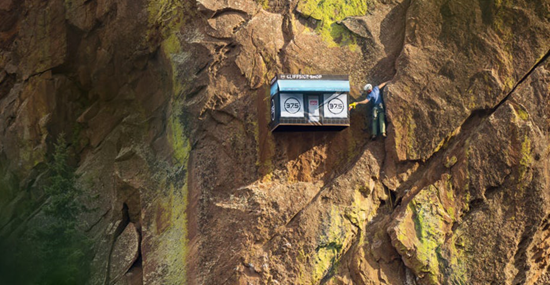
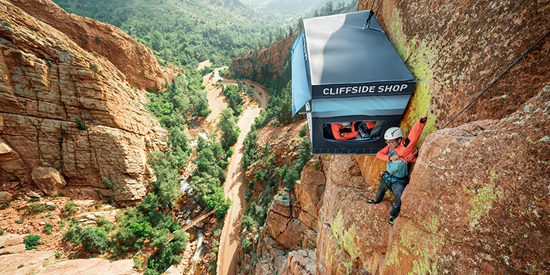
3. 37.5 Technology cliffside pop-up shop

wps1857.tmp

The prize for coolest hanging tent of 2017 is up for debate, but we don't think there'll be much argument about the award for coolest use of a hanging tent. Back in August, the folks at performance fabric company 37.5 Technology created what they called the "world's most remote pop-up shop." We're inclined to believe them because they operated out of a Black Diamond Cabana Double Portaledge climbing tent hung on a sheer cliff face above Boulder, Colorado at an elevation just under 6,700 feet (2,042 m).

The "shop" part is a bit of a misnomer since 37.5 actually handed out free clothing made from its volcanic sand and coconut fiber-based fabric. But we guess if you climbed up the 350-ft (107-m) crag in Eldorado Canyon State Park, you earned yourself a bit of swag.

Sure, it was basically just a marketing stunt, but it was pretty unique and did raise US$15,000 for various climbing organizations – US$100 for each of the 150 climbers who stopped by. You can read more about the effort it took to "open shop" from 37.5...or just keep your eyes set high, as it hasn't ruled out popping up at another popular crag.

Camping the high seas...or at least a pond or lake

You love playing in the water all day, so why not sleep there (or at least on your favorite water toy)? That's the strategy a few tent makers are taking, and if you're using an inflatable watercraft, it might just make sense.

4. SmithFly Shoal

wps8E73.tmp

Out of the few different watercraft tents we saw this year, the SmithFly Shoal looked like the least capable watercraft. In fact, we're not sure you'd want to paddle it very far at all. But the Shoal also looked like the one you'd most enjoy camping in. Its flat inflatable raft/floor looks downright cozy, and the broad-sided tent rises high enough for about 6.3 ft (1.9 m) of standing room after inflating into shape. SmithFly says it'll hold up to high winds and weather, but we reckon you better have a good anchor when out on the water. If water camping doesn't work out, the tent can be used back on land.

The US$1,499 price tag looks a little ridiculous, but there's not exactly a ton of competition in the water-top camping market. SmithFly is advertising January deliveries on new orders.

5. Hold Up Le Tunnel

wps4735.tmp

Whether or not you like the idea of sleeping on the water, using your inflatable watercraft as a sleeping pad does make some sense. Why carry an inflatable sleeping pad when you already have one in the form of a raft or paddleboard?

The folks at Hold Up have designed the Le Tunnel tent to work with their Trekker paddleboard in creating a solo shelter with inflatable SUP mattress below you and weatherproof shelter over your head. On the water, the tent stows in a dry bag strapped to the board, so you have a familiar, performance-oriented paddleboard to use during the day and a shelter at night.

Hold Up and its products came to our attention during the ISPO show back in February, but the company has not yet added the Le Tunnel (or pricing information) to its online store.

Living at penthouse level

Roof-top tents (RTT) is another category of outdoor shelter that has seen an explosion in recent years, pulling campers up off the ground for a comfy night of sleep. Basic soft-sided flip-outs and hard-shell pop-tops still rule, but 2017 saw several companies exploring new tent types and tweaked designs.

6. iKamper Skycamp

wps331D.tmp

When we first saw the Hardtop One, we knew iKamper was on to something. Hard-shell roof-top tents are prized for their sleeker form and easier set-up and teardown, but they're limited in interior space due to the fact that their footprints are contained within the confines of the vehicle roof. IKamper gives the hard-shell RTT the ability to expand out beyond that footprint and sleep a family of four.

In place of the Hardtop One's sliding floor extension, the new Skycamp uses a fold-out extension to create a more spacious interior for three adults or two adults and two children. And though it pops and folds, instead of just popping up like other hard-shells, you're still only looking at about a minute of set-up time. Another nice feature: detachable fabric, so you can go breezy mesh in the summer and heavier canvas in the cooler months.

It seems the market was ready for exactly this type of RTT, as iKamper raised over US$2 million on Kickstarter earlier this year. It's been shipping tents out to backers and is now offering tents at retail prices between US$3,300 and US$3,500, depending upon fabric selection. You'll find these tents, along with some accessories, at iKamper's online store.

7. Gentletent GT Roof

wps5299.tmp

While iKamper and others were working to improve upon traditional RTT designs, some other industry minds were thinking outside the box. Australia's Moab Rooftop Tents plopped a dome tent on the roof, while Austria's Gentletent put some air into RTT design, introducing the GT Roof inflatable tent at the Düsseldorf Caravan Salon. The GT Roof's five-minute set-up is actually a bit longer than hard-shell RTTs, but on the plus side, the two-person comes in at a company-estimated 44 lb/20 kg (the Skycamp above weighs around 150 lb/68 kg, for comparison).

The inflatable floor sounds like a comfortable bonus, but we have trouble thinking about a lightweight, inflatable roof-top tent without picturing those giant wind tube men that local businesses use to catch your attention. Hopefully, the €2,300 (approx. US$2,700) Gentletent GT Roof experience is better than the one we're picturing.

Go it alone or with the entire crew

8. RhinoWolf

wps1E37.tmp

The internet isn't the only place that folks like to be social. Millennials have been transforming outdoor activities from goal-oriented, gear-obsessed sporting ventures to more relaxed social experiences. So grab a beer, play a little cornhole and prepare to retire in a monster tent with a dozen or two of your bestest and newest friends.

The RhinoWolf was one of the modular, expandable tent systems we saw this year, and it took on a different form from others. Each 2.8-lb (1.3-kg) freestanding shelter is small enough to use as a solo backpacking tent, but if you find yourself missing the experience of tenting with others, you can zip one RhinoWolf together with one or two more to create a larger two- or three-person shelter.

This capability is limited only by the number of tents at the campsite, and perhaps the terrain, so, with the right number of RhinoWolfs and a desire to do it, you can create a long camping tunnel for everyone at camp. Each RhinoWolf is designed specifically around a Klymit sleeping pad and zip-in quilt, creating an all-in-one sleeping solution that weighs in at around 5.5 lb (2.5 kg).

RhinoWolf held a successful Indiegogo campaign earlier this year, and according to a late-November update on that campaign, it was on track to start shipping before the end of 2017.

If you're looking for outdoor gear every bit as cool and innovative as these tents, be sure to check out our camping gadget and gift favorites.

See more images at the gallery.

Top image: 37.5 Cliffside Shop. Credit: 37.5 Technology.

[Source: New Atlas.]

Sunday, 17 December 2017

13 TECHS THAT DIED IN 2017

wps7940.tmp
In Memoriam: The Tech That Died in 2017
By Eric Griffith,
PCMag, 15 December 2017.

Every year brings its hardships and losses. The tech world is not immune; brands and gadgets come and go. A must-have device or addictive service is easily discarded as VC funds dry up and newer, shinier offerings emerge.

Once again, PCMag is here to remind you of the tech tools and interfaces that will not be joining us in 2018 (until a future re-launch; I'm looking at you, Polaroid). We're not talking about the start-ups that barely got off the ground, but the well-known brands that said farewell in the past 12 months.

Many were forgotten by the masses long ago; it may surprise you they even still existed in 2017. But all (okay, most) are worthy of a quick doff of the hat in respect for the fallen.

(For a look back, check out the tech we lost in 2015 and 2016.)

1. AOL Instant Messenger, Alto Email


Verizon now owns what's left of AOL - what many of us used to call America Online - and this year, it took a couple of AOL features out of commission, permanently. The first to go on Dec. 10 was the AOL Alto Email Service. It was supposed to be a smart inbox for mobile users, but failed to get any traction after five years.

The same can't be said for AOL Instant Messenger, aka AIM, which most of us probably used at one time or another. But in the last decade, rival services like iMessage, Facebook Messenger, Google Hangouts, Snapchat, and a billion other messaging services easily eclipsed AIM, and its user base dwindled. The writing was on the wall back in March when AOL pulled third-party support from the AIM service. By October, the original instant messaging service's fate was sealed, and AIM was dead by Dec. 15. RIP.

2. CompuServe Forums

wps3F60.tmp

CompuServe's Forums - an internet destination that was all the rage back in the early 90s - went dark on Dec. 15. You'd be forgiven for thinking they were no longer a thing, but remarkably, they have lived on - until today. No explanation was given for the closure. However, like AIM, CompuServe is now under the control of Verizon-owned Oath.

3. Net Neutrality


The saddest thing on this year's list is the death of a principle: an open and free internet where ISPs treat all data the same no matter the source.

The term net neutrality dates back to 2003, coined by Columbia University law professor Tim Wu, but didn't really start making headlines until 2007 when Comcast was accused of blocking P2P traffic. That led to an enforcement action under the GOP-led FCC, and the introduction of formal net neutrality rules under Obama in 2009. But the issue was then caught up in the courts for years as ISPs like Verizon sued, arguing that the FCC did not have the authority to regulate broadband providers.

By 2014, the FCC made the controversial decision to reclassify broadband as a telecom service rather than an information service. Broadband had become a public utility like water or electricity - not a luxury, the FCC argued. And that argument held up - until Trump won and selected Ajit Pai as FCC chairman.

Pai, a former Verizon lawyer, hates the "utility-style regulatory approach" and thinks the internet has fared just fine without regulation. He voted against the net neutrality rules in 2015 when he was just a commissioner, and moved to gut them when he became chairman. This week, he got his wish, when the FCC voted 3 to 2 on party lines to reverse the Obama-era net neutrality rules.

All this despite calls by internet pioneers like Tim Berners Lee and many in Congress asking for a pause to the proceedings (if for no other reason than the comment period was full of fake and duplicate comments).

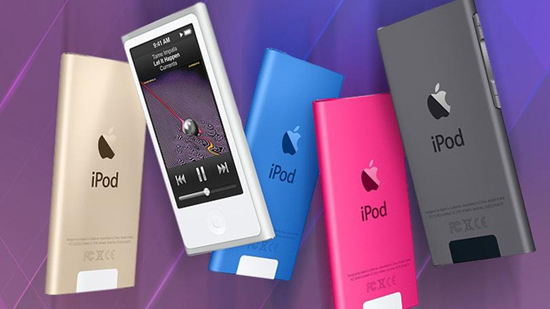
4. iPod Nano and Shuffle

wpsB02C.tmp

Smartphones pretty much killed MP3 players, but Apple's iPod was still kicking around - until this year. Apple said in July it would kill the last two standalone iPods in its lineup: the iPod nano and shuffle. While you can still buy them until the stock runs out, the screen-free shuffle and small-screen nano won't be getting updates, ever again. Is the iPod touch next?

5. Google Spaces

wps541E.tmp

Launched in 2016, Google Spaces was supposed to be a messaging app for small groups to help them get organized, sort of like Slack, but not just for businesses. Heralded as a "pointless exercise" almost immediately, Google must have agreed. It killed Spaces in under a year.

6. Wunderlist, Word Flow, and Groove Music

wps105A.tmp

Microsoft, much like Google, isn't afraid to kill off a service or product that isn't doing much for the bottom line. But unlike its rival, Microsoft often serves up an even better replacement.

That's what happened with Wunderlist, an excellent cloud-based task-management app. It launched in 2013 and was acquired by Microsoft in 2015. But in April, Microsoft introduced To-Do, a new "intelligent task management app" built by the Wunderlist team. To-Do is currently in preview, but once it's up to snuff, Microsoft will retire Wunderlist, so it's perhaps best to familiarize yourself with To-Do (or any of our other favorite to-do list apps).

The same thing happened to Word Flow, a mobile keyboard Microsoft made for Windows Phone but later ported to iOS. It was best known for offering very cool one-handed typing options, as well as GIFs and customized themes. But earlier this year, people noticed that Word Flow was no longer available on iOS. If you search for it in the App Store, you're directed to Swiftkey, a rival keyboard app Microsoft acquired in 2016.

Groove Music, meanwhile, launched in 2012 as Xbox Music, and was intended to take on rival services like Apple Music, Tidal, and Spotify. That didn't happen, though; the Groove Music Pass streaming service will shut down on Dec. 31. Music purchased on Groove will still be accessible on OneDrive, and users can get a 60-day free trial of Spotify to fill the void in their lives.

7. Facebook Ticker

wps43CF.tmp

Remember when Facebook used to show you things from your friends in chronological order? It gave that up in favor of algorithms a few years back, but to satisfy those who wanted to keep up with every like, comment, and photo, it added the Ticker in 2011. This running stream of all your friends' activities has been clogging up your News Feed ever since, until this month when Facebook unceremoniously axed the feature. Facebook is now all algorithms, all the time.

8. App.net


In 2012, Dalton Caldwell, founder of music service imeem, announced plans for a Kickstarter-like, 30-day online funding campaign that would gather money for a Twitter-like service that would rely on paid subscribers rather than ad dollars. In a video (above) announcing the project, Caldwell said he was "really disappointed with the way that free, Web 2.0 services have let me down." The focus at firms like Twitter, he said, had been on advertisers, resulting in a poor experience for users and developers.

Ultimately, that online funding effort topped $500,000 but not enough people wanted to pay $50 per year for a social media account. By 2014, App.net said it didn't have enough money to pay its employees, and the site languished until March 2017, when it finally shut down.

9. Yik Yak

wps4939.tmp

Yik Yak debuted as an anonymous social media network, and nothing bad ever happens with gossipy, anonymous posts, right? Not exactly. It was once considered a $400 million brand, but anonymous cruelty isn't a great business plan, and the kids lost interest. In the end, Square bought Yik Yak's engineers for $1 million.

10. Jawbone

wpsF318.tmp

Launched in 1999 as AliphCom to make communications equipment for soldiers in the field, Jawbone was an early pioneer in Bluetooth audio for cell phones, with unique looking headsets called the Jawbone, from which the company eventually took its final name. By 2010 it was making speakers (JamBox), and the UP brand of wearables debuted in 2011 for a $1.5 billion valuation in 2012.

Despite the buzz - its CEO was in Fortune's 40 Under 40 in 2012 and one of Time's 100 Most Influential People of 2014 - it couldn't last. Jawbone needed investment to keep up with acquisitions and pay its lawyers (it sued Fitbit and lost). By 2015, it was all-in with fitness trackers, but only had 2.8 percent of the market. It liquidated its assets in July.

11. Vertu

wpsDE26.tmp

Vertu sold ridiculously expensive "luxury" Android phones made with high-end materials like titanium, sapphire, and ostrich leather. But $9,000+ phones were not enough to sustain UK manufacturing operations, which shut down in July. Murat Hakan Uzan, who bought Vertu in March 2017, says he'll bring the brand back someday. We hope so, as it was always fun to include Vertu in roundups of over-priced tech or ridiculously niche smartphones.

12. Lily Flying Camera Drone


When we first discovered Lily back in 2015, we described it as an "action cam with a brain" It was supposed to follow you around and record your every move from on high; simply toss it in the air to get going. Like everyone else, we were astounded it had $34 million in pre-orders the following year. That's a lot, even for a $900 waterproof drone. But it wasn't enough. Lily will never come to market, dead before it even got a chance to live beyond the concept stage. If you ordered one, you should have already received a refund.

13. The Gaming World Mourns

wps99E6.tmp

Turbine shut down the servers for the Windows-based MMORPG Asheron's Call and Asheron's Call 2: Fallen Kings (from 2003) in January. The original, published by Microsoft, had been running since 1999 and was the third big game of its kind, after Ultima Online and Everquest.

A more recent game was Marvel Heroes, called Marvel Heroes Omega by the end, a free MMORPG famed for having comics writer Brian Michael Bendis involved when it launched in 2013. But this year, Disney (owners of Marvel) cut all ties with the developers at Gazillion Entertainment, the rights went away, and the servers were unceremoniously shut down early since the whole thing put Gazillion out of business.

Nintendo also went on a murder spree in 2017. In April, it stopped selling the Classic Edition retro gaming console. In November, it did away with the Miiverse - the social network within the Wii and 3DS for posting art. And the deaths continue into the future: the Wii Shop for buying games will be killed off fully by 2019.

[Source: PCMag.]