Pages

Sunday, 4 February 2018

23 UNDERWATER DRONES - THE BOOM IN ROBOTICS BENEATH THE WAVES

wps3F41.tmp
23 Underwater Drones - The Boom in Robotics Beneath the Waves
By Tom Metcalfe,
Live Science, 21 January 2018.

Aerial drones have buzzed their way into almost every aspect of the modern world, from photography and television news coverage, to environmental monitoring and archaeology.

And many of the concepts developed for aerial drones are being adopted and adapted to work in a very different environment - underwater.

Here's a look at 23 of the many ways that drones are being used beneath the waves, by oceanographic scientists, archaeologists, militaries, commercial divers, photographers and undersea explorers.

1. Shipwreck Search

wpsA426.tmp

Concepts developed in aerial drones, such as greater levels of autonomy, are finding new expression underwater. Autonomy - the ability to take action without direct control - makes a drone more like a true robot and less like a remote-controlled device.

Although they lack of complete autonomy, very advanced remote-operated underwater vehicles, known as ROVs, have become a mainstay of scientific and commercial underwater operations, from undersea oil drilling projects to scientific research in the most extreme environments in the ocean.

The most celebrated ROV team are Argo, ANGUS and Jason Junior (shown above) which were used by the US research ship Knorr to discover the shipwreck of the Titanic in 1985 - after they had completed a top-secret mission to inspect the remains of a lost US Navy nuclear submarine, the USS Scorpion.

2. Robot ROVs

wps51DD.tmp
Photo credit: Schilling Robotics

The Deepwater Horizon oil spill in 2010 resulted in a gathering of the world's largest robotic underwater armada, as about a dozen large "work-class" ROV's struggled for months to stem the oil gushing from a shattered wellhead on the seafloor beneath 5,100 feet (1,600 meters) of water.

Among the lessons learned: making ROVs more autonomous, even while they remain tethered by an umbilical cable to a control ship on the surface. Advanced ROV's - like the Schilling UHD shown here above a test pool - already use pressure gauges, compasses and doppler sonar to keep themselves oriented; automating ROVs further could help to refine their awareness of what surrounds them, a feature that might have been useful navigating cables and moving gear in the Gulf.

3. Diving Buddy

wpsC809.tmp
Photo credit: Deep Trekker

Thanks to miniaturization, you don't need a support ship to operate an ROV. The electrical conductivity of saltwater makes radio communication very difficult underwater, so ROVs are connected directly to an operator by long umbilical cables to carry out expert tasks like underwater inspections.

A commercial example is the Deep Trekker drone shown above, which is controlled by a video-link handset that can be operated from the surface or by a diver in the water. When fitted with a multibeam sonar system that can "see" in dark or murky waters, the drone has been used by scuba divers to search for shipwrecks in Lake Huron, and to explore inside the protected wreck of the USS Arizona at Pearl Harbor in Hawaii.

4. Yellow Submarine

wpsC825.tmp
Photo credit: Lockheed Martin

Fully autonomous underwater drones offer advantages that are already being put to work by the oil and gas industry. Lockheed Martin's yellow Marlin drone submarine has been used to inspect offshore rigs and underwater pipelines, a sector that costs up to a billion dollars a year in the Gulf of Mexico.

The Marlin can take operate at depths of up to 1,000 feet (300 m) and keep going for up to 16 hours. An updated version of the drone, the Marlin Mk2 shown above, featured in a U.S. Navy technology demonstration that included launching a Lockheed Martin Vector Hawk aerial drone.

5. Deep Divers

wps6A21.tmp

Underwater drones have been used to explore the most extreme depths of the world’s oceans. The Nereus was a hybrid of an autonomous drone and a remote controlled ROV built by the Woods Hole Oceanographic Institution to explore Challenger Deep in the Mariana Trench near Guam, the deepest surveyed point of the world’s oceans, at a depth of 35,768 feet (10,902 m).

Nereus successfully reached the bottom of Challenger Deep in May 2009, but the vessel was lost in 2014 while exploring the Kermadec Trench near New Zealand, at a depth of 32,500 feet (9,900 meters), when it imploded due to high pressures as high as 16,000 lbs. per square inch (psi).

6. Wave Gliders

wpsF1C1.tmp
Photo credit: Liquid Robotics/Facebook

The most travelled drones on the planet are Wave Gliders, developed by California tech firm Liquid Robotics, which have covered more than 1.4 million miles of ocean so far. Each drone consists of a surfboard-sized "float" and a wing-shaped "sub" that hangs up to 26 feet (8 meters) under the water. The drones use wave motion and solar power to travel thousands of miles at sea without fuel, with applications in environmental monitoring, defense and maritime surveillance, and offshore oil-and-gas operations.

7. Ocean Gliders

wps4456.tmp

Autonomous ocean gliders, or underwater gliders, like the Slocum glider shown above, can convert small changes in buoyancy into forward motion. They are used extensively for scientific research at sea, such as remote water sampling, environmental monitoring, or acoustical surveillance over months and thousands of miles of ocean.

In 2016, ocean gliders equipped with microphones recorded the mysterious "Western Pacific Biotwang," which researchers think may be the never-heard-before call of a minke whale.

8. Underwater Mapping

wpsE125.tmp
Photo credit: Phil Short

Experts eventually foresee a fleet of underwater robots mapping the floors of the oceans, lakes and rivers - much like Google has mapped the streets.

Underwater drones have already been used to map underwater sites of importance. In 2015, the Sirius AUV, shown above, was used to map the Antikythera Mechanism were found, along with other treasures.

9. Fly and Dive

wps364B.tmp

A drone that can fly and dive may seem like a cool gimmick at first, but there are numerous applications for such a unique talent. The 'Naviator' drone is being developed by a team at Rutgers University School of Engineering, who see it being used to inspect bridges both above and below the water, for search and rescue operations, and the evaluation of seaborne environmental incidents, like oil spills or algae blooms.

A fly-and-dive drone could also be used for research into wildlife species like whales that spend time both above and below the waves.

10. South China Sea Drone Drama

wps8BFD.tmp
Photo credit: US Navy

In December 2016, a Chinese warship seized an underwater autonomous drone deployed by a US Navy oceanographic research vessel, the USS Bowditch, in the contested South China Sea region.

According to news reports, crew of the Bowditch were about to recover the drone after its mission when it was picked up by a Chinese warship instead.

The Chinese government returned the drone to the US Navy a few days later.

11. Underwater warriors

wps5596.tmp
Photo credit: US Navy/Flickr

In September this year the US Navy created its first dedicated underwater drone unit: Unmanned Undersea Vehicle Squadron One, or UUVRON 1 for short. The US Navy sees underwater drones eventually being used in "every spectrum" of naval operations, from mine hunting and surveillance to humanitarian assistance and scientific research.

The above image shows civilian contractors for the US Navy securing a Kingfish underwater vehicle, which can use side scan sonar to search for and investigate suspected naval mines and other objects of interest floating or on the sea floor.

12. Experimental Naval Drone

wpsEB7.tmp
Photo: AUVAC

The US Navy's Naval Undersea Warfare Center (NUWC) has developed its Manta unmanned underwater vehicle as a modular test bed for autonomous underwater drone technologies.

The Manta UUV is over 30 feet long and carries a payload of up to five tons, which can include additional smaller underwater drones, for which it acts like a mother ship, and torpedo weapons.

13. Mantabot

wps7784.tmp
Photo credit: University of Virginia/YouTube

The US Navy is also funding research into advanced underwater drone concepts like the swimming "Mantabot" developed at the University of Virginia, which uses silicone fins for swimming based directly on the cow-nosed ray, a species related to mantas.

The streamlined shape and swimming technique allows the drone to move quickly and quietly through the water using relatively little energy - a useful feature for underwater drones that would let them stay at sea for long periods without recharging.

14. Naval Drone Swarms

wps249E.tmp

A recent briefing paper for the UK Parliament, as it considered whether to modernize or scrap its Trident nuclear missile subs, warned that advances in drone technology could soon make submarine warfare obsolete.

The report warned that swarms of cheap robot sub-hunters could blanket the oceans with acoustical and other sensors that could negate a submarine's ability to travel undetected underwater.

The US Navy has also experimented with autonomous boat drones to guard US ships and swarm enemy vessels.

15. Science Swarm

wps7550.tmp
Photo credit: IZGartlife (University of Ganz)/YouTube

The world’s navies are not the only ones interested in swarms of underwater drones - scientists are too. Researchers at the University of Ganz in Austria have developed the CoCoRo swarm of more than 40 underwater bots to research how they can act together to accomplish various tasks underwater.

The autonomous drones in the CoCoRo swarm come in three different types, depending on their function, and use flashes of light to communicate.

16. Plankton Mapping Swarms

wps5352.tmp

Scientists have also used swarms of underwater drones to investigate environmental events like plankton mating.

Researchers at the University of California-San Diego build a swarm of 16 autonomous underwater drones and dropped them off the coast.

The drones were told to stay at a depth of 33 feet, and to drift with and map the "internal waves" that enable by plankton species to mate.

17. Floating Sensor Networks

wps1EF0.tmp
Photo credit: Hydroswarm/Twitter

Tech start-up Hydroswarm wants to build thousands of pumpkin-shaped underwater drones to map the oceans and act as a surveillance system for everything from oil pollution to illegal fishing to drug smuggling.

The EVE underwater drone - standing for Ellipsoidal Vehicle for Exploration - was developed by Sampriti Bhattacharyya, a mechanical engineer at the Massachusetts Institute of Technology. Bhattacharyya says the EVE drone is designed to be used independently or as part of a swarm of underwater drones that could create a Google Maps for the oceans.

18. Underwater Robot Miners

wps1EF.tmp
Photo credit: VAMOS Project

Underwater robots designed to work in hazardous flooded mines were tested at a china-clay pit in the UK in October this year.

The EU-funded VAMOS project (Viable Alternative Mine Operating System) is developing three types of underwater drones to extract minerals from abandoned, flooded mine sites considered too dangerous or costly to access.

Mines deeper than the local water table usually fill with water unless it is pumped out - eventually they are abandoned and flood completely. The developers say it makes more sense to reopen an existed mine with robot miners, rather than excavate a new pit.

19. Drones Under the Ice

wps6BAF.tmp

Underwater drones are used by scientists to explore some of the most remote regions of the oceans - including the coldest waters on earth, beneath Antarctica's ice shelves, where the temperature is a few degrees below the normal freezing point because of the salinity of the seawater.

Researchers have deployed torpedo-shaped drones from holes cut into the ice, equipped with radiometers to measure the light absorbed by clumps of ice algae growing on the bottom of the ice shelf.

Based on the drone measurements, scientists are able to estimate the total amount of algae growing on the ice - an important source of food in the ecosystems beneath the ice shelves.

20. Wartime Wreck Search

wps79F.tmp
Photo credit: Project Recover

Underwater robots have also been used to search for the downed wrecks of American warplanes from World War II, as part of an effort to discover the final resting places of their crew.

"Project Recover" uses a variety of new underwater technologies, including autonomous underwater drones equipped with sonar and cameras, to make a thorough and regular search of the ocean floor for wartime plane wrecks, which are often very hard to spot.

In 2014, Project Recover divers using drones found two World War 2 warplanes in the islands of the Republic of Palau in the Western Pacific Ocean, and in 2016 they found two lost B-52 bombers near Papua New Guinea.

21. Anti-Lionfish Drones
wpsC321.tmp

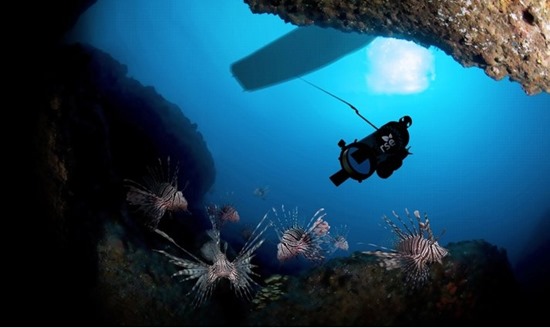
A non-profit group called Robots in Service of the Environment (RSE) is developing an underwater drone to hunt down and terminate Asian lionfish, which have become a serious threat to coral reef systems in the Western Pacific, where they have no natural predators.

The deep-diving drone is guided by controllers at the surface to track and close on the invasive fishy enemy, before sucking them into a containment tube and stunning them with an electrical charge - one drone can humanely dispatch up to ten lionfish before returning to the surface with its catch.

22. Manta Ray Drone

wps9C5E.tmp
Photo credit: Evologics/YouTube

The BOSS Manta Ray is an autonomous underwater drone developed by German robotics company Evologics, which specialises in aerospace and maritime robotics.

The drone is designed to mimic the manta's flexible body, which gives it the ability to control its depth very precisely with its large wings, while its "flapping" mode of swimming is very energy efficient. It is also equipped with jet thrusters to give it a high-speed mode.

23. Robotic Jellyfish

wps91CC.tmp
Photo credit: Festo

Like Evologics, some other underwater drone makers technology companies are also looking for ideas from nature - a concept known as biomimicry.

German engineering company Festo has developed its Aquajelly underwater robots to mimic the swimming motions of jellyfish. They can also communicate with each other - something real jellyfish probably can't do - to coordinate their behaviour.

Top image: Festo AquaJellies 2.0. Credit: Festo.

[Source: Live Science. Some links added.]

Saturday, 3 February 2018

VIDEO: WHY SITTING IS BAD FOR YOU

wps9625.tmp
Sitting down for brief periods can help us recover from stress or recuperate from exercise. But nowadays, our lifestyles make us sit much more than we move around. Are our bodies built for such a sedentary existence? In this video by TED-Ed, Murat Dalkilinç investigates the hidden risks of sitting down.


[Source: TED-Ed/YouTube.]

INFOGRAPHIC: THE DAZZLING ALLURE OF CRYPTOCURRENCY - DISPELLING THE MYTHS OF THE CRYPTOCURRENCY WORLD

wps33E8.tmp
Like a genie appearing out of thin air promising success, cryptocurrency has developed a mythical aura. The cryptocurrency world is evolving at a speed that leaves many newcomers lost in a haze of uncertainty. The following infographic by Coin Central helps dispell some of the most popular myths and help get you on track to a better and more complete understanding.

https://coincentral.com/wp-content/uploads/2018/01/coincentral.png

Infographic Sources:
1.
Zcash
2. Litecoin
3. Monero
4. Bitinfocharts
5. Cryptocurrency Market Capitalizations
6. Bitcoin: Some things you need to know
7. SEC Issues Investigative Report Concluding DAO Tokens, a Digital Asset, Were Securities
8. Virtual Currencies Now Permissible Investments in Vermont
9. IRS Virtual Currency Guidance
10. A Fistful of Bitcoins: Characterizing Payments Among Men with No Names
11. Rise of Bitcoin Competitor Ripple Creates Wealth to Rival Zuckerberg
12. BitLicense Regulatory Framework
13. Why the Price of Ripple is So Much Less than Bitcoin
14. Ripple cryptocurrency surges as Japanese groups agree to use it
15. South Korea Clamps Down on Bitcoin Trading Amid Market Frenzy
16. Statement on Cryptocurrencies and Initial Coin Offerings
17. Delaware Passes Groundbreaking Blockchain Regulation Bill
18. Russia Will 'Never' Consider Bitcoin Legalization, Says Minister
19. Monero’s Third Birthday: A Complex History, Promising Future
20. What Happens to Bitcoin After All 21 Million are Mined?
21. Arizona’s Blockchain Bill Passes Senate Leading the Way to Smart Contracts
22. Why Is Bitcoin's Value So Volatile?
23. European Parliament Parliamentary Questions: Answer given by Vice-President Ansip on behalf of the Commission
24. Bitcoin is Now Useless for Micropayments, But Solutions are Coming
25. China has declared the hottest part of the cryptocurrecy market “illegal”
26. Illinois Department of Financial and Professional Regulation: Digital Currency Regulatory Guidance
27. Litecoin founder Charlie Lee says he’s sold all his holdings in the cryptocurrency
28. Bitcoin investors beware: The IRS wants its cut and you may not know it
29. Blockchain in the U.S. Regulatory Setting: Evidentiary Use in Vermont, Delaware, and Elsewhere
30. Cryptocurrencies: Regulation: Written question - 110111
31. 2017 Global Cryptocurrency Benchmarking Study
32. Bitcoin Regulation In China Still Unclear, But Chinese Exchanges Thrive Overseas

[Post Source: Coin Central.]

Friday, 2 February 2018

9 MUSEUMS AROUND THE WORLD THAT EVERY CAT LOVER SHOULD VISIT

wpsDFCA.tmp
9 Museums Around the World That Every Cat Lover Should Visit
By Kirstin Fawcett,
Mental Floss, 30 January 2018.

Cats are put on a pedestal (sometimes literally) at a handful of feline-loving museums around the world. Here are nine institutions that showcase kitty artifacts, host feline-themed exhibitions, and even serve as homes to real-life cats.

1. The Cat Museum - Kuching, Malaysia

wpsC97D.tmp
Image: Patrick Liu/Wikimedia Commons

People in Kuching, Malaysia, are kitty crazy: Even the city’s name means "cat" in Malay. Kuching is filled with large feline statues, the local radio station is called “Cats FM,” and guests at the 2017 ASEAN Film Festival and Awards, held in Kuching, helped set a Guinness record for the largest gathering of people dressed as cats. It’s perhaps no surprise, then, that Kuching is also home to an impressive cat museum.

Located in Kuching City North City Hall, the museum contains four galleries filled with thousands of feline artworks, cat relics, photos, and other objects (including an Egyptian mummified cat). They trace the history of cats and examine different cultural depictions of felines from around the world.

2. The Cat Museum - Šiauliai, Lithuania

wps5F6B.tmp
Image: Antuanas/Flickr // CC BY-NC-ND 2.0

Šiauliai, Lithuania’s fourth-largest city, has its very own cat museum. Local animal lover Vanda Kavaliauskienė founded the attraction in 1990 after her collection of cat-themed memorabilia grew too large for her apartment. Visitors can view thousands of artifacts - including photos, artworks, and mini feline figurines from around the world - or cozy up with live cats strolling around the premises. (There’s also a mini-zoo with exotic animals if you experience cat overload.)

3. The Cat Museum - Minsk, Belarus

wps748D.tmp
Image: Cat Museum/Facebook

In addition to viewing plenty of cat art, visitors at the Cat Museum in Minsk, Belarus can check out special exhibitions, enjoy cat-themed books and games, make cat art, and sip coffee or tea in a cat-themed café - all while petting members of the museum’s cat “staff.” These adoptable rescue kitties live on site and are presided over by Donut, the museum’s feline “director.”

4. Kattenkabinet - Amsterdam, The Netherlands

wps2424.tmp
Image: Kent Wang/Flickr

Housed in a restored 15th-century home on Amsterdam’s Herengracht canal, the KattenKabinet (“Cat Cabinet”) art museum examines the role that cats play in art and culture. Museum founder/homeowner Bob Meijer launched the attraction in 1990 in honor of his beloved deceased tom, which he’d named John Pierpont Morgan after the famed U.S. banker.

In addition to a section devoted to John Pierpont Morgan, the KattenKabinet’s collections include original works by greats like Picasso, Toulouse-Lautrec, and Rembrandt - all of which depict cats, and are guarded by a bevy of in-house felines.

5. The Serpukhov Museum of History and Art - Serpukhov, Russia

wps251B.tmp
Image: Feline Frequency/Twitter

The Serpukhov Museum of History and Art is home to a valuable collection of Western European and Russian paintings and home furnishings. Most of these objects came from the collections of A. Maraeva, a successful merchant, and the museum itself is located in her former mansion.

In addition to providing visitors with a sense of local history, the Serpukhov Museum’s staff has been known to stage the occasional practical joke. In 2016, they decided to trick local media outlets by writing up a fake job application letter from an orange feline nicknamed Maray (for Maraeva) that hung around the mansion to greet visitors. Signed with a scribbled paw print, the note read: “As I am a direct relative of Maraeva, I ask you to give me a job in your museum. Maray the Cat.”

The museum sent the letter to the Russian media, along with a press release announcing that they’d taken the feline up on its offer. They ended up fielding so many questions about Maray that they decided to commit to the joke and hired him as a furry doorman. He now works a normal 9-to-5 shift, with his own special spot in the museum, and is compensated with food and shelter.

6. The Maneki Neko Museum - Cincinnati, Ohio, USA

wpsA23F.tmp
Image: Maneki Neko Museum/Facebook

Fans of Asian culture and cats can visit the Maneki Neko, or Lucky Cat Museum, in Cincinnati for an extra dose of good fortune. Housed in the small art space are more than 1000 models of the Japanese maneki neko, the “beckoning cat” with a raised paw you’ll often see in Asian restaurants as a symbol of luck and prosperity.

Museum owner and operator Micha Robertson began collecting maneki neko of all shapes, sizes, and designs more than a decade ago. Eventually, she amassed so many that she decided to open a tiny museum dedicated to her feline finds. "For me," Robertson told local radio station WVXU in 2015, "it’s just taking a basic idea - [it's] not just a cat, but it’s a cat with its paw raised - and it’s interpreted so many ways. Each one is very different from another. Even the ones that are the same basic look are still very different. I love seeing how many different ways it can be interpreted. And the weirder they are, the more I love them."

Robertson isn’t alone in her fascination: Two similar homages to the maneki neko exist in Japan, including the Maneki Neko Art Museum in Okayama and the Maneki Neko Museum in Seto.

7. Yumeji Art Museum - Okayama, Japan

wpsA76E.tmp
Image: Yumeji Art Museum/Facebook

Fans of Yumeji Takehisa (1884-1934), an influential Japanese artist and poet of the Taishō period, can visit museums dedicated to his work in Okayama and in Setouchi, Japan. But only the Okayama location has Kuronosuke [pictured above], a black-furred feline that serves as the establishment’s “manager” and mascot.

Museum officials rescued Kuronosuke in 2016 after a car nearly ran him over. Noting that the homeless kitty looked like a black cat from one of Takehisa’s illustrations, they decided to “hire” him to amuse visitors. Kuronosuke - all dressed up with a red ribbon around his neck - began regularly greeting museum patrons several times a week in December 2017. His attendance is “whimsical,” according to news reports, since he’s probably more interested in chasing mice than schmoozing with art lovers.

8. The American Museum of The House Cat - Sylva, North Carolina, USA

wps5EC9.tmp

Harold Sims is a retired biology professor and a full-time collector of cat memorabilia. With his wife Kay, he’s spent more than 30 years building a vast assortment of feline art, crafts, and tchotchkes. In April 2017, Sims opened up his own roadside museum, the American Museum of the House Cat, inside a Sylva, North Carolina antique mall. Its two rooms are filled to the brim with as many as 10,000 artifacts. (Still more cat objects exist in Sims’s private collection.)

Curiosities at the American Museum of the House Cat range from vintage kitty toys (such as 19th-century automatons) to an Egyptian cat amulet dating back to 1000 BCE and a petrified cat discovered in a 16th-century English chimney. Admission fees go towards Catman2, a no-kill cat shelter in Cullowhee, North Carolina that Sims opened adjacent to his home in 2002. In addition to 60 to 80 rescues per year, Catman2 is also home to - surprise! - even more cat art.

9. The State Hermitage Museum - St. Petersburg, Russia

wpsC392.tmp
Image: ewwl/Wikimedia Commons

The State Hermitage Museum houses more than 3 million works of art and artifacts, spread across a vast complex of historic buildings. Safeguarding these treasures are efficient security agents, many of whom have tails and whiskers.

The former Winter Palace, where Russia’s tsars once resided, is today the museum’s main building. It’s reportedly been home to cats for hundreds of years, beginning in 1745 when Empress Elisabeth issued a call for “the finest cats of Kazan” to help rid the building of mice. In later years, during the reign of Catherine the Great, these kitties were nicknamed the “Winter Palace cats.”

Today’s museum cats are a far cry from aristocratic mousers. Many (if not all) of them are former strays, some of which were found huddled near the museum’s underground heating system in the late 1990s. Their mere presence is said to deter mice, which are perhaps equally as dangerous to art as thieves or hands-y visitors.

The Hermitage cats are tended to by a team of full-time volunteers, managed by their own press secretary, and permitted to roam through staff offices (they’re banned from galleries and the museum director’s wing). They're also adoptable.

Top image: Kuching Cat Museum, Kuching, Sarawak, Malaysia. Credit: Shoestring/Wikimedia Commons.

[Source: Mental Floss. Some images added.]

Thursday, 1 February 2018

TOP 10 STRANGEST WIKIPEDIA EDIT WARS

wps9CD6.tmp
Top 10 Strangest Wikipedia Edit Wars
By Jack Francis,
Listverse, 1 February 2018.

Wikipedia is the site that has helped many people with a tough piece of homework. It’s a place loved by students but hated by teachers. A place that contains so much information that it would take 17 years of constant reading just to get through the English portion of the site. A place that anybody can edit - whenever, wherever, or whoever they are.

However, you probably don’t know that hidden battles occur every day all over the site to make sure that the information stored is not ruined. These “edit wars” are undertaken by those who believe it is their duty to protect certain articles on Wikipedia. They follow one simple rule: To keep the information consistent with how they want it to be.

10. Cuteness

wpsA743.tmp

What is cuteness? Is cuteness a survival technique, or is an animal’s cuteness based on opinion?

A variety of scientific studies have found that young animals look especially cute so that others are more likely to care for them. Dogs have specifically been bred by humans to be cute. For certain dog species, cuteness has been proven to be an effective way to pass their genes to the next generation.

But many would argue that the survival argument isn’t true and that cuteness is based on your own viewpoint. Surprisingly, this debate has caused around 22,000 total edits to the cuteness page by Wikipedia’s tireless editors. They have either added or removed words that discussed the survivability of cute animals.

9. Chicken, Alaska

wps2194.tmp
Photo credit: wavejourney.com

You would think that the population of a small village would not be a hot topic among Wikipedia’s volunteers, but around 9,000 edits have been made to the page about this tiny town in Alaska. The main disagreement concerns the 2000 census, which stated that only 17 people lived there. Eight were children (or chickens, as one editor wrote).

One editor aggressively argued that this is correct, as the statement that “for every 100 females there were 88.9 males...[is] absurd nonsense from an outdated source. [...] There are SEVENTEEN PEOPLE IN THE VILLAGE, for f—k’s sake.” Meanwhile, another editor argued that “forcing in meaningless statistics from a decade and a half ago is vandalism.”

As of early 2018, it seems that the warring editors have an uneasy truce. The Wikipedia page states that there were seven residents at the time of the 2010 census. But year-round, there are usually 17 inhabitants due to the mining in the area.

This may seem trivial to many. But luckily for the rest of us, there are some who want to keep this small town’s population updated and accurate.

8. Star Trek InTo Darkness?

wpsA26E.tmp
Photo credit: The Guardian

The release of Star Trek Into Darkness was received with criticism by Star Trek fans despite making over US$450 million in worldwide revenue. So you would probably expect that the Wikipedia editors argued about how the film was received by the audience, but that assumption would be wrong.

The real edit war concerned something much more trivial - the capitalization of “into” in the title. All the official media released by those behind Star Trek into Darkness had the word “into” capitalized, which led to a long battle between Wikipedia editors over whether the word should be “Into” or “into.” Believe or not, there were around 3,000 edits over this seemingly trivial point.

The debate appeared to be over for a while when the editors agreed to use “InTo.” But this truce seems to have ended now, with the current title on Wikipedia being Star Trek Into Darkness.

7. Cat

wps86E3.tmp
Photo credit: David Corby

Cats are one of humanity’s favorite pets and are loved by many people across the world. But what is the proper way to refer to the relationship between a human and his cat? This is a topic of hot debate among the Wikipedia editors.

The groups argue about the “power” dynamics in the human-cat relationship. Some maintain that the human “owner” is in charge of the relationship. Others contend that the cat holds all the power, with the human performing the role of “caregiver.”

The final side of the debate is probably the most hopeful. It asserts that the relationship is a companionship with benefits on both sides and that the human assumes the role of a “human companion.” So far, this argument has caused around 11,000 edits, a significant number for the simple cat.

6. Iron Maiden

wpsF667.tmp
Photo credit: thetimes.co.uk

Everyone has heard of the band Iron Maiden, which rose to fame in the early 1980s. They have released several platinum and gold albums in the US and UK and have sold over 100 million albums worldwide. So you wouldn’t expect any arguments about the band’s popularity.

You would be wrong, although there’s a twist to the debate. It’s over whether the band is more famous than the horrific torture and execution device known as the iron maiden. The first cited use of this device supposedly occurred in the 16th century, although it’s debatable whether this instrument of torture really existed.

Nevertheless, the Wikipedia editors are squabbling over whether the main page for “Iron Maiden” should be about the band or the torture device. The torture device is certainly more brutal. However, some people believe that the band is full of Satan worshipers since their release of the song “The Number of the Beast.” Allegedly, it is a satanic chant when played backward. Then again, what heavy metal song isn’t?

This disagreement has resulted in around 9,000 edits to where the link “Iron Maiden” leads. It is still changed frequently, so searching for “Iron Maiden” could bring you to either page.

5. Mathematics

wpsE8D8.tmp

Here’s a little-known fact: Clicking the first link outside of brackets on any Wikipedia article will normally lead you to philosophy. You can try it yourself. Go to any page, and you will find that clicking the first link will usually lead all the way back to philosophy. This is true for most pages on Wikipedia except mathematics and three of its first four links.

This has produced a multiyear edit war over how the first four links (which go to pages on quantity, change, structure, and space) should be ordered so that the mathematics page eventually goes to philosophy. The article that leads to philosophy is “space.” To play the “every link leads back to philosophy” game, “space” should be the first link on the mathematics page.

However, some people argue that manually changing the links to make sure that philosophy is first ruins the integrity of the game, so they restore the original order of the links. This has led to a countless number of edits to the mathematics page over many years.

4. Cow Tipping

wps6915.tmp
Photo credit: Commons Shaped Box

Cow tipping is the pushing over of an unsuspecting or sleeping cow for fun. It is supposedly a fun hobby for those who live in rural areas. But it is likely to be a myth because pushing a cow onto its side would require around 1,360 newtons of force. This is approximately equivalent to the force that 4–5 people could put out, but you would likely need more than that.

However, the edit war over this one is not about the truthfulness of the statement. Instead, the editors are feuding over the caption that accompanies the picture on the page. Certain people believe that the cow should be referred to as “an unsuspecting potential victim.”

In 2006, Psychonaut3000 (an editor of this page) stated that the cow is unsuspecting as it has no knowledge of cow tipping activities. Also, the cow is a potential victim as there is nothing to suggest that the cow is immune to being tipped. A reasonable point, but it has been argued back and forth more than 2,000 times!

3. Arachnophobia

wpsFE12.tmp

This page only has around 1,600 edits, but the nature of the edit war warrants its inclusion on this list. Arachnophobia (the fear of spiders) is the third most common phobia in the US, with 30.5 percent of the population reporting that they are afraid of spiders. It is behind only glossophobia (fear of public speaking) and necrophobia (fear of death) for most common phobias in the US.

For the arachnophobia page, the argument concerns whether a large picture of a tarantula should appear on the page. Some suggest that a page frequently visited by arachnophobes should not contain a picture that scares them. However, others contend that the picture should be visible to maintain the integrity of the website. Instead of removing the spider picture, these editors believe that it would be simpler for arachnophobes to turn off images in their browsers.

2. Jesus

wps7E6F.tmp

Whether you are Christian or not, most people know that Jesus was born in the year 4 BC according to the Bible. The argument on the Jesus page occurs on any Wikipedia page with a date, and that is whether to use BC/AD or BCE/CE. (At Listverse, we use BC and AD.)

As this subject is hotly debated on Wikipedia, there have been approximately 20,000 edits on the Jesus page alone. Although many votes have taken place to decide which side is right, the current agreement, at least on the Jesus page, appears to be on the BC/AD side at the time of this writing.

1. Tiger Or Lion?

wpsB23D.tmp

Which is the most powerful cat? The tiger or lion?

Seemingly a question that would normally be limited to playgrounds, this argument rages on the Wikipedia page for tigers, too. This has led to much annoyance on both sides. One editor, JBoyler, stated that they should “let the tiger’s actions speak for themselves” and that all those who argue that a tiger is the most powerful cat should “grow up” and stop ruining the page with “childish tantrums and quibbling.”

Some of the Wikipedia editors are not happy with simply comparing the tiger to the lion. They like to add to the page that tigers are also likely to be successful in battles against brown bears.

Top image credit: geralt/Pixabay.

[Source: Listverse. Top image added.]
