Space Photos: The Most Amazing Images This Week!
By Doris Elin Salazar, Space.com, 7 July 2019.
Passengers viewed the 2019 total solar eclipse from a plane flying over the Pacific Ocean, a ''mole'' emerged from underneath the Martian ground and the crew of the International Space Station captured the snow-capped peaks of a South American mountain range. These are just some of the Top Photos this week from Space.com.
More than 50 people got an aerial view of the July 2 total solar eclipse that crossed South America through Chile and Argentina. The passengers took a special flight operated by Chile-based airline LATAM, which took off from Easter Island, about 2,200 miles (3,540 kilometers) off the Chilean coast, and chased the moon's shadow as it rolled eastward across the Pacific.
This image of the North Pole shows noctilucent clouds, which are clouds that form at high altitudes and usually appear during the hour after the sun has set. The blues and purples seen at the center of the image represent the light from the clouds bouncing back into space. These reflectivity measurements were taken by NASA's Aeronomy of Ice in the Mesosphere (AIM) mission on June 12.
Image credit: Martin Bernetti/AFP/Getty via Space.com
Tourists wait for a solar eclipse at La Silla European Southern Observatory (ESO), in La Higuera, Coquimbo Region, Chile on Tuesday (July 2). The path of totality first made landfall in South America near La Serena, Chile and ended just south of Buenos Aires, Argentina.
The moon's shadow passes south of Hurricane Barbara during the total solar eclipse of July 2, 2019, in this photo captured by the weather satellite GOES West, which is a joint project of the National Oceanic and Atmospheric Administration (NOAA) and NASA. Tuesday's event was the first total solar eclipse since the August 2017 "Great American Solar Eclipse.''
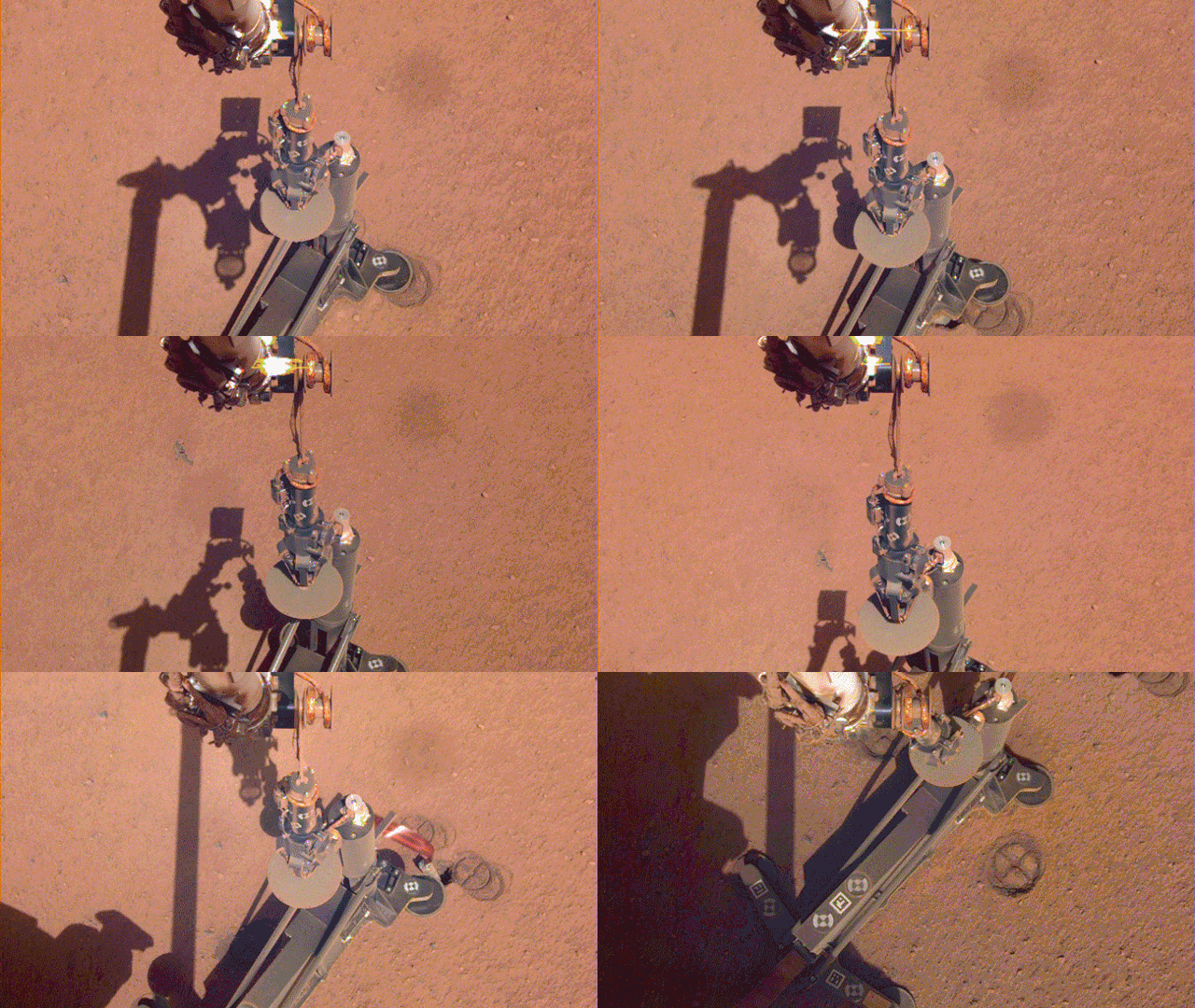
The Instrument Deployment Camera on NASA's InSight lander caught sight of its robotic arm moving the support structure for the "mole," a digging instrument that has stopped tunneling down through the Martian surface. InSight's engineers are relieved to have successfully removed the support structure, because they should now be able to more accurately diagnose the problem. The InSight lander is tasked with learning about the Red Planet's internal structure.
Details of the sun's brilliant corona come to light during the total solar eclipse of July 2 in this composite of polarized images captured from the European Southern Observatory's La Silla Observatory in Chile. The sun's corona, which is only visible during totality, can reveal information about magnetic activity on the surface of the sun. - Hanneke Weitering
Two NASA astronauts beamed home their holiday wishes from the International Space Station on Thursday (July 4). Christina Koch and Nick Hague are the only two Americans currently living off the planet. - Hanneke Weitering
A total solar eclipse darkens the sky above the La Silla Observatory in Chile in this aerial shot captured via drone during totality. Thousands of spectators had gathered at the observatory to see the eclipse. In the foreground are several of the telescopes that belong to the observatory, while the Andes Mountains provide a breathtaking backdrop. - Hanneke Weitering
A photo of Earth taken from the International Space Station reveals the frigid mountain tops of the Andes in South America. A total solar eclipse passed over this mountain range. Parts of Chile and Argentina witnessed totality, when the moon blocks out the sun entirely, while the rest of South America saw a partial eclipse. - Hanneke Weitering
Top image: Panoramic image of the 2 July 2019 total solar eclipse as it passed over ESO’s La Silla Observatory in Chile. Credit: ESO/M. Zamani.
[Source: Space.com. Top image and some links added.]
The Bizarre Proposed “Solutions” to Climate Change
By Himanshu Sharma, Toptenz, 5 July 2019.
Fighting climate change - a widely-used euphemism for the on-going climate catastrophe - is humanity’s biggest priority at this point. Or at least it should be, as most governments of the world are simply not bothered with something that may as well be the end of our species. It’s not even like we have to do impossible things to stop it; many scientists are of the opinion that if we just come together and take certain measures (like stick to treaties like the Paris agreement), we could avert the worst effects of it.
Though in usual human style, we’re busy thinking up other creative (and often outlandish) ways of trying to prevent this calamity, rather than actually joining hands and fixing what we’ve collectively broken. Here are some of the most bizarre potential solutions we’ve come up with to the biggest question facing humanity right now; how do we tackle climate change.
10. Blot out the sun
There are some definite reasons as to why things have got as bad as they are when it comes to ever-rising global temperatures. One of the biggest is greenhouse emissions. Nearly all industries around the world are responsible for it, and if countries like China look like major contributors to it right now, it’s only because the polluting stages of most developed countries are already in the distant past.
There are other culprits, too, though something that’s definitely not responsible is the existence of the Sun. In some weird leap of reason, however, some scientists have concluded that it’s the Sun that’s the whole problem, and are now looking for feasible ways to block it in order to cool the Earth down. They’re already planning experiments to inject chemicals into the atmosphere to dim the intensity of its rays, and while many other experts have warned against the adverse effects of literally dimming our primary source of energy, it looks like they’re going ahead with trying it out anyway.
9. Have smaller children
Even if the majority of the pollution and global warming is caused by industries, we all contribute to it in tiny ways. Every one of us has a carbon footprint, no matter how many plastic bottles we give up and online petitions against climate change we sign. Of course, it’s not nearly as much as, say, the oil industry, so as long as we do our part in living sustainably, things should be fine.
For some scientists though, the best way we can reduce our carbon footprint is by reducing the size of people themselves. In a research paper, some scientists argue that genetically engineering our babies to be smaller will go a long way in helping the environment. It seems that they came up with this by solving the incredibly complex ‘big people = big pollution’ equation. It may even work, though we think that there might be better ways of doing this without the whole eugenics vibe.
8. Using cow farts as fuel
Vegans may be annoying, though they aren’t entirely wrong. The meat industry is actually quite a huge producer of greenhouse emissions, and cutting down on our meat consumption may really help with global warming. Some of the animals bred for consumption produce particularly harmful gases like methane, which is much deadlier than your usual carbon dioxide and such. Take cows, who account for 25 percent of all methane emissions in the world. Instead of cutting down on meat consumption, though, some scientists have come up with what they think is a better way; collecting their farts and using it as fuel.
Despite how ridiculous it sounds, it may just be one of the more sensible options on this list, even if we’re yet to fully work out the logistics of how it would work. Argentina has come up with a way to equip its cows with backpacks that collect the farts and convert the methane into fuel powder, which can then be used to power various things on the farm. It may be some time before this plan may actually start yielding some results, though it may just be crazy enough to actually work.
7. Build massive underwater walls
The oceans are the focal point in our fight against global warming, as they’re consistently growing warmer due to the rising temperature on the surface. What happens underwater affects us in more ways than we realize, or even yet understand. If we had to find a solution to restore the health of our oceans, we’d probably find ways to dump less plastic and oil into it, and limit our greenhouse emissions to cool the Earth down and stop the now-consistent rise in sea level. Though for the scientists who have given up on those solutions entirely, there’s another possible solution; build enormous walls of concrete underground.
We aren’t just talking about walls you build to keep water out of your farm; these would be gigantic underwater structures - starting from the ocean floor - to stop warm water from going near glaciers to halt their melting, and generally isolate the effects of warming to certain sections of the ocean. Who would build those walls? Of course, robots, as humans still aren’t the best at building structures at the depths we’re talking about.
6. Artificially brighten clouds
One of the most alarming parts of the whole climate change debate is how little time we have to be sitting around and having debates around it in the first place. Scientists have given us till 2050 to cut down our carbon emissions to zero if we’re going to even have a chance at reversing its worst effects. And we have the solutions, suggested by those same scientists, only if we could stick to them.
As we can’t really come together to do that, some scientists have more drastic solutions for the problem, one of them being artificially brightening clouds to reflect more sunlight back into the sky (as dark surfaces absorb the heat). There are many proposed ways to do it, like injecting salt into the clouds, or making whole new clouds of our own.
Yes, we’re talking about the same huge floating things found in the sky around the world, and yes, they realize the enormity of the task. It’s a part of a new type of potential solutions to global warming known as sunlight reflection methods (SRM). This is actually one of the more sensible plans, as others include painting the mountains white - instead of, you know, doing something to maintain the natural white of the ice from melting off them - or launching massive mirrors into orbit.
5. Cover buildings with slime
Even though industries - like oil and mining - are hugely responsible for climate change, they’re only a part of the problem. Modern civilization is inherently built to take from the Earth to thrive rather than coexisting with it, even though there have been many civilizations in the past that knew how to combine sustainability with economic development. Of course, we can take notes from them and start rearranging how we plan our cities and architecture, or we can find ways to keep them as it is, with some modifications.
According to researchers from U.K.’s Institution of Mechanical Engineers, one of those ways is covering our buildings with algae. It’s not a bad idea per se, as it’s not like they’d just throw algae on the side of buildings and hope it sticks. It would be contained in huge tubes running throughout the length of the buildings, and could help by reducing CO2 levels in the air with photosynthesis. It’s obviously too expensive to do right now, and they’re looking into ways they could make it cheaper.
4. Sin tax on meat
As we said above, the meat industry is one of the biggest sources of greenhouse emissions in the world, and if something could be done about it, we’d go a long way in our fight against climate change. We’re not exactly asking everyone to go vegan overnight, but rather collectively coming up with more sustainable practices that could help reduce that.
Some of those solutions are more radical than the others, though, one of them being a sort of a sin tax on the consumption of meat, similar to what we have on products like tobacco and alcohol. An investor group called Farm Animal Investment Risk & Return (FAIRR) thinks that governments would start considering this sooner than we expect, and has already started taking measures to invest in more sustainable meat-producing ventures.
Other studies have also suggested a similar tax on meat due to its overwhelming contribution to global warming, and we can’t argue with their reasoning; they tried asking us nicely first.
3. Kill the camels
Different countries have come up with their own solutions to global warming, each according to how rich they are and how they’re contributing to it. Where countries like India and China are drastically reconsidering the way their industries work, other countries at a higher risk of drowning due to rising sea levels - like Malaysia - have taken to being nicer to other nations, in the hopes that we’d do something about the problem a bit faster.
Australia’s assessment of the situation, on the other hand, is rather focused - they think it’s all because of those pesky camels. In case you didn’t know, yes, Australia has camels. It actually has so many that it sends some to Saudi Arabia whenever they’re a bit short. According to an increasingly-popular opinion in Australia, eradicating camels should solve climate change for the foreseeable future, as they’re one of the biggest producers of methane, and are generally looked down on as pests. While that may be true, if we go by that, we should just kill all the animals in the world, as most of them produce methane. The camels need protection from changing climate as much as we do.
2. Turn CO2 into rocks
Iceland - and Scandinavia in general - has been particularly worried about a climate change, as it’s one of the few countries that will feel its worst effects before most other nations due to its proximity to the Arctic. It’s also one of the more technologically advanced countries in the western world, and has been trying to come up with creative solutions to tackle the problem with the tech that it has.
It may sound a bit weird, though from all the items on this list, it may just end up having the most impact. The University of Iceland - along with a bunch of other researchers - has come up with a way to turn CO2 emissions into rocks, and store them underground so it’s never released back into the air. If you’re asking ‘well why don’t we just do that then’, you should know that it’s not easy to do. It takes CO2 emissions from an industrial facility, mixes it with water and sends it to another facility, which in turn dumps it deep into the Earth. The fizzy liquid mixes with the basalt in the ground, and turns into rocks within a few months, and the technology that can do it is expensive and only proven to be effective at one facility.
1. Resurrecting animals
If a lot of our efforts to stop climate change are focused on saving the Arctic, it’s because of a more pressing reason beyond maintaining the natural ice cover. It’s believed that a lot of greenhouse gases - worse than what we already have in the atmosphere - are buried deep beneath the Arctic permafrost, and its thawing could release them in the atmosphere, further accelerating global warming.
According to a group of scientists at Harvard, the best way to do that would be by resurrecting the woolly mammoth. The on-going theory is that the mammoths will do regular mammoth things - like running around, trampling trees and shrubs and generally having a good time - which would help increase the grass cover. Grass, as we know, absorbs less heat than other plants, and could theoretically stop the thawing of the permafrost over a long enough period of time. Though to be honest, we really don’t think we have that long, as mammoth resurrection is still quite a bit in the distant future.
Top image: Climate change. Credit: Tumisu/Pixabay.
7 Apps That Make Running and Jogging More Enjoyable
By Shubham Agarwal, Make Use Of, 2 July 2019.
Running can often feel like a monotonous workout. There’s not much variety, and the constant movement hampers your ability to focus on podcasts or audiobooks. Hence, keeping yourself entertained while jogging isn’t always possible.
Thankfully, a few developers are trying to bring a fun element to this activity by gamifying your running sessions. Here are the best apps that make running more enjoyable.
1. Zombies, Run!
Have you ever fantasized about running for your life in a world overrun by zombies? A game titled Zombies, Run! lets you experience exactly that. It (virtually) transforms the boring routes you know with zombie-riddled paths. Your job is to book it until you reach the safe house, collecting supplies as you go.
You begin by selecting a mission. Each one has a different distance and speed. You’ll have to keep up the defined pace in order to escape. Once you begin running, the app will build up the thrill through your headphones with radio messages from your team members, story narration, a dramatic score, and zombie screams when you slow down.
As you progress through the route, the app will automatically add supplies scattered across the route to your bag. Plus, you have the option to view your statistics and progress on a map.
Zombies, Run! is free to play but for a $6 monthly fee, you can unlock all the stories immediately.
Download: Zombies, Run! for Android | iOS (Free, subscription available)
2. Charity Miles
Charity Miles turns your running miles into cash for a good cause. It tracks your movement - whether you’re running, biking, or simply out for a walk. Based on how much distance you’ve covered, Charity Miles calculates an amount which you can donate to one of 40 available charities. These support a range of causes, from ALS to cancer.
The app is backed by a series of sponsors, so you don’t have to worry about giving up your data in exchange for supporting charity. In addition, Charity Miles can sync your statistics from third-party sources, such as a Fitbit tracker. Charity Miles also features a handful of social tools that allow you to exercise and earn together with your friends.
Charity Miles is an effortless way to get more out of your runs. In addition to burning calories, you’re able to support a cause without spending a dime yourself. And by the way, running isn’t the only way you can earn charity money. You can donate to charity by browsing the web, playing games, and more.
StepBet is another nifty app which rewards you for staying active. The app brings the concept of betting to your workouts, but unlike Charity Miles, does require some contribution. The idea is straightforward and can even motivate you to run more.
StepBet hosts community-driven competitions containing fitness challenges. To participate in these, you have to spend the minimum amount. So the greater the number of participants, the bigger the prize pool.
The pot splits equally when the challenge expires, and people who completed the goals get rewarded. However, users who couldn’t reach the targets have to say goodbye to their bet money. StepBet doesn’t have its own tracking engine. Instead, it relies on third-party sources including Google Fit, Samsung Health, Garmin, and Fitbit.
Workout playlists on streaming services like Spotify aren’t tuned perfectly to everyone’s pace. Most of us thus end up skipping tracks and switching playlists far more often than we’d prefer.
Enter RockMyRun, an app which understands your personal pace and actively tries to match the music’s beat to it. RockMyRun was designed in collaboration with a handful of the industry’s finest DJs, such as David Guetta, Zedd, Afrojack, and Major Lazer.
You can also specify your goal and the app will update the song depending on at which stage you’re at. Apart from the usual electronic and house playlists, there are a bunch of genres you can choose from like country, pop, and rock.
Download: RockMyRun for Android | iOS (Free, subscription available)
5. Run An Empire
Run An Empire is a strategy game set in the real world. Your objective is to grow your empire and capture as many territories as you can. And to do that, you will have to walk or run near them. So in this game, to earn resources and conquer new places, you will need to don your running shoes and cover them by foot yourself.
As you accumulate miles, the game rewards you with more manpower, warriors, digital currencies, and other goodies. Since Run An Empire is a real-time game, you will have to constantly battle your neighbors and other players for territories.
You can pair Run An Empire to external fitness accessories; it even displays a comprehensive set of stats such as the number of calories you’ve burned. It’s free, but you can raise your level by purchasing in-app currency.
Download: Run An Empire for Android | iOS (Free, in-app purchases available)
6. Fitness RPG
Fitness RPG is a role-playing game where you can equip heroes to fight your way to the top. Unlike other similar titles, Fitness RPG gamifies your pedometer and uses the data to fuel your energy levels inside the game.
You can use this energy to buy upgrades for your characters, unlock new weapons, and raise your overall level. Apart from taking part in the single-player campaign, Fitness RPG also has a multiplayer mode where you can pit your heroes against your friends’ armies. The game will sync with third-party services such as Fitbit and Google Fit.
Walkr is a fitness adventure that functions mostly the same as Fitness RPG. Here, the premise is that you’ve hopped onto a rocket ship to discover all the planets in space. To ensure you complete the whole journey and return back home, you need energy. You fill those energy bars by walking or running in real life.
On top of the 50 unlockable planets, you will occasionally encounter lost creatures. However, you can only assist them if you have enough fuel to spare. The game also lets you compete with your friends and team up to solve missions.
Download: Walkr for Android | iOS (Free, in-app purchases available)
Get in Shape With Your Phone
You’ll no longer have to suffer through runs as boring chores in your day. With these apps, you can now easily jog through a space adventure or a post-apocalyptic world where you’re running for your life.
Your phone can also serve as your training coach and save you hundreds of dollars in gym costs. Have a look at the best workout apps to get in shape.
Measles is an airborne disease caused by the measles virus and is one of the most contagious known to man. The measles virus has been around for thousands of years and its outbreaks have been responsible for the deaths of millions of people. The following video by Seeker takes a deep dive into the disease and the science behind it.
10 Of The World’s Most Bizarre Sports
By Lesley Connor, Listverse, 1 July 2019.
The history of sport is as old as humankind; we enjoy getting out into the great outdoors, kicking a ball, swinging a bat or racquet, or engaging in some physical activity and competition. The first Olympic Games were held in ancient Greece in 776 BC. Crowds cheered as athletes wrestled, threw, jumped, and ran their way to victory.
Since that time, when we think of international sports, we still tend to think of the Olympics. We also enjoy watching cricket, football, and baseball on an international level. However, there are also some lesser-known, bizarre sports which actually hold international championships each year, attracting competitors and spectators from across the globe.
Some of these sports are so insane that you’ll wonder how they ever became popular.
10. Ferret Legging
Ferret legging is believed to have originated with miners in Yorkshire, Northern England. It is an endurance stunt where ferrets are trapped in the pants of participants. The winner is the contestant who is able to keep the ferrets in his pants the longest. It may seem relatively simple, but there are a few strange rules, and the event has been known to last several hours. The competition is open to male participants only. Contestants tie their trousers firmly at the ankles, preventing the ferrets from slithering out. One ferret is placed down each leg of their pants, and the belt is fastened tightly at the top. Rules of the competition include that the ferrets must have teeth and must not be sedated and that the participants must not wear underwear.
Contestants can stop a ferret from biting only from the outside of the trousers. The winner is the ferret legger who has endured the insanity the longest. The current ferret-legging world record is five hours and 30 minutes.
9. Wife Carrying
The sport of wife carrying originated in Finland and has developed into an international competition. Competitors carry their wife or female teammate through an obstacle course, with the winner being the couple who completes the course without fouls in the shortest time.
The track is 253.5 meters (831 ft) long, with two dry obstacles and a water obstacle to navigate. Wives must weigh at least 49 kilograms (108 lb) or carry weights to bring them up to the legal weight. “Wives” need not be contestants’ legal spouses; competitors may “borrow” a wife from a friend or neighbor.
While there is no restriction on the carrying method, the “Estonian carry,” where the wife dangles upside down with her legs on the husband’s shoulders and her arms around his waist, is the most popular.
Wife carrying competitions are now held in a number of countries, and international championships have been held in Sonkajarvi, Finland, since 1995. (The competition was only open to Finns from 1992 to 1994.) The current world record stands at 55.5 seconds.
8. Cheese Rolling
The sport of cheese rolling originated in Gloucestershire, UK. The unusual game dates back to the 1800s in the form of a local festival to celebrate the coming of spring each May. Originally a local novelty event, the annual Cooper’s Hill Cheese Roll now attracts participants from all over the world.
Participants gather on a steep hill to chase a roughly 3.6-kilogram (8 lb) wheel of cheese down to the bottom. The first person to cross the finish line wins the cheese. The cheese is given a one-second head start before competitors begin the chase. However, the heavy cheese can reach speeds of up to 110 kilometers per hour (68 mph), sometimes resulting in injuries to participants.
Indeed, injuries are reported each year, sustained from either being hit by the fast-rolling cheese wheel or stumbling on the sprint down the steep hill. Seems like a lot of effort if you prefer cheddar or brie over Gloucestershire cheese.
7. Bog Snorkeling
Bog snorkeling competitors attempt to snorkel through two lengths of a muddy, water-filled peat bog using only flipper power to propel them through the morass. Snorkelers travel from around the world to the Welsh town of Llanwrtyd Wells each August to compete in the world championships. Competitors must complete two laps of a 55-meter course, using only their flippered legs.
More serious athletes can opt for the Bog Triathlon, which includes one lap of the bog, a 19-kilometer (12 mi) mountain bike ride, and a 13-kilometer (8 mi) run. The current bog snorkeling world record stands at one minute and 18.82 seconds. You’d be happy as a pig in mud if you beat this.
6. Toe Wrestling
Similar to the time-honored pub sport of arm wrestling, toe wrestlers lock toes and attempt to pin each others’ feet down. The toe wrestling competition began in a pub in Derbyshire, UK, in 1976. Despite organizers’ application to have the sport included in the Olympic Games being rejected in 1997, the world championships continue to be held in Derbyshire each year.
Competitors lock toes in the ring, attempting to wrestle their opponent’s foot to one side. Both hands must be kept flat on the ground, with the noncompeting foot held in the air. Winners are decided by the a best-out-of-three round. The odd broken toe and sprained ankle is not uncommon in this bizarre sport.
5. Extreme Ironing
For most of us, ironing is seen as a chore rather than a pleasant pastime or sport. However, the Extreme Ironing World Championships have been held since 2002. Competitors from around the globe compete in a number of categories to set up their ironing boards in the most bizarre locations.
The location is limited only by competitors’ imaginations. From abseiling or scuba diving to water-skiing and even horse riding, extreme ironing enthusiasts are never hard-pressed for a new bizarre ironing spot. Competitors are judged not only on the location in which they undertook the chore but the quality of their ironing workmanship - no creases or burn marks allowed.
4. Kaninhop - Bunny Jumping
Horse jumping and dog agility trials are nothing new, but Kaninhop, or “rabbit show jumping,” is bounding into an international championship sport.
Highly trained rabbits first navigated their way around a Kaninhop course in Sweden during the 1980s. The sport has gained international interest, with dressage events now popping up in the US, Japan, and even Australia.
Rabbits are judged by their time to complete the course as well as the height of their bounce. The current jumping world records stand at 100 centimeters (39 in) for height and 3 meters (10 ft) for length. A number of training clubs have been established around the world, where Kaninhop enthusiasts meet to train their long-eared friends.
3. Cardboard Tube Dueling
Belting our friends and siblings with an empty Christmas paper tube was once a fun holiday activity. However, cardboard tube dueling has become a recognized “sport” which even has an international organization which coordinates events worldwide.
The Cardboard Tube Fighting League (CTFL) now has branches in the US, Australia, Belgium, and the UK, where regular events are held. The aim is to regain some childhood fun with organized cardboard duels and battles.
During a tournament, competitors progress through a series of bouts and must use the same tube for the first and second rounds. A damaged or broken tube means instant disqualification in the initial rounds. The last person with an unbroken tube is declared the winner.
Only regulation tubes, 91 centimeters (36 in) long and 3.8 centimeters (1.5 in) in diameter, are allowed. Competitors can participate either in a one-on-one duel or a team event in an all-out cardboard battle. Fancy dress - made from cardboard, of course - is optional during some events.
2. Camel Wrestling
The Turkish sport of camel wrestling dates back several thousand years, providing Turk tribes similar entertainment to European horse racing and cockfighting. Similarly, wagers are made as owners parade their elaborately cloaked animals prior to the bout to display the camels’ strength and prowess. The contest begins with a female camel in heat being paraded before two male camels, who then inevitably fight for the “prize.”
The full-grown bull camels are specially fed to increase their weight and increase their chances of victory as they push and butt each other around the arena. Inevitably, one camel will give in and run away, often with the victor in hot pursuit. The winner is the first camel to make his opponent scream, fall, or run away.
1. Ostrich Racing
Ostrich racing originated in Africa and is a long-established pastime in a number of African countries. The sport has been popular in Florida since the 1890s, when a theme park in Jacksonville offered ostrich rides to visitors. The International Camel & Ostrich Races have been held in Virginia City, Nevada, for some 60 years.
The large flightless birds are harnessed in a similar manner to a horse. Riders mount the birds, holding on as the ostriches bolt down the track at speeds of up to 69 kilometers per hour (43 mph). The birds are said to be significantly more difficult to handle than a horse, with many “spills” expected on the racetrack.
They can also be raced using a buggy and harness, trotting the jockey precariously around the track.