Pages

Monday, 31 March 2014

TASTY TECH EYE CANDY OF THE WEEK IV


New Picture 225
Tasty Tech Eye Candy Of The Week (Mar 30)
By Tracy Staedter,
Discovery News, 30 March 2014.

This week, we present a host of tech meant to save people and perhaps save the planet.

1. Carbon Nanofibers

New Picture 215

Carbon nanofibers are grown in labs under extreme conditions, namely inside a vacuum chamber filled with ammonia gas and heated to 700 degrees Celsius. This week, researchers from North Carolina State University demonstrated that they could grow vertically aligned carbon nanofibers without ammonia and using ambient air. The advance will make the process cheaper and safer. The nanofibers could one day be used like wires to power tiny electronics.

2. Green Machine

New Picture 216

Deserts are taking over the planet. The UN estimates that more than 1 billion people in some 100 countries are threatened by desertification, which consumes more than 46,000 square miles of arable land each year. The Green Machine concept, designed by Malka Architecture and Yachar Bouhaya Architecture for the Venice Biennale, is a rocket platform that would be commissioned as a mobile oasis to roam over dry lands and plant seeds.

Giant balloons would capture water condensation from the air, while the treads would inject seeds, fertilizer and water into the ground. Power would come from solar panels, wind turbines and other renewable energy sources. Enough electricity could be generated to support a small community. The architects are working on a project to address desertification on the Moroccan side of the Sahara Desert.

3. Solar Cells Harvest Infrared Light

New Picture 217

Most solar cells convert the visible part of the sun's spectrum into electricity. But the infrared part of the spectrum remains elusive. Now researchers in Spain have created photovoltaic spheres just a micrometre or two across that trap infrared light until it's absorbed by the silicon and turned into electricity. That could improve the efficiency of solar power and make solar panels more cost effective.

4. Sand Babel Tower

New Picture 218

This year's eVolo Skyscraper Competition churned out an amazing list of futuristic architecture. Take this piece from Chinese designers Qiu Song, Kang Pengfei, Bai Ying, Ren Nuoya and Guo Shen, who won honourable mention for their Sand Babel Tower. The twisting structure is built from sand using a 3-D printing manufacturing process and it's powered by the sun.

5. Mirror Culture

New Picture 219

For those of us who still have cassette tapes collecting dust in closets, it's a little hard to believe that CDs and DVDs are about to join them. Instead of packing them into a box, though, one group of artists in Bulgaria turned them into a work of art. Mirror Culture is a curtain of 6,000 optical discs strung up over the entrance to the Sea Garden public park in Varna, Bulgaria. Borislav Ignatov of Ignatov Architects, lead the project and describes it as a "literal reflection and recording of our time.”

6. Buoyant Airborne Turbine

New Picture 220

The most powerful winds are located higher in the sky than land-based wind turbines can reach. That's why Altaeros Energies is sending an inflatable, high-altitude floating wind turbine 300 meters over the skies of Fairbanks, Alaska. The Buoyant Airborne Turbine is a helium-filled ring with a wind turbine suspended inside. It has a power capacity of 30 kilowatts and will create enough energy to power about 12 homes.

7. WarkaWater

New Picture 221

These sculptures look like giant wicker baskets but they're actually water harvesting structures that can turn atmospheric water vapour into more than 25 gallons of potable water per day. The WarkaWater, designed by Arturo Vittori and inspired by the Warka tree, could hydrate the more than than 750 million people around the world that do not have access to safe drinking water.

The structure has two layers: an external semi-rigid exoskeleton built from juncus or bamboo and an internal plastic mesh. Dew forms on the mesh and then drips into a basin at the base. Each tower costs about US$550 and can be built in less than a week. Vittori is currently looking for financing to build two WarkaTowers in Ethiopia by 2015.

8. Cybathlon Parathletes

New Picture 222

A new competition, the Cybathlon, is being organized for people with disabilities that use advanced assistive devices, including robotic technologies. The event, conceived of by ETH Zurich and the Swiss National Competence Centre of Research in Robotics, will take place in 2016 and be comprised of different disciplines that apply the most modern powered knee prostheses, wearable arm prostheses, powered exoskeletons, powered wheelchairs, electrically stimulated muscles and novel brain-computer interfaces.

9. StratoBus

New Picture 223

This autonomous airship is being developed to carry out long endurance missions 12 miles above the Earth’s surface. Designed by French-Italian aerospace company Thales Alenia Space, alongside Airbus Defense & Space, Zodiac Marine, and CEA-Liten, the rigid blimp-like aircraft will work something like a satellite, conducting observations, maintaining security as well as improving telecommunications and broadcasting signals.

10. 3D-Printed Skull Cap

New Picture 224

A 22-year-old Dutch woman with a medical condition that causes her skull to constantly grow thicker and compress her brain just received a transplant of her entire cranium. The surgeons relied on a 3D-printed plate that accurately mimicked the shape of her natural skull.

Top image: The StratoBus. Credit: Thales Alenia Space.

[Source: Discovery News. Edited. Top image and links added.]


10 DEEPLY DEPRESSING FACTS ABOUT BULLYING


New Picture 195
10 Deeply Depressing Facts About Bullying
By Morris M.,
Listverse, 30 March 2014.

Who here was bullied at school? If you’re from the US, chances are you experienced it at some point: Around 80 percent of all American school kids report being harassed by their peers. But modern bullying goes way beyond Nelson Muntz handing out wedgies and into some seriously dark, disturbing territory.

10. It Destroys Your Future Job Prospects

New Picture 196

The standard old-school view says bullying is a “natural part of growing up,” something we leave behind when we graduate to the world of work. But research suggests not only is this untrue, but being bullied can ensure we never even get to work at all.

In 2013, a group of researchers decided to check in on some young adults they’d included in a bullying study a decade and a half ago. Now in their mid-twenties, the group had grown up and seemingly moved on. But when the study doctors dug a little deeper, they found some shocking results. The subjects who had been bullied way back in middle school were nearly two times less likely to hold down a job than their non-bullied peers.

Unsurprisingly, this had a knock-on effect on the victims’ finances. Subjects who had been bullied were far more likely to live in poverty and make bad financial decisions. As the misery-flavoured icing on this depressing cake, they also tended to suffer from health problems, leading to skyrocketing health bills.

9. It Damages Your Mental Health

New Picture 197

How many of you can still remember the absolute worst moments of your childhood? That time when you wet yourself when you were way too old to get away with it or got completely humiliated by some arrogant teacher? Now imagine feeling that about your entire childhood. It’d destroy you, right?

If recent research is anything to go by, the answer is a resounding “yes.” As another part of the above study, researchers looked into the long-term mental health effects of childhood bullying. Adults who were bullied at school suffered crippling levels of anxiety and agoraphobia, while also being prone to severe panic attacks. Meanwhile, those who had responded to being bullied by becoming bullies themselves were prone to awful depressions and feelings of panic. In short, cruelty that had happened up to 15 years beforehand was still wreaking havoc on its victims’ lives.

8. It Can Get You In Trouble With The Law

New Picture 198

It’s no secret that bullying sometimes gets so out of hand that the cops are called in. But although we might expect bullies to experience the odd run-in with the law, their victims surprisingly often experience the very same thing.

According to multiple studies, being long-term bullied as a kid increases your chances of being arrested. Not by some tiny amount - one study estimated that nearly a quarter of all kids who get picked on will wind up in a cell at some point.

The trouble is that late childhood and early adolescence are the times when we’re meant to learn social skills and how to be a part of society. If we spend all that time being beat on and made to feel like dirt, joining society no longer seems a desirable achievement. Long-term bullied kids shut off. They disconnect from the world around them and become miserable, angry, and bitter. All that anger and bitterness tends to come out when they hit adulthood, resulting in fights, petty crime, and jail time.

7. It Affects The Entire Economy

New Picture 199

But it’s not just those who were bullied who have to live with the effects. According to recent research, it affects all of us, whether or not we were even involved. Youth violence costs the US economy US$158 billion every year.

This budget-shredding figure comes courtesy of Plan International, a charity devoted to children’s rights. They reached it by calculating public money lost by frightened kids skipping school and future earnings lost to those who drop out to escape their tormenters. They also agree that it’s only an estimate: The real figure is likely to be much higher. If true, this would mean the United States loses almost double the federal education budget annually to bullying.

6. It Increases Sexual Violence

New Picture 200

Most of us would consider childhood bullying and teenage sexual violence to be completely different things. But a joint study between the Centre for Disease Control and Illinois University says otherwise. According to their research, there’s plenty of evidence for a “bully–sexual violence pathway.”

“Sexual violence” was taken to include acts like pulling down clothes, as well as groping or grabbing genitals. And, happily, only a small minority of children seemed to graduate from bullying to any of these things. But the researchers also noted that the problems get worse as the kids get older, culminating in some pretty dark stuff. Bullies sometimes transplant their sexual urges onto their victims, while other boys get so freaked out at the idea of being gay that they sexually harass girls to prove their heterosexuality.

5. It Makes You Prone To Suicide

New Picture 201

Studies have claimed adolescents who get picked on are around 2.5 times more likely to try to kill themselves. But what’s less well known is how that risk stays with you for life. In 2007, a UK study found that adults who had been bullied at school were twice as likely to attempt suicide in later life.

The study included over 7,000 people all the way from young adulthood right up to the elderly. It specifically controlled for other factors like childhood sexual abuse, violent parents, and having been a teenage runaway. Yet the authors still concluded that bullying alone could cause a significant rise in your adult suicide risk. In essence, bullying stays with you. And what seems like a harmless bit of schoolyard fun could in reality be a long-term death sentence.

4. It Messes Up Everyone Involved

New Picture 202

So far, we’ve focused mostly on the baggage victims get stuck with in later life, but bullies themselves can suffer as well.

On just about every single measurement that matters, bullies do as bad as or worse than their victims. They’re more likely to engage in risky behaviour, experience negative financial outcomes, and suffer social problems as adults. The only measurement where they do better than their victims is health, and even then, they do worse than those who weren’t involved in bullying at all.

So what’s going on? Is this just a symptom of the classic tortured bully trope, where a kid lashes out because of inner pain? Well, maybe in some cases. But studies have shown that plenty of normal, well-adjusted, and popular kids become bullies, too. Unbelievably, it may be that the simple act of bullying messes up the perpetrator as much as it does the victim.

3. We Can’t Solve It

New Picture 203

By now, you might be feeling slightly depressed. At least there’s a ray of light, though. Just pump enough money into anti-bullying campaigns, and it’ll all be sorted, right? Well, sorry to bring you down even more, but Arlington University says otherwise.

In a study published in the Journal of Criminology, researchers examined over 7,000 kids at 195 different schools, with and without anti-bullying programs. Schools with bullying prevention procedures suffered higher rates of bullying than those without. According to the study’s authors, things like “anti-bullying week” not only awaken kids to the concept of picking on others, they unintentionally give them information on how to weasel out of punishment afterwards.

Things aren’t totally hopeless. The researchers suggest more sophisticated programs could help identify bully-victim dynamics and create tailor-made prevention policies. But unless a lot of people are willing to pump a lot of money into them, these projects likely won’t ever get off the ground.

2. Kids Actively Reward It

New Picture 204

If we adults are powerless to help bullied kids, then it’s tempting to think maybe the kids themselves can make a difference. Only don’t hold your breath: A recent UCLA study revealed that middle school kids get more popular the more they bully.

This creates a massive problem for campaigners. If kids associate being a bully with being the coolest kid in class and standing up to bullying with getting beaten for your lunch money, then they’re going to side with the bullies every time. In fact, only the top 2 percent of universally liked kids in any given grade and the bottom 2 percent of universally despised kids seem immune from the need to bully, according to the study. For everyone else, acting like a total jerk is a guaranteed way up the social ladder.

1. It’s Human Nature

New Picture 205

Every single society in human history has had bullies, in one form or another. Bullying also exists across the animal kingdom, and in primates, it serves a very specific function. Chimps or apes who fail to conform to a group dynamic can endanger everyone around them or at least make the group less effective at surviving. So a bit of bullying can keep wayward primates in line.

Humans no longer need strict conformity and total cooperation to survive, yet our urge to pick on others remains. The whole thing is nothing more than a throwback, a septic appendix poisoning the entire body of humanity. And we’re stuck with it.

Top image: Bullying at the Instituto Regional Federico Errázuriz, Santa Cruz, Chile. Credit: Diego Grez/Wikimedia Commons.

[Source: Listverse. Edited. Top image added.]


Sunday, 30 March 2014

BEST NIGHT SKY PHOTOS OF THE WEEK XXVII


New Picture 316
Best Night Sky Photos of the Week: March 29, 2014
By
Space.com, 29 March 2014.

From brilliant images from Arizona's Kitt Peak Observatory to a spectacular image of 'Seven Sisters,' don't miss these amazing night sky images by stargazers and Space.com readers.

1. Pleiades Perfection: Amateur Astronomer Snaps Spectacular Photo of 'Seven Sisters'

New Picture 305
Credit: Chuck Manges | www.astrochuck.blogspot.com

Astrophotographer Chuck Manges of Hooversville, Pennsylvania, took this amazing photo of the Seven Sisters, aka the Pleiades star cluster. [See how it's done.]

2. Orion Nebula Glows in Psychedelic Colours in Stunning Amateur Photo

New Picture 306

Astrophotographer Robert Fields captured this photo of Messier 42, or the Orion nebula, from Irvington Observatory of Howell Twp, Mississippi. [See how he made its crazy colours here.]

3. Astronaut, 2 Cosmonauts Arrive at Space Station After 2-Day Delay

New Picture 307

Three new crew members have finally made it to the International Space Station, two days later than originally planned. [Read the full story here.]

4. Astronomy Tourism: Photos from Arizona's Kitt Peak Observatories

New Picture 308

The Kitt Peak National Observatory is about 50 miles outside of Tucson on a remote mountaintop that rises high above the Sonoran Desert. Just below the summit, the 4-meter Mayall telescope is the largest optical telescope on the mountain. It was completed in 1970.

New Picture 309

Kitt Peak, southern Arizona, is valued as an observing site for its dark skies. This image shows the moon, as seen on March 18, 2014, from MDM Observatory.

New Picture 310

A jet plane photobombs a night-time shot of the sky taken from Kitt Peak on March 19, 2014.

New Picture 311

Jet planes leave their mark on the night-time sky as the zodiacal light glows behind the 1.3-meter telescope at MDM Observatory at Kitt Peak on March 19, 2014.

New Picture 312

The 4-meter Mayall telescope is housed in an enormous 18-story building at the top of Kitt Peak, some 6,800 feet high. Before sunset on March 18, 2014, the dome opens to the skies in preparation for a night of observing. [See more photos here.]

5. Fly Me to the Moon

New Picture 313

Astrophotographer Pál Váradi Nagy sent in a photo of a plane crossing in front of the moon, taken March 22, 2014 from Kolozsvár, Romania, EU. He writes in an e-mail to Space.com: “[B]lur due to burst mode/mirror flipping.”[See more photos here.]

6. I Can See All Around

New Picture 314

The night sky over Cerro Paranal in the Atacama Desert of Chile has an unusual distorted appearance in this image. European Southern Observatory (ESO) photo ambassador Gabriel Brammer used a fish-eye lens to create this spectacular circular effect. The 360-degree view shows the Very Large Telescope (VLT) platform, with the four VLT Unit Telescopes (bottom left), each about 25 meters tall, observing the night sky, one of them pointing a laser up into the night. The laser provides an artificial guide star for calibration purposes. The Large and Small Magellanic Clouds, two of the closest galaxies to our own, appear as blurry smudges just above the laser beam. The photographer created the image from a number of different wide-angle pictures, stitched together. [See more photos here.]

7. In a Land Down Under

New Picture 315
Credit: David Finlay/clearskies.tv

Astrophotographer David Finlay sent in an image of the Aurora Australis. He obtained the image on Feb. 20, 2014, at Saddleback Mountain, Kiama, NSW, Australia, which is a 1-1/2 hour drive south of Sydney. He writes in a press release for his proposed TV series, “Clear Skies”: “Nobody associates observing aurora from a location near Sydney, Australia. People think I'm lying when I tell them I've seen aurora from 34 degrees south nine times over the last 12 years, and last month was my 9th time. If you're vigilant, and know when and where to observe, it's not just possible to observe aurora from extreme latitudes, it's easy and exciting!…photographer Rudi Vavra [and I] have decided to create a series of independently-produced documentaries of our astro-adventures. We capture eclipses, comets, transits, meteor showers, and aurora on video (including time lapse)…“ [See more photos here.]

[Source: Space.com. Edited.]


10 OF THE MOST BIZARRE BOOKS EVER WRITTEN


New Picture 62
10 Of The Most Bizarre Books Ever Written
By Andrew Handley,
Listverse, 30 March 2014.

If literary history teaches us one thing, it’s that people were just as confused and immature in the Middle Ages as they are now. From unsolvable codes to 13th-century penis doodles in the margins of bibles, history is like an all-encompassing high school cliché that never comes to an end. These books span the course of written history, and they’re all utterly bizarre.

10. Codex Seraphinianus

New Picture 63
Photo credit: Parigi Books

Written in a language that no one understands and filled with illustrations of surreal, impossible things, Codex Seraphinianus is possibly the strangest encyclopaedia in the world. When Italian architect Luigi Serafini published the book in 1981, he presented it as a factual, scientific work. One look at the outlandish potpourri of images, however, reveals that Codex Seraphinianus is anything but scientific.

The entire book is handwritten, and the illustrations are all hand drawn and coloured by Serafini himself, a task that he laboured over for two years. Scholars have spent years trying to decipher the book, but the only thing we’ve figured out is that “Seraphinianus” is just a variation of Serafini’s name. As for the book’s language, the “alphabet” has about two dozen characters, and relates to absolutely nothing else humanity has ever created.

9. The Book Of Soyga

New Picture 64

On March 10, 1552, mathematician John Dee had a conversation with an angel. As a firm believer in both science and the occult, Dee’s life straddled the line between reality and the spirit world. He had already amassed the largest library in London, but it was the anonymous Book of Soyga to which he devoted his most attention.

The book was a conundrum - over 40,000 letters covered its pages, but they were arranged in a haphazard fashion that made little sense. As Dee worked tirelessly to translate the code, he slowly realized that the Soyga was an in-depth list of magical incantations. The biggest mystery of all was contained in the last 36 pages. Each page was devoted to a table of letters - a code which Dee never managed to crack. So he decided to go beyond our world for the answer.

On a trip to continental Europe, Dee enlisted the help of a spiritual medium to summon the Archangel Uriel. Dee opened the conversation by asking if the book meant anything. Uriel replied that the Book of Soyga had been given to Adam in the Garden of Eden. When Dee asked for help translating the tables, Uriel replied that he didn’t have the necessary clearance; only Archangel Michael knew the secret.

Dee never managed to reach Michael, and after his death, the book was lost for nearly 500 years. There are now two known copies of the Book of Soyga - one in the British Library and one in Oxford’s Bodleian Library. The code is still unsolved.

8. Prodigiorum Ac Ostentorum Chronicon

New Picture 65

Otherwise known as the Chronicle of Portents and Prophecies, this book was written in 1557 by the French humanist Conrad Lycosthenes. Laid out like an encyclopaedia, the book transcribes otherworldly happenings since the time of Adam and Eve. But while the encyclopaedic Codex Seraphinianus was a book of fantasy, Lycosthenes’s Chronicle was relatively factual - at least in the sense that it covered actual reports. Sandwiched in between well-documented disasters, floods, and meteor showers (including Halley’s comet) are descriptions of sea monsters, UFOs, and various biblical themes.

The Chronicle was incredibly detailed and contained over 1,000 original woodcut illustrations of the phenomenon described. There are still several copies floating around, usually on rare book websites, where they sell for several thousands of dollars.

7. The Ripley Scrolls

New Picture 66

When Isaac Newton began delving into the mystical world of alchemy, he turned largely to the works of Sir George Ripley, a 15th-century writer who created some of the longest-lasting works on the subject. His most enduring is without a doubt the enigma that has come to be known as the Ripley Scrolls.

The scrolls are a picture-book recipe for creating the elusive philosopher’s stone, a fictional material supposedly able to turn lead into gold. Although the original version of the Ripley Scrolls has been lost to time, a handful of artists in the 16th century created reproductions of the alchemical work, and 23 of those remain. Each one is slightly different, since all the reproductions were made by hand. The largest scroll is a massive 6 meters (19.5 ft) long, with a dense patchwork of illustrations covering the majority of it.

6. The Story Of The Vivian Girls

New Picture 67

The entire time Henry Darger was working as a janitor in downtown Chicago, nobody knew that he was secretly writing one of the most bizarre and intricate storybooks of all time. When he died in 1973, Darger’s landlord discovered a 15,000-page manuscript entitled The Story of the Vivian Girls, in What is Known as the Realms of the Unreal, of the Glandeco-Angelinian War Storm, Caused by the Child Slave Rebellion.

The book was immense, a sprawling epic composed of more than nine million words and over 300 watercolour illustrations, most of which were made by juxtaposing images from magazines and newspapers and tracing over them. Some of the final illustrations were laid out on massive sheets of paper over 3 meters (10 ft) wide. Nobody really knows how long Darger worked on the book, although it’s believed to have been decades. He lived in the same cramped, single-room apartment for over 40 years, and he never spoke a word of his lifelong dream to anybody.

5. Popol Vuh

New Picture 68

Calling Popol Vuh “bizarre” is probably inaccurate; in the correct context, it’s no more unusual than any book of mythology or history. But from an outside view, this tome is breathtaking. Written over the course of centuries by an unknown number of people, Popol Vuh covers the entire span of Mayan history and mythology - taken straight from the mouths of the 16th-century Maya.

In the early 1700s, a Dominican priest named Francisco Ximenez journeyed into the heart of the Mayan civilization and began transcribing Popol Vuh, which means “Book of the People.” Ximenez’s original text was written in two columns - one for the original K’iche’, the language of the Guatemalan Maya, and one in Spanish. It’s because of this dual version that we still have a relatively accurate version of the stories, even after four centuries of translations.

As for the book itself, its content covers everything from the creation of the world up until the time it was written, sort of the Mayan parallel to the Bible.

4. The Rohonc Codex

New Picture 69
Photo credit: Klaus.Schmeh

One of the most mysterious books in existence today is a work known as the Rohonczi Codex, commonly spelled Rohonc Codex. Not only do we not know what it says, we also have no idea where it comes from. In the early 19th century, the manuscript was donated to the Hungarian Academy of Sciences in the city of Rohonc, but that’s where the trail tapers off.

One of the reasons the Rohonc Codex has remained undeciphered for so long is its apparent alphabet. Most alphabets have somewhere between 20 and 40 characters, making it relatively easy to start replacing coded symbols with letters. The Rohonc Codex has nearly 200 separate symbols in its 448 pages, and no matter how many scholars take a crack at it, nobody can agree on a translation, let alone a general geographic area where it might have been written. Guesses range from Hungary to Romania to India.

It’s such an impressive code that scholars in the 19th century concluded that it had to be a hoax, although these days it’s believed to be genuine. If you want to take a crack at it, you can access all the pages online.

3. Codex Mendoza

New Picture 70

The history of the Codex Mendoza reads like the plot to an adventure novel. Following the long and bloody conquest of the Aztec Empire, the Spaniards claimed their region of Mexico as property of the Spanish king, and they instated Antonio de Mendoza as the new empire’s first viceroy. One of Mendoza’s acts as ruler was to commission a history of the Aztec people, which he sent via ship back to Spain.

On the way, French pirates seized the Spanish ship, killed everyone on board, and plundered its storage hold. Lost in the mix, the Codex Mendoza was carried to France, where it was found by one of the king’s advisers in 1553. For the next hundred years, the Mendoza floated around Europe, surfacing here and there before its final plunge into obscurity. It wasn’t until 1831 that the document was found in a storage room at the Bodleian Library.

Intricately detailed, the Codex Mendoza is broken into three sections. The first one gives the lineage of the Aztec kings, the second one lists all the Mexican towns that paid taxes to the Aztec empire, and the third is a description of everyday Aztec life. The images were hand painted by Aztec slaves under the command of the Spanish empire. Brought together, the Mendoza gives us the single largest glimpse into the Aztec empire, which is especially important since the Spanish burned nearly everything else the Aztecs had.

2. Dancing Lessons For The Advanced In Age

New Picture 71
Photo via Anti-Kavariat

Dancing Lessons for the Advanced in Age is a Czech novel written in 1964 by Bohumil Hrabal. It’s a story about an old man who walks up to six women sunbathing in the middle of a city and just starts talking about things that have happened to him in his life. It sounds like an average setting for any normal literary work, except for one thing: The entire book is only one sentence long. And we’re not talking about a Hemingway-esque “For sale: baby shoes, never worn” sentence - Hrabal’s book is 128 pages long, making it just a little shorter than The Great Gatsby.

Hrabal was known for using lengthy sentences in his novels, a style which helped him combine a sense of both sadness and comedy in a single event. He’s considered one of the greatest Czech authors in history, and - one sentence or not - Dancing Lessons has been called “the best book you’ve never read.”

1. The Smithfield Decretals

New Picture 72

Officially known as the Decretals of Gregory IX, this is a collection of canonical law ordered in the 13th century by Pope Gregory IX. Such collections were fairly common at the time, but what’s bizarre about these decretals is the illustrations that went along with them.

The Smithfield Decretals were created as an illuminated manuscript, which was a style that combined illustrations and flowery calligraphy with the lettering. It was a painstaking and expensive process, because each drawing had to be done by hand. Again, nothing unusual about that; plenty of early religious texts did it.

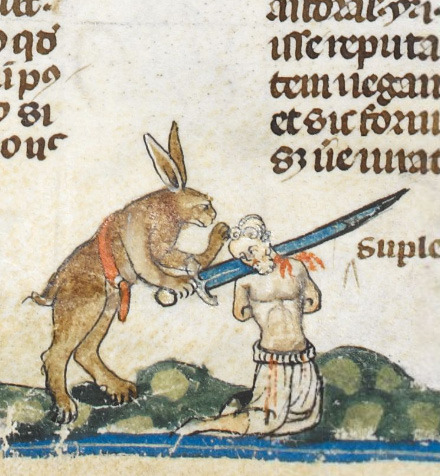
But when you dig through the copious illustrations in the Smithfield Decretals, you start finding some very weird things. Scattered throughout the pages are violent scenes of giant rabbits decapitating people, geese lynching a wolf, unicorns, and plenty like the intriguing scene pictured above, which appears to be...well, you can see for yourself.

Top image: Codex Seraphinianus, via Jamie Forrest.

[Source: Listverse. Edited. Top image added.]