Pages

Saturday, 27 September 2014

VIDEO: WATCH A MASTER PIZZA MAKER MAKE DELICIOUSLY PERFECT PIZZA


Watch a master pizza maker make deliciously perfect pizza
By Casey Chan,
Sploid, 27 September 2014.

A.W. Mangieri is the chef at famed Una Pizza Napoletana in San Francisco and he makes pizzas. Fantastic, simple and delicious 12-inch Neapolitan pizzas that look absolutely perfect. I've never had them but I can totally smell and taste them through this video. Plus, Mangieri seems a little crazy about pizza so they must be good.

Michael Evans filmed this short of Mangieri called Bake Pizza Ride Bikes, which focuses on two of Mangieri's passions which are, you totally guessed it, making pizza and riding bikes.

All I want is pizza now.


[Source: Sploid.]


9 OF THE WORLD'S MOST BIZARRE SNAKES


wpsAA90.tmp
9 Of The World's Most Bizarre Snakes
By Bryan Nelson,
Mother Nature Network, 26 September 2014.

Scaly and scary

Snakes haunt our dreams and inhabit our mythology. They appear in the Bible, in shamanic visions, in linguistic metaphors (think: "snake in the grass") and in creation myths the world over. Our fascination is no doubt fuelled by the danger snakes pose, but it may also stem from the legless reptiles' improbable form. Evolution has gifted snakes with a variety of odd but clever body designs and adaptations.


1. Langaha madagascariensis

wps48E8.tmp
Photo: Alextelford/Wikimedia Commons

This bizarre-looking snake, also known as the Malagasy leaf-nosed snake, is an arboreal species endemic to Madagascar. Their strange nasal appendage (pointy in the male, leaf-shaped in the female) may help them blend in with vines and branches or sight their prey, which they ambush. No one knows for sure. They are poisonous but not aggressive. Their bites are extremely painful but not life-threatening.


2. Flying snake

wps7C93.tmp
Photo: Gihan Jayaweera/Wikimedia Commons

It sounds like something out of a B-grade creature feature: a flying snake! But these airborne serpents are real. (Don't believe it? Check out this video.) They glide for stunning distances through the air (without actually flying) by leaping from tree branches. While airborne, they flare their ribs and suck in their abdomens to make themselves wider and more concave for better aerodynamics.


3. Desert horned viper

wps141D.tmp
Photo: reptiles4all/Shutterstock

These snakes, which hail from Northern Africa and the Middle East, could be the reason the devil is often depicted with horns. The serpents' horns, which are modified scales, are retractable, allowing the snakes to burrow easily. Scientists aren't sure of  the purpose of the horns, but they may help prevent the build-up of sand around the eyes.


4. Tentacled snake

wps187B.tmp
Photo: Ryan Soma/Wikimedia Commons

This aquatic snake, a native of Southeast Asia, is the only species in the world to possess twin "tentacles" on its snout. Scientists speculate that the snake uses the tentacles as lures to attract tiny fish, its favourite prey, but they may also function as sensory organs that help them detect movement.


5. Barbados threadsnake

wps10F4.tmp
Photo: Blair Hedges/Wikimedia Commons

Endemic to the Caribbean island of Barbados, this threadsnake is the smallest snake species in the world, only 4 inches long and about as wide as a spaghetti noodle. You'd be forgiven for mistaking it for a tiny worm or grub crawling through the grass or under a rock. The snake's diet consists of termites and ant larvae.


6. Iridescent shieldtail

wps92B5.tmp
Photo: Sandilya Theuerkauf/Wikimedia Commons

This species, found in the mountains of India, might be the world's most colourful serpent. It may also be one of the world's least known snakes, as only three specimens have been identified. Its iridescent back and belly are separated by a brilliant yellow stripe.


7. Iwasaki's snail-eater

wpsF251.tmp
Photo: Masaki Hoso/Wikimedia Commons

You can probably guess what this snake eats, but it is an even more specialized hunter than its name implies. Not only does it eat only snails, but due to its highly unusual asymmetric jaws, it is efficient only at feeding on snails with dextral (clockwise-coiled) shells. The extreme adaptation has its limits, though. Scientists believe that snails are beginning to evolve counter-clockwise-coiled shells to protect themselves.


8. Eastern hognose snake

wpsC895.tmp
Photo: Hunter Desportes/flickr

Other than its upturned snout, which is used for digging in sandy soil, this snake doesn't appear too strange - until  threatened. Then it becomes the world's biggest drama queen. Capable of flattening its neck to resemble a cobra, it will strike, but the strikes are pure bluffs; it doesn't bite, it merely "head butts." If this strategy doesn't work to fend off threats, the snake rolls on its back and plays dead, going so far as to emit a foul musk and letting its tongue hang out of its mouth.


9. Spider-tailed viper

wpsA95E.tmp
Photo: Omid Mozaffari/Wikimedia Commons

This viper has one of the most unusual tail adaptations in the snake world. The tail appendage, which at first might look like a deformity, is designed to look like a spider. Its purpose isn't to make the snake seem extra terrifying (a spider and a snake, yikes!), but rather, to act as a lure. When the viper rattles it, arachnid-eating prey are attracted and drawn into striking range.

Suggested Stories: (1) 8 superlative spiders; (2) Is that snake venomous?

Top image: Many-horned adder (Bitis cornuta), via Outdoor Photo.

[Source: Mother Nature Network. Edited. Top image added.]

NATIONAL GEOGRAPHIC'S BEST SPACE PICTURES THIS WEEK XXVII


wps6BDF.tmp
Week's Best Space Pictures: The Sun Stretches, Dust Swallows Africa, and the Milky Way Arcs
By Linda Qiu,
National Geographic News, 26 September 2014.

The sun sends out magnetic material, dust blows across the Atlantic, and the Milky Way arcs over the Himalaya in this week's best space pictures.

1. An Elusive Green Light

wpsB239.tmp
Photograph by Yuichi Takasaka, TWAN

The famed northern lights shine across the shores of Pontoon Lake in Canada's Northwest Territories in an image released September 23.

Green is the most common colour of this natural phenomenon that has dazzled sky-watchers for millennia. (See more aurora pictures.)

2. Calving Chunks

wpsF84.tmp

Ice chunks crack off a central ice sheet in Greenland in an image released September 23. Jakobshavn Glacier, seen at the bottom, and others drain some 39 billion tons (35 billion tonnes) of ice annually. (See "Greenland Glacier Races to Ocean at Record Speed.")

3. Arcing Over India

wps8934.tmp
Photograph by Ajay Talwar, TWAN

Stars in the Milky Way galaxy arc over the Himalayan night sky in a panorama. The bright light at the bottom of the image isn't a meteorite or a fallen satellite, but the light from a tent perched on Hatu Peak, India.

4. A Saturnian Family Portrait

wps3C0.tmp

Three of Saturn's 53 moons appear together in a rare family photo captured by the Cassini spacecraft. Tethys (centre) is the largest of the three, with a jumbled terrain telling of a violent past.

Prometheus (lower left) is the smallest of the three and spends its time carving tracks into Saturn's F-ring. Hyperion (to the left of Tethys) is the "wild one," tumbling around Saturn in a chaotic spin. (See "Pictures: Huge 'Snowballs' Seen Piercing Saturn's Outer Ring.")

5. Blowing in the Wind

wps646C.tmp

Dust from the Sahara swallows Africa in an image released September 21. Astronauts on the International Space Station took the picture as the station passed over Libya.

Saharan dust reaches all corners of the world, fertilizing Amazonian soils, settling on Atlantic coral reefs, and, perhaps, increasing snowpack in California's Sierra Nevada mountain range. (See "How Dust Might Make Drought Worse (or a Bit Better) in California.")

6. Quite a Stretch

wpsCA28.tmp

Magnetic plasma arcs away from the sun and out of sight in an extreme ultraviolet image captured by NASA's Solar Dynamics Observatory. The superheated material is likely reaching from one magnetically active region to another.

7. Ripple Effect

wpsD62B.tmp

Crests known as transverse aeolian ridges (TARs) ripple across Mars's surface. Up to 19.7 feet (six meters) tall and tens of feet apart, the ridges are shaped by the wind in a mysterious process that continues to baffle scientists. TARs are commonly found in the channels and craters that riddle the red planet's surface.

8. Training for Space

wpsD7DE.tmp

Dawn breaks over a launchpad in Kazakhstan as workers ready the area for a Soyuz TMA-14M in an image captured September 23. The Soyuz capsule is scheduled to carry Expedition 41 crewmembers to the International Space Station (ISS) on September 25.

Two Russian cosmonauts and a NASA astronaut will spend five and a half months orbiting Earth aboard the ISS. Now in its fourth generation of spacecraft, the Soyuz series first launched in the 1960s. (Watch "Live From Space: Soyuz Launch.")

Photo Gallery by Nicole Werbeck.

[Source: National Geographic News. Edited. Some links added.]


Friday, 26 September 2014

5 SMART DEVICES TO HELP MANAGE YOUR GARDEN


wps6060.tmp
5 Smart Devices To Help Manage Your Garden
By Dave LeClair,
Make Use Of, 25 September 2014.

The smart, connected home is a rapidly growing market, with home owners seeking ways to make the devices within their house communicate with their smartphones, PCs, and tablet. But what about around your home? Sure, having a connected doorbell is cool, but how about a connected garden? Turns out, a smart garden is completely possible, thanks to the devices we are going to take a look at today.

1. Greenbox

wpsFA11.tmp

Price: US$249

Availability: Currently taking reservations with an estimated ship date of early 2015.

What it is: Greenbox is a really neat device designed to work with homes that already have a sprinkler system installed. It replaces the system’s controller with one that is far smarter. It allows you to take control of your watering schedule from a smartphone or computer, and by connecting to the Internet to track the weather, it knows exactly when it should and shouldn’t activate the sprinkler system. It’s looking quite promising, and it’s definitely a smart garden tool to keep your eye on if you already have sprinklers installed.

2. Edyn


Price: US$99.99 for garden sensor and US$59.99 for water valve.

Availability: Taking pre-orders with a Spring 2015 estimated ship date.

What it is: Edyn is a device built around providing you with information. You shove it into the ground, and it connects with your smartphones and tablets to give you all kinds of information about the soil. The device takes it a step further, recommending plants to grow based on the conditions. This takes much of guess work out of gardening, which is just fantastic. With the optional water valve, it will automatically control your sprinklers based on the the information it detects from your garden bed.

3. RainMachine

wps9131.tmp

Price: US$249

Availability: Available for sale right now.

What it is: This device serves a similar purpose to the Greenbox, using weather data from the Internet to adjust an existing sprinkler system. It accesses its data from NOAA, which is quite accurate, and if for some reason it cannot connect to the Internet, it will use historical data to make watering decisions. It has been quite well-received by Amazon shoppers, so it looks like a great device to consider if you want to use the Internet to manage your watering schedule. [RainMachine at Amazon]

4. Koubachi Plant Sensor 2

wps73A3.tmp

Price: US$129 for outdoor, US$99 for indoor model.

Availability: Available now.

What it is: The Koubachi Plant Sensor 2 does a little bit of everything. It senses conditions from the soil and offers advice for managing your plants. It also integrates weather predictions to help you make the best decisions for your garden. Everything from soil conditions to sunlight data is available, and we all know that knowledge is power. Of course, it also connects with your smartphones and tablets, so you can keep track of your garden whether on the home or on the go. Additionally, the outdoor model is resistant to bad weather, which means you can leave it out there safely. If you don’t need that then get the indoor model, so you can keep track of how your plants in the house are doing. [Koubachi Plant Sensor 2 at Amazon]

5. Parrot Flower Power


Price: US$59.99

Availability: Shipping right now.

What it is: Parrot Flower Power is the most affordable of the plant sensor devices, but it’s still quite heavy on features. It has Bluetooth and WiFi connectivity for real-time monitoring of data; whether right where your plants are, or across the country. It detects moisture level, heat, sunlight, and more, so you’ll definitely be able to make an informed decision with the Parrot. It will even alert you if something needs to be adjusted right away (too much water, or if the soil is bone dry), which could actually save your plants, thus saving you money. Some users are complaining about the Parrot’s interface, so you might find that one of the other sensors on this list is a better option. [Parrot Flower Power at Amazon]

Now Get Planting!

Who says growing awesome plants in a garden can’t benefit from the conveniences offered by today’s technology. These slick products, some of which are available right now, will change the way you grow plants, manage your lawn, and more! If you want to have a completely smart home, you can’t neglect the outside, and these cool devices have you covered!

[Source: Make Use Of. Edited. Some links added.]


TOP 10 DINING TABOOS


wps35C7.tmp
Top 10 Dining Taboos
By Mike Brown,
Toptenz, 26 September 2014.

“Keep your elbows off the table.” “Don’t talk with your mouth full.” These are popular reprimands we’ve all heard while sitting around the dinner table. If you’re planning on traveling abroad, minding your manners may be a bit harder than you thought. Check out this list of quirky dining taboos in other countries.

10. Asian Noodles Taboo

wps24DC.tmp

In Asian countries, it is known that rice and noodles are the staple of their diets. Eating a bowl of pasta seems pretty cut and dry. Pick it up and put it in your mouth. But if you’re in China, chopping your noodles in half will definitely draw a few dirty looks your way. To the Chinese, long noodles represent longevity. It is customary for people to slurp up a heaping bowl of lengthy noodles on their birthday. Your mom would have a fit if she saw you with noodles wagging from your lips. Tell her not to blame you, it’s Chinese tradition. In addition to watching your noodles, you better be careful of where you point your chopsticks. It’s rude to aim them at another person. That we can understand, but the “don’t flip your fish on your plate” is a little unusual. But who are we to argue with tradition? This one is mainly practiced in areas that rely on fishing. Apparently, flipping your fish over is symbolic of capsizing the boat.

Neighbouring Japan also has its fair share of intriguing dinner table taboos. They too are particular about their chopstick placement. In both countries, it’s frowned upon when you poke your sticks straight up in a bowl of rice. It’s a practice that is reserved for funeral services and a sign of disrespect for the dead when done any other time. If you’re out in a restaurant, the owner will take offense. This is a sign of you cursing his business. Better watch out for the steaming hibachi.

9. New Guinea Menstrual

wpsB254.tmp

As if “that time of the month” isn’t already filled with an overflow of emotions, women in New Guinea must take care not to violate traditional taboo. According to their customs, women on their cycle are viewed as being ill. To heal themselves, they aren’t allowed to eat fresh meat, red fruit, or juicy bananas. On top of everything else, they have to watch their step as well. Anyone who eats food prepared by a menstruating women, or a meal she’s stepped over is believed to be destined for a horrible cough. The usual victim is the woman’s husband, some even believe this illness could lead to his death. In Papua, New Guinea, the Wogeo only believe blood is dirty when it comes from a woman’s menstrual cycle. In fact, they even say that those who come in contact with this blood are likely to die. As with the majority of ancient customs and taboos, no one really knows when or why they started. They’ve been taught what they’ve been taught and dare not question tradition.

8. Don’t Go Dutch

wps1CAE.tmp

In America, some men would jump for joy if a woman offered to pay for her half of the date. Well in France and Russia, the “independent woman” mentality is not welcome. When picking up the tab, it’s all or nothing over there. Only an uncivilized person would only pay for half the bill. In fact, most women won’t even bring their wallets on a date. Just a not-so-subtle reminder that she’s not paying for a thing.

Since we’re on the topic, it’s also expected to dress for the occasion. Jeans and a tee are never ok. In Russia, it’s viewed as an honour to get acquainted with someone new. When getting ready for your date, it’s preferred to dress formal.

Say you were invited to eat at someone’s home, it’s extremely rude to show up empty-handed. When you’re first greeted, it’s also taboo to shake hands through a doorway. Also, don’t ask for a to-go box or doggy bag. In America, we see it as a sign that we loved our meal and want to take it home. In France, it’s the exact opposite. There is a bunch of differences we accept over here but people across the water may not share our sentiments. Something as simple as using the wrong hand gesture is social suicide. Your trip will be much more pleasant if you study the taboos before you travel.

7. Italians Are Sensitive About Their Cheese

wps1345.tmp

Our Italian dining experience is normally tailored around ordering lasagna from Olive Garden. On the contrary, an authentic experience in Italy will vary quite a bit. First thing to remember, don’t insult the chef by asking for more cheese. Instead, you might get a swift whopping by an old loaf of garlic bread. Seafood in Italy isn’t meant to have cheese on it. If you ask nicely, the chef might oblige but most of the time, you’ll just get a dirty look.

Also, Italians take their meal definitions seriously. Breakfast food is for breakfast. Lunch is for lunch, and so on. Ordering a cappuccino after breakfast is not cool. More milk than what’s in a macchiato’s after mid day will give the locals permission to tell you about yourself. You don’t need to speak Italian. They’ll make it perfectly clear that you’ve crossed the line. When you’re offered food, proper etiquette says you should always decline the first time. After they insist again, you humbly accept and merrily enjoy the cuisine.

6. Tardy Tanzania

wpsE31B.tmp

This dining taboo is one we can get used to. Americans pride themselves on arriving promptly on time (well, most of them), but in Tanzania it is considered rude to show up to an invitation early. Out of respect, invited guest should always wait 15-20 minutes after the affair’s commencement to make an appearance. If you’re looking for something to wear, loose-fitting clothing is always appropriate. Most meals are enjoyed while sitting on the floor.

Also, Tanzanian men and women don’t eat together. In fact, taboo prevents men from entering the kitchen at all. That’s a card we know a bunch of American men wish they could pull. “Honey, I would help with the dishes but I’m forbidden from coming in the kitchen.” A bowl of water and towel will be passed around for you to clean your hands. This as well as the ugali, or communal bowl for the meal, must all be passed only with the right.

5. You Can’t Eat Melons in the US

wpsD5CA.tmp

Our global dining taboo list has found its way back to the Americas. You’re probably thinking, I have American etiquette down packed, what else can you teach me? We bet you didn’t know that you could be arrested for eating a watermelon in Beech Grove, Indiana. The wacky law applies to Beech Grove’s parks. It was established after a bunch of watermelon pierced park trash bags, making a terrible mess. So when you’re in Indiana, you best be sure to mind your melons.

We’re not finished with the U.S. of A. just yet. If you thought park-eating watermelon offenses were crazy, then don’t ever visit Gainesville, Georgia. To this day, it is illegal to eat fried chicken with anything but your hands. Passed in 1961, these crazy out-dated taboos normally go overlooked. One lucky 91-year old’s friends thought it would be funny to have her arrested for eating her birthday meal with utensils. (Oh look, a heart attack - just what I always wanted!) Everyone had a good laugh and the charges were dropped.

4. Be Careful What The Baby Eats

wps62C9.tmp

Jamaicans believe children should not be given chicken before they can talk or else the baby will never speak. They even believe that infants who drink milk from the bottle will grow up to be drunks. Intriguing superstitions can be found all across the Pacific. In Nigeria, children are not allowed to eat eggs out of fear that it will cause them to steal when they get older. Silly as it may sound to us, if this is what has been passed down from generation to generation, would you rather go with the flow or risk raising a sticky-fingered mute? Some even say that pregnant women should stay away from eggs for the same reason. Sweet food, snails, puffer meat, and kola-nuts are also added to an expectant Nigerian’s list of foods to avoid. The reasons behind this taboo vary from causing the baby to drool all over itself to having scaly skin.

3. Eat With the Right, Wipe with the Left

wpsAD8B.tmp

This taboo is respected in many different nations. African, Caribbean, and even Muslim countries all believe that only the right hand should be used for eating. For certain hygienic reasons, these customs teach that each of our hands serves its own purpose. The left is solely for wiping. We touched on it earlier but the eat with the right, wipe with the left taboo deserves further explanation. If overlooked, you pose great risk of offending others. Not only should you dine with your right hand, it is the only one to be used in greetings. When arriving for a meal, never offer the left for a shake. If you catch the right one on the wrong day, you might fall victim to a swift right hook.

Some will give you a pass on holding a cup with your left hand, but never ever wipe your mouth with it. To be on the safe side, keep it under the table. Put it between your legs or even sit on it. Do whatever you need to do to keep from being offensive.

2. A Polite Goodbye

wpsCE5F.tmp

Hopefully you never get too thirsty in Kazakhstan. If you happen to order a cup of tea, don’t look as it as half empty. See the miniature portion of your steaming drink as a nice, warm, half-full hug. Never ask the server to pour you some more. In Kazakhstan, a full cup of tea is the most polite way we’ve ever heard of telling someone they’ve overstayed their welcome. The people of Kazakhstan drink tea about 6 times per day. Now we can understand why they use it as a form of communication. (And why they only give you half a cup!) Formally a nomadic society, the people of the Republic still carry deep superstitious beliefs. Tea is only consumed warm, they believe cold drinks will make you sick. Aside from telling you to get out, the half full cups of tea also show how much the guests wants to be able to serve you during your visit. The passing of an empty cup for a refill is a courteous act hosts love to participate in. Other taboos are a lot more common. Things like picking your nose…just don’t do it. Anywhere.

1. Don’t Eat With Your Hands

wpsE128.tmp

Some customs tell you which hands to use but if you’re traveling to Chile you better grab your utensils. Chileans never eat anything by hand. Even the smallest French fry must be stabbed with a fork. Pizza, chicken nuggets, and whatever else you can think of, the people of Chile don’t believe in finger food at all. Usually, dinner is not served until 8pm or later. Even if you’re ravished with hunger, keep those hands out of your mouth. Licking your fingers or utensils is considered vulgar. Avoiding the temptation is obviously why they eat everything with utensils. Standard European manners are taken to the max to avoid being disrespectful. In Chile, you need to know which utensils are the correct ones to use for your meal. If we ever visit, we’ll need to write a few notes on the palm of our hands. To us, salad fork or dinner fork…they all work the same.

Top image by Sidra Morris via Examiner.

[Source: Toptenz. Edited. Top image added.]


10 CREEPY URBAN LEGENDS SPREAD BY THE INTERNET


wps3BD8.tmp
Viral Fear: 10 Creepy Urban Legends Spread by the Internet
By
Urban Ghosts Media, 25 September 2014.

Urban legends have been around as long as mankind has been able to communicate to each other that they’re afraid of the dark. Those fears haven’t gone away, and, if anything, we’ve found new things to be afraid of in our modern era. We’re afraid of the intelligence of our technology, that one day, it might not need us. We’re afraid of what lurks in the deep, we’re afraid of what waits in the darkness, and now, we’re afraid we might know too much. Thanks to the internet, urban legends aren’t just for telling around the campfire any more, and they’re still downright disturbing.

10. The Rake

wps4B94.tmp

The Rake is said to be a mysterious, monstrous creature that eventually kills the victims that it stalks, first appearing in 2003 and reportedly hunting the residents of rural New York. Originally, there were videos of the supposed creature posted online, but all the videos soon disappeared - conveniently, perhaps. In 2006, documents were collected that told the story of the Rake, and attempted to paint a historical record of its horrible deeds.

Supposedly, the creature first appeared in the 12th century, although no records are said to survive. There is a mention of it in a reputed 17th century ship’s log, where it’s the last entry ever made. And there’s supposed suicide notes that bid the world farewell, insisting death is a better fate than one that involves the Rake, and there’s journal entries that are said to end with a sighting of the Rake.

The Rake is named for its long, clawed hands, and what it does to its victims. It’s described as a hairless, deformed man of some sort, that looks twisted and broken. Its eyes glow, and it moves with a horrible silence. That silence is one of its favoured weapons, sneaking into bedrooms while its victim is asleep.

One of the main stories about the Rake is told by a woman who has the thing appear at the foot of her bed. It savages her daughter, and while her husband is driving the little girl to the hospital, he drives his car into a lake and kills them both. The mother, distraught, is left questioning.

She begins to look for others that have seen it, and finds that she’s not the only one that’s been stalked by the creature and left tormented but alive.

For now.

9. Nostradamus’s 9/11 Predictions

wps8501.tmp
Image: Zereshk, public domain

Close on the heels of the September 11 tragedy in New York City came people eager to point out that someone, somewhere, knew it was going to happen. In the case of an email forward gone viral, it was said that Nostradamus had predicted the 9/11 attacks centuries before, in a few unsettling verses that seem to point directly at the attacks.

While the verse had been - at least mostly - written before the attacks, it hadn’t been written by Nostradamus at all, and it certainly hadn’t been written in the 16th century. The core of the verses were written in 1997, by a student at Brock University in Canada. The student, Neil Marshall, had written the verse to mimic Nostradamus’s style and, in the ultimate irony, illustrate just how easily a verse could be interpreted to mean whatever the reader wanted it to mean.

Eventually, other lines got added in and swapped out, several of which actually had been written by Nostradamus and were pulled from other prophecies. A couple of different versions were making the rounds, along with other Nostradamus urban legends like the one when his body was exhumed, he was found holding something inscribed with that day’s exact date.

A great story, but absolutely not true.

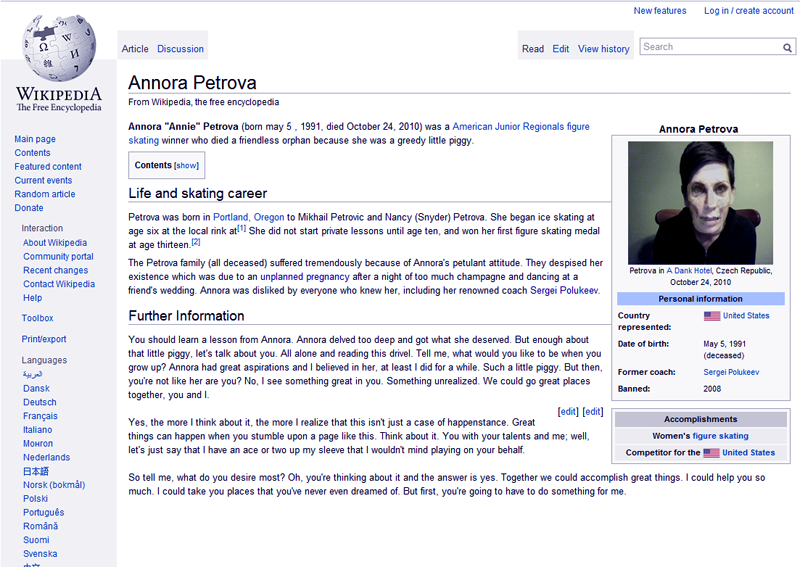
8. Annora Petrova

wpsD12A.tmp
Image: via onepagewonder.com

According to the email supposedly sent from one friend to another, Annora Petrova was an ordinary young girl with hopes of becoming a champion figure skater. One night while she was bored, she Googled her name and found a basic Wikipedia page for herself. She kept checking the page, and soon realized that it was just a little bit ahead of her real life, giving her a glimpse into competition wins - and losses.

When she tries to change the page herself to say that she’s won a competition, it turns on her.

The page updates itself, spewing tear-inducing hate at her. Finally, it tells her that she becomes “a pathetic little orphan.” Calls to her parents are answered by laughter, and they’re both killed in an accident.

Annora heads to Switzerland to try to restart her career, and while everything seems to have sorted itself out, she looks at her Wikipedia page again. This time, it tells her that she dies on the following day, “friendless and alone.”

The email ends with a screen-shot of the wiki…and make sure you take a look at the picture before - and after - you click on it.

7. The Webkinz Killer

wpsE423.tmp
Image: screenshot via YouTube

In the middle of all the blood and gore and other questionable content, there occasionally comes a few truly kid-friendly sites. Webkinz is one such site. Kids buy adorable stuffed animals, and with those animals comes a code to unlock all kinds of learning games and fun, interactive content on the site. Everything’s fuzzy and adorable, so of course, it’s a target for urban legends.

According to the story, unsuspecting kids will be playing their favourite game, feeding their little pet or decorating their house when something in the game will turn and murder that cute little virtual pet right on the screen.

Legends vary. Some say they’ve gone to the doctor (veterinarian?) and their pet dies after taking their medicine. Visit the clinic at midnight, and he’ll just chop your head off. Another character is said to have a shotgun stashed under her desk, and another has a knife. Sometimes, they attack without warning, and other times, you need to click on something in particular. Usually it’s a random black box that pops up on the screen, and other times, it’s opening packages that either cripple your pet or just make the screen go black…to the sound of chainsaws.

Webkinz itself has issued a statement saying that it’s absolutely not true, and they would never, ever, ever let anything happen to a child’s beloved virtual pet.

6. Legend of Zelda: Majora’s Mask

wpsB0DB.tmp

Here’s one for the gamers.

In 2010, a forum user named Jadusable posted a series of bizarre videos and posts about a copy of Legend of Zelda: Majora’s Mask that he had picked up at a garage sale. A college student strapped for cash, he was strangely unsettled by the blank cartridge the old man - who he would never be able to find again - handed him. He played the game anyway, and he found a strange save file called “Ben.”

Everything was normal at first, but soon, things started happening. There were strange game glitches, there were horrible, in-game deaths that shouldn’t have happened, and there was a statue that followed him everywhere. He didn’t mean to, but he deleted the game…and it started calling him Ben. Soon, he started seeing the statue outside of the game, in his dreams, out of the corner of his eye.

Friends and roommates notice his bizarre behaviour, but he doesn’t explain it. Not entirely, and not until the end - until his last communication, when he explains what’s been going on - and pleads with his readers not to download anything he’s posted about the game.

He doesn’t want Ben to spread.

Ben was the spirit of a neighbourhood boy, trapped in the game that he had been given. Ben began to spread, infecting his computer, speaking to him through it, changing his posts and doctoring his videos. Ben started appearing in his dreams, haunting him or, as Ben said, having fun with him.

Ben was bored, and Ben needed someone to play with.

His last supposed communication details his conversations with Ben, and the truth about what was going on. It’s the truth that Ben wouldn’t let out before, and he’s hoping that with this warning, he’ll be able to stop Ben from spreading to those who had been following him on YouTube. Sure that Ben was going to grow tired of playing with him, Jadusable signed off with the promise that he was going to destroy the game, and - hopefully - stop the spread of Ben.

5. The Megalodon Shark Lives

wpsDBFF.tmp
Image: Karen Carr, cc-3.0

So you’ve just gotten over your fear of Jaws, and you’re finally back swimming in the ocean again. You’re an adult, after all, and giant sharks don’t…

Hold on.

According to the Discovery Channel and loads and loads of videos posted on the internet, giant sharks do exist, and they’ve been savaging people off the coast of South Africa. Shark Week, still immensely popular with Discovery Channel viewers in spite of the idea that much of what the broadcast is either re-hashed, crap, or both, ran a pseudo-documentary in 2013 about the discovery of live, prehistoric, megalodon sharks. In 2014, they followed it up with “The New Evidence,” trying to further establish that the megalodon shark really, really was real. Promise.

They said that fishing vessels in South Africa had been attacked, killing everyone. The documentary was supposedly about a marine biologist on the trail of the truth, but it could more accurately be described as an actor reading a script. Nonetheless, the megalodon special brought in record viewers, and Twitter blew up about the Shark Week revelation, and the story took to the internet and got bigger and bigger.

Real shark experts are still trying to establish the truth behind this new urban legend. The stigma attached to sharks is real enough already, and they’re one of the most misunderstood animals in the world. The tragedy behind this urban legend is that it’s not helping the case of one of the most majestic ocean-dwellers in the world.

But you still might want to stay out of the water. Have you seen the teeth?

4. Poisonous Spiders Are Breeding in North America

wpsF03.tmp
Image: Rijuche89, cc-3.0

Part of the success of urban legends is that they prey on some of our innate fears. Like spiders. Even the harmless ones are creepy and nasty and…well, just look at it.

That’s the Two-Striped Telamonia, and it’s not really a dangerous spider. It’s found in the jungles of southern Asia, and no one’s even been killed by it - mostly because it’s not poisonous. But it did end up being the poster child for an urban legend that surfaced first in 1999.

The emails, variously cited as being from the University of Florida and the Journal of the United Medical Association, warned that this vicious spider had hitched a ride on a plane and made it to North America, where it was breeding indiscriminately. Said to be highly poisonous, it was reported first that 3 Chicago women were stricken by vomiting, chills, fevers, and paralysis, with no discernible reason. They all died, and it was determined that the cause was from a spider bite.

And because the story wouldn’t be complete without a way for any one of us to be bitten, it was also said that the spiders gravitated toward dark, cool, damp places…like under your toilet seat. Where they would wait, lurking in the darkness, waiting for someone to sit down, for the next victim to bite, leaving puncture wounds in a place that no one would look…

Of course, it’s not true. But the legend still makes its rounds, usually with pictures of the same harmless spider. Early versions name places that don’t even exist, while later versions point the finger at restaurants like Olive Garden as being home to the spider. While there certainly are spiders out there that can do some serious damage, they’re probably not living under your toilet seat and they’re definitely not that one.

But still…look before you sit down.

3. The Russian Sleep Experiment

wpsBC4.tmp
Image: Skeptoid.com

This is one of those urban legends that we find ourselves really, really hoping that it’s not true but, as we’re reading it, we have a sneaking suspicion that there might be something to it. Stranger things have happened, of course, and it’s all based in something we’ve all felt at one point or another - like we would never sleep again.

The story details an experiment done by Russian scientists in the 1940s. It was supposedly done on political prisoners who were subjected to a toxic gas, keeping them awake for a target 30 days. Needless to say, they didn’t make it. Complaints turned into paranoia, which turned into screaming. By the time the experiment was 14 days in, they no longer wanted their freedom. On day 15, scientists discover that the test subjects were eating each other - and themselves. Still, they retained superhuman strength, fuelled by rage. Researchers who tried to save dying subjects reported they refused anaesthetic…and smiled as they were being operated on.

Brain waves flat lined, even though they were still, technically alive. Removal of the gas that was keeping them awake left them in a state of violent panic and finally, one was restrained enough that the researchers could force him to talk, and to tell them what he was.

Madness.

It’s not clear whether it’s the sleep deprivation that causes their madness, or if it’s their sleeplessness, if they’ve allowed something inside their heads. But we’ve all been there, laying awake at night, unable to get comfortable, unable to sleep, knowing that we’ll need to get up in the morning and face the day with gritty eyes and aching muscles.

Imagine that for night after night.

2. The Victim of the Beast

wpsF386.tmp
Image: Noel Fields, cc-nc-4.0

Sometimes, there’s a weird relationship between truth and the urban legend.

In the Salt Lake Cemetery, there’s a small, flat gravestone to Lilly E. Gray. Beneath her birth and death dates, there’s a simple inscription that no one’s been able to explain. It simply says, “Victim of the Beast 666.”

The connotations are…kind of clear. There’s some sort of connection to satanic rituals or devil worship, or someone believed she was a target. Right?

The gravestone says that Gray was buried in 1958, although the records even on that are up for dispute. There seems to be a bit of confusion on just who, exactly, she is, with records on even her basic information not quite matching. And no one seems to remember her, or know why the strange inscription is on her gravestone. Or why, for that matter, her husband is buried on the other side of the cemetery.

There have been a number of wild speculations, but it’s one of those cases that with more information, things just grow that much more weird. In 2009, a paranormal researcher uncovered a document from her husband to the Utah State Board of Pardons that…well, it’s weird. He demands an end to the “farce,” telling the board that he had never gone to court and that his “kidnapers” had been holding him in prison. His parents, the document states, “died of grief when kidnapers murdered my wife.”

Some people who have visited the grave say that they’ve encountered weird chills and bizarre incidents - like a car door suddenly slamming shut on a hand - while there. So was Lilly a victim of “that” beast…or of her husband, perhaps? Knowing participant or unwilling target?

We don’t know, but don’t step on her gravestone. That’s when things happen.

1. Snuff Film Evolution

wps9D2C.tmp
Image: via Wikipedia

Sometimes, the legend comes first and it’s only made truth by what comes after.

There’s a couple things that make an official snuff film. In addition to it being the filming and broadcasting of an actual murder, it’s generally a murder that has to be thoroughly pre-planned and it’s a film that’s commercially available and produced for entertainment value. While there’s certainly YouTube videos out there that show deaths on camera, they’re not considered snuff films as they’re not marketed as anything but documentary or news.

For a long time, snuff films were the thing of urban legends. In the infancy of the internet, movies were made and videos were uploaded claiming to be real snuff films, but were ultimately disproven. One of the most commonly referenced was Snuff; the film was in pretty wide circulation in the 1970s, but it was ultimately proven - amid quite an uproar - that it was fake.

Truth can come from urban legends, though, and that finally happened with 2009’s 3 Guys 1 Hammer, which showed pretty graphic footage of two Russian teens going on a 21-person murder spree over 2 months.

Then, there came 2012’s 1 Lunatic 1 Ice Pick. The video, uploaded to a number of gore web sites, seemed to show a young man tied to a bed, stabbed with an ice pick, and then dismembered.

Some of the viewers tried reporting it to authorities, while others criticized his film-making technique and even the sound effects. When Canadian government officials received a gruesome package containing a severed hand and a severed foot belonging to the victim, they finally took it seriously.

While it’ll long be debated whether or not the 1 Lunatic of the above-mentioned video would have turned to murder if he didn’t have an audience on the internet, it’s an eerie, creepy reminder that just because something is an urban legend today, it might not be tomorrow.

Top image via The Slender Man Wiki, cc-sa-3.0.

[Source: Urban Ghosts Media. Edited.]